My personal blog as a 'grown-up' Goth and Romantic living in the Highlands of Scotland. I write about the places I go, the things I see and my thoughts on life as a Goth and the subculture, and things in the broader realm of the Gothic and darkly Romantic. Sometimes I write about music I like and sometimes I review things. This blog often includes architectural photography, graveyards and other images from the darker side of life.

Goth is not just about imitating each other, it is a creative movement and subculture that grew out of post-punk and is based on seeing beauty in the dark places of the world, the expression of that in Goth rock. It looks back to the various ways throughout history in which people have confronted and explored the macabre, the dark and the taboo, and as such I'm going to post about more than the just the standards of the subculture (Siouxsie, Sisters of Mercy, Bauhaus, et al) and look at things by people who might not consider themselves anything to do with the subculture, but have eyes for the dark places. The Gothic should not be limited by what is already within it; inspiration comes from all places, the key is to look with open eyes, listen carefully and think with an open mind..

Showing posts with label goth. Show all posts

Friday, 28 August 2020

Romantic Goth: My first love in Goth style

Aesthetically, Romantic Goth is my first and most constant love. Yes, my hair is a fantastical set of neon colours, but they owe more to the myth of mermaids drowning sailors than to the CyberGoth hybrid subculture - although I like that sort of more danceable industrial too! 

A woman with neon-green to royal blue gradient hair, neon green at the top, fading through emerald green and aqua to the deep blues of the ocean. She has pale skin, and dramatic make-up. She is wearing eyeshadow in neon green, emerald green and bright blue, with metalic violet and black eyeliner in a 'winged' style, and black mascara. She has vines in a swirling design drawn on the right side of her face. She is wearing green metallic lipstick outlined in metallic violet. She is wearing a high-necked velvet top with a v-neck style mesh insert, and with one arm across her body she is showing that the sleeves of the top are mesh, terminating in a point at her hand. She is wearing a pewter pendant of a winged Grim Reaper from Alchemy Gothic. Her hair is long, with a fringe and a thin braid either side of her face. She is in a room with dark purple walls.
This top from :Punk Rave: has inner mesh sleeves.
The outer sleeves are velvet and split all the way to the elbow


The first time I saw a Goth was probably 1993; my family had gone to Reading - a town in Berkshire - for some shopping, but this happened to coincide with the Reading Festival, one of the UK's largest rock festivals. I think The Cure were playing that year, and a lot of Goths turned up. The one I remember most clearly, was a woman in a deep red crushed velvet fantasy dress with bleached platinum hair back-combed; a more colourful variant on the usually black version of this look. I thought this was beautiful, the prettiest lady I had seen, and unfortunately, being a small child with no appreciation for - or understanding of -what was taboo in my household, I think I said something excited about this, and got sharply chastised by my mother who dragged me away and gave me a lecture on how these were bad and dangerous people I shouldn't associate with... but I think the seed was sown, and that aesthetic imprint stayed with me. 

A woman with hair that is a gradient from neon green through aqua to royal blue, wearing a velvet blouse with double sleeves, a faux-leather cincher (both black) and necklace of a winged grim reaper made from pewter stands infront of a silver and black damask pattern curtain
Me in my study: my aesthetics aren't limited to my clothes.
The velvet top I am wearing the Saphira top from :Punk Rave:

I've been a fan of the Romantic Gothic aesthetic ever since - that wonderful mix of the macabre, fantastical and historical, and this post is something of a paean to that.  

The Romantic Gothic aesthetic is certainly one that is enjoyed outside of the Goth musical subculture, and one that pre-dates it; it's that Hammer Horror, Elvira, and 'vampire' aesthetic of villains and supernatural creatures that has existed for centuries. It's not surprising that is has been adopted by fans of the Gothic in general as well as Goth, and being visually striking, it's also not surprising that a lot of people come to the aesthetic before the music (same with all Goth and Gothic styles).  I was one of those people, and although I came to the Goth subculture eventually, it was a path that went via lots of Symphonic Metal and bands like Evanesence, Nightwish, and Within Temptation where that aesthetic was prominent. There were plenty of films with gorgeous costumes, too, especially older horror films and a good few fantasy films with more 'Gothic' looking villains and villainesses. I saw all that and I wanted to look like them. It was magical, romantic, otherworldly, and while I knew it was a costume, but every now and again I would see someone, maybe online, maybe walking through the Queensgate shopping mall in Peterborough or past some Oxford colleges, or maybe in Shrinking Violets in Bristol, who dressed that way, in ordinary life, and I knew it was possible.

The first Goth shop I went into was actually a Hippie shop called Rod & Maureen's in Peterborough, that had a Gothic section in its upstairs. I was more into fantasy-inspired hippie clothes at the time, but I saw some gorgeous purple velvet dresses in there... The second was probably Mystic Rose in the Harris Arcade in Reading, where I wanted everything Raven and Alchemy Gothic made, but could barely afford a pair of earrings, then I went to the indoor market - St. Nick's - in Bristol - while I was in my Steampunk phase, and I bought my first ever made-for-Goth item, a black frock-coat, to wear with a white frilly shirt from a mainstream store, and green velvet trousers, and whatever brocade waistcoat I could find, a monocle and a cheap costume-shop 'top-hat', or with a high-necked blouse, and a floor-length purple velvet skirt from a hippie shop... I still have that coat, although I'm a now a bit too busty to fit it.

I wasn't allowed on eBay as a teen, and I didn't have PayPal, so I mostly relied on charity shops; mail-order catalogs and Goth shops were generally more than I could afford, and while my Dad didn't openly disapprove, he was hardly going to let me spend money on that sort of fashion.  I rapidly learned that I wasn't going to find exactly what I wanted in Oxfam, and that I would have to learn to modify things, and rapidly learned to apply lace and better buttons to things, and how to do other simple modifications. With a limited budget, basic sewing skills, and a general lack of time and resources, I was a long way from looking like an evil sorceress-queen or a vampire lord, or really looking like anything that was vaguely put-together, but with patience, improving my sewing skills, and finally getting access to the great secondhand resources of eBay and the like, well as becoming an adult and having a full-time job, I could finally start to build a wardrobe that I really like. 

A woman with hair that is neon green at the top, in a gradient to royal blue at the bottom. Her hair is long, down to her bust, and she has a small braid either side of her face and a fringe. She is wearing heavy dramatic makeup in colours matching her hair - neon green, emerald green and tropical blue eye-shadow with black and violet winged eyeliner, metallic green lips lined in metallic violet, and ornate swirling vines down the right side of her face. She is wearing a black velvet top with a high neckline and a mesh v-neck cut out. She is wearing a pewter Alchemy Gothic pendant of the Grim Reaper with wings
New hair-do required matching make-up

A decade and a half later and it literally is enough clothes for two wardrobes  and several boxes, because I'm something of a clothes collector now. I'm slowly scouring the internet for all the beautiful dresses I pined over as a teen but which were then far out of my price-range, and finding them secondhand on the internet for about £15 -£20, and then customising them with lace and trims. There's a meme on the internet 'be the Goth queen your 12 year old self dreamed of' and while 'queen' isn't always the aesthetic I'm going for ('prince', 'pirate', and 'terrifying bog-witch' sometimes), it's something I feel strongly about; it might have taken many years to get there, but I've actually achieved a (fairly minor) goal; I look like the kind of person my younger self admired. 

I went through a lot of style switches and hopped subcultures as a teen, but even when I was dabbling in Steampunk or a more 'Hippie' aesthetic, things with lace-up details, big bell sleeves, lots of lace, full skirts, brocade waistcoats, velvet trousers, etc. always ended up in my wardrobe. It appealed to my love of history and also to my love of fantasy - whether that was the graceful elves of Lord of the Rings or the decadent vampires of 'Interview with a Vampire' - it also always felt luxurious to be wearing this rich fabrics and fancy lace, and growing up very poor, I'd had very little luxury. At some point I would like to do an article on class dynamics and the 'fantasy aristocrat' aesthetic, but this isn't going to be it. 

I think there's an element of escapism, in that Romantic Goth clothes let you dress like something apart from the regular world, but I don't think it's necessarily a pretense; there's a little of that when it starts getting into painting yourself an undead grey/white, wearing contact lenses and fangs, latex ear prosthetics etc. deliberately looking like a fantasy creature, but that tends to be reserved for the sorts of festivals where taking on a persona is part of the fun, or for photoshoots - one step down from LARPing, but for most people involved, we don't think we're literally vampires, demons, sorceresses and fae, nor are we LARPing - what we're doing is expressing our fandom, our enjoyment of literature, film, comics and art depicting fantastical themes. I can't speak for others, but I'm not trying to take on a persona (sometimes I do as a bit of a joke, but it's several layers deep in irony and campiness), I'm expressing what I love in those things.It's not about being the villain, it's about having their  wardrobe; it's not about being someone else, it's about being enthusiastically and outrageously myself.

My decor is stereotypically Goth in black and silver

To me, Romantic Goth embracing all the decadence, drama and fanciful things that many people only allow to be expressed in the realms of fantasy; there is no reason other than social acceptability to NOT to dress like that. Building my identity positionally to 'the mainstream' is something I think is pretty pointless, and I don't dress differently as some act of defiance, but it's not like I'm oblivious to the fact I stand out, that even many other Goths dress a lot more casually than I do, especially with the popularity of the more minimalist Nu-Goth aesthetic at the moment. I turn heads, and not always in a good way; I don't like attention even if it's positive, and while I disregard the negative opinions of strangers as irrelevant, it's a lot harder (and stupider) to ignore when that escalates to outright aggression. However, as I've written about before, I will never trade expressing myself for blending in.

While a lot of Romantic Goth takes historical inspiration, primarily Medieval Europe, Baroque and Victorian, and more recently there's an increasing interest in the Norse cultures of the 8thC to 11thC, there's a wide variation from those who are interested in getting the historical attire correct for the period, with the right shoes, undergarments, and maybe some actual elements of antique dress, to those who are less interested in recreating history and more interested in being creative with the inspiration - I am certainly the latter; I love history (hence my second degree studies being in history & archaeology), and I also know how much time, effort and research it takes to do historical garb justice, and I don't have that time, sewing skill, or money to pay someone who does. I also love the creativity and aesthetics of the more fantasy orientated designs. I do like to borrow elements from historical dress, especially Edwardian and Victorian, sometimes a little 18thC stuff, but I don't want to recreate history, just use it for inspiration. 

I've noticed a slight decline in the Romantic Goth aesthetic - I think it was pretty popular in the '90s, and then with the explosion of Goth-specific manufacturers, became a lot more accessible in the '00s, but in recent years the Pastel Goth and Nu-Goth aesthetics have dominated, although the 'witchy' aesthetic that was previously characterised by white-on-black occult prints seems to be shifting to something involving more black dresses, with the same big black hats popularised by American Horror Story: Coven. There's also a lot of people into a Norse aesthetic at the moment - 'Vikings' 'Norsemen' 'Vinland Saga' and 'The Last Kingdom' probably contributing strongly to that! I think there's something perennial about Romantic Goth, and while which particular fantasy/supernatural icon or historical period dominate, it will continue. A lot of the older Romantic Goth brands seem to have dwindled, although some like Sinister and Dark*Star are still going strong, but new ones - like the sponsor of this post, ::Punk Rave:: are filling that niche. 

I accepted the ::Punk Rave:: sponsorship because I've bought quite a few clothes from them in the past, and I've always been impressed by both the attention to detail and the quality. They're at the pricier end of the scale, so I tend to buy new clothes from them once in a while, but even secondhand they are well worth checking out because the clothes are durable enough that they'll still be in good repair. These are definitely clothes worth the money. I really love their take on the Romantic Goth aesthetic, as there's a lot of influence from Gothic Lolita and Visual Kei aesthetics, which is refreshing compared the usual Western fare. Unlike many Goth brands, Punk Rave actually show their factory on their website and have their clothes made within the company rather than outsourced to a supplier; this allows for a lot more oversight in quality, and my guess is that the better fabric choices came when they opened their own factory, as their very early garments had lace that really wasn't as nice as it is now. Punk Rave's lace is often FAR nicer than I see on many other brands - no scratch raschel lace! A $50 coupon is wonderful, and I will be putting it towards ::a lovely cloak:: from them, but my opinion isn't bought - I will only ever recommend brands I genuinely trust. 

A Gothic woman standing. Behind her is a dark purple wall with a poster of the phases of the moon/moon calendar for 2020. To her left is a black wall with an assortment of ornate silver frames, and a dark-brown wooden cabinet with  glass front of several Gothic arches, on top of which is a silver and black damask table-runner and many ornate silver-coloured items. Behind her to the right is a stack of books on art, architecture and archaeology. She is wearing a close-fitting black velvet top with a v-neck mesh insert at the neck; the sleeves of the blouse have the outer velvet layer split from the wrist to the elbow so the droop down and reveal a mesh inner sleeve. She has an hourglass figure achieved with a corset. She is wearing a faux-lether waist-cincher over her clothes; it laces up at the front, but this is a false closure. She is wearing a black velvet skirt that is close fitting at the top, but flares at the bottom. It has mesh insert panels at the bottom and a 'hankerchief' hem
What is that expression I've got??

As a bonus for reading this far, have a 'blooper reel' picture of me in an awkwardly imperious pose - it's an out of context image from me trying to film a room decor tour, but at least you get to see the whole outfit with faux-leather cincher and mesh insert skirt. I will try again at filming a tour of my study decor, which is just as Romantic Goth as my clothes are - my love for the aesthetic goes far beyond just fashion. Check out my Instagram account of @domesticatedgoth for more decor pictures. I'm wearing a corset in the photo; those elasticated cinchers don't give an hourglass figure. 

Thursday, 18 January 2018

'Goth' and 'Gothic; A Disambiguation

Most of my readers probably already know the difference, but I commonly see the two words used interchangeably, so I feel like a disambiguation could be useful. I guess part of the reason is that the Goth subculture is built upon the Gothic, but Goth is a more complex layering.

The term Gothic comes from the name of the architectural style, which itself was a misnomer. The pointed-arch style which is called Gothic was named so after Neo-Classical styles became fashionable, where the pointed arch style was misattributed to the historical Germanic tribes, whereas it mostly originated in France. The application of the term to things that were a specific kind of 'spooky' came a bit later, with late Romanticism bringing about a certain sort of horror novel, where an atmospheric setting was an essential component as much as supernatural elements, and the setting was often something like an old castle or abbey or such building, and often those buildings were Gothic - because by the 18thC those buildings were already centuries old and a good few had plenty of myths and legends already attached to them. That genre of horror, at that time primarily literary, but with a few illustrations and artworks beginning to emerge, which became the 'Gothic novel'.

As time progressed, the elements of the Gothic novel - the conflict between good and evil, the idea of there being a secret or mystery to uncover, the supernatural entities such as ghosts, vampires and werewolves (or the 'explained supernatural' of the likes of the works of Ann Radcliffe), and the atmospheric setting - got applied to more works in other mediums, such as paintings, poems, plays, music and into the 20thC cinema.

It is this Gothic genre which underpins a lot of the Goth subculture - it has given us a fashion aesthetic, an attitude of dark Romanticism, and plenty of subject matter for songs - however, it has also influenced aspects of metal, and there's plenty of people who enjoy aspects of the Gothic without being members of any subculture too, they just read a lot of Gothic novels and watch vampire movies. Those elements have permeated pop-culture, as well as subcultures, and are very prevalent. Often, when something is misidentified as 'Goth', what has been identified has been an element of the Gothic.

So, what makes Goth different to the Gothic?
I would say - in general terms, with exceptions - that all Goths are Gothic, not all Gothic things (or people) are Goth. The Gothic is the fertile ground from which Goth grew, but Goth is more than just an appreciation for the Gothic, and it has a very specific manifestation.
While Goth is a manifestation of the Gothic, Goth has more elements to it than just the Gothic, and it is something more specific. Most obviously, it has the Goth genre (and it's subgenres/similar enough genres) of music; the stuff that evolved out of '80s post-punk. You can see the influences of the Gothic in the lyric content and imagery of that '80s post-punk ("Bela Lugosi's Dead, Undead..." playing vampires in Gothic horror movies), but there are other visual, philosophical, and musical influences in that genre. Goth as a subculture is an eclectic amalgam of other aspects of primarily Western culture - it's taken from fetish culture, it's got fuzzy borders with the realms of metal (Fields of the Nephilim... ), it's taken horror tropes from outside the Gothic genre of horror (a I know a lot of Goths that are interested in the murderous psychopath sort of horror stories, for example), and it balances nihilism and Romanticism. Goth came about in the '80s, so there's stuff in the Goth fashion/style that's just a darker adaptation of what was popular in the '80s, such as angular makeup and back-combed hair. Goth also grew from punk, so there's aspects of punk thinking, although somewhat less political, in Goth, too, obvious in Goth's emphasis on the resistance of individuality despite external pressures to conform.

For example, while I'm a Goth because I like Goth music, try and make it to gigs when I can, participate in the club scene (as dwindling as it is where I live), have an attitude with roots in those movements outside of the Gothic that influenced Goth, and I take aesthetic cues from Goth fashion as well as Romantic fashion, I'm fundamentally also Gothic because that is the underpinning mind set - which, in me personally manifests itself in a love for the Gothic as originated in Gothic novels; the ruined architecture, the spooky castles, the ghosts and vampires, the cemeteries, the ancient curses and that dramatic, Byronic sort of decadence... 'Gothic' is the broader umbrella under which Goth shelters. It's also probably the term which should replace 'Goth' in terms like 'Pastel-Goth' or 'Cholo-Goth' which seem to have very little to do with the Goth subculture, but do have a connection to the darker things in life and, at least with Pastel Goth, I've seen Gothic elements like vampires, ghosts, bats and zombies as motifs.

I've seen terms like 'Darksider' and 'Schwarz Szene' to describe the broader miasma of dark subcultures (I'd say 'cloud' but we're being spooky here!) including Industrial, Cyber-Goth, and some parts of Metal, and I don't think Gothic can really replace that, because certainly some of the darkness embraced  in these subcultures is from quite a different angle than that within the Gothic genre - lots of dystopian, science-fiction inspiration exists in Industrial and Cyber-Goth especially, and again, the sort of horror that explores themes of madness, psychopathy, and a generally more 'clinical' (for lack of a better word) look into why people do terrible things, rather than a philosophical or supernatural/religious angle. There are still elements of the Gothic, however - songs about demons, devils, vampires and ghosts, supernatural motifs and a sort of Gothic-meets-science-fiction reminiscent of things like the 'Doom' gaming franchise, it just seems to be less of a thematic core, and certainly less of a strong underlying principle or aesthetic.

[An aside on Pastel-Goth: I've seen the term 'Creepy-Cute' used for what is known as 'Pastel-Goth'and I know that this is probably related to the play on words  in Japanese between 'kawaii' (cute) and 'kowoi' (scary), so maybe that is a better term altogether? I also don't know what this aesthetic is called in Japan, which appears to be where it originated.]

I think the word "Gothic" as a term to describe a person whose personality includes that sort of mind-set, those interests, that sort of aesthetic, is under-utilised, and is the answer for a lot of people who aren't Goth specifically, but want an umbrella to identify with - 'Gothic' is probably the better term. Certainly, it's an adjective rather than a noun, and lot of us are used to rolling our eyes (perhaps discreetly) when asked "so, are you a 'goffik'?" but I think it's the perfect term for people who love spooky things, but aren't so keen on the sound of the genres considered 'Goth' and would rather listen to say, metal or darker classical works, or maybe darker folk or similar, and just can't get into fishnet and backcombed hair, and hate clubbing, and as all Goths are inherently a bit Gothic anyway, we're all under the same spooky umbrella, so it's not excluding anyone by saying they're not a Goth, rather including a wider range of people by saying 'we're all Gothic', and most of the arguments over the term Goth don't really stem form what Goth is or isn't, but whether someone is included or excluded from the category. 

Friday, 2 June 2017

Subcategories - A Discussion


This is a response to my ::previous article:: being discussed in part on the Cemetery Confessions internet radio/podcast, in the most recent episode, ::here::. I suggest you listen to it - both because Cemetery Confessions is an excellent pod-cast, and because otherwise this post won't really make much sense. 

I don't intend this as an argument in any personal term, this is just my riposte in the debate, and I don't want anyone to misconstrue this as an attempt on my part to start any drama - I see this as a debate, where I've raised points, the Count and those on the show have given disagreements, and I give counter-arguments in the debating sense of the word - and I hope this conversation keeps going! 

The first disagreement discussed is in relation to Romantic Goths.  To them, Romanticism is only an underlying tenet of Goth, rather than something that can be considered a separate aspect of it - I agree that Romanticism is indeed a major contributing factor to the Gothic mindset and the Gothic Subculture in general, and it is an underlying tenet indeed  - the distinction I was making is that there are some people who gravitate more to that specific aspect of the subculture. All of the things I mention as being apart of a subcategory are not exclusive to the subcategories- and they shouldn't be - and the way I see a subcategory, it is more about from which perspective you approach the subculture, rather than an separate group within Goth that is a bubble divided from the other parts. Everything that I see as a subcategory has to be within Goth already. 

The second is that I think my take on the Megan Balanck stereotypes has been misconstrued - I don't actually agree with the way Goth is broken into subcategories by Megan Balanck, and I don't think I am all those labels that I fit according to her list - as my original article explained. I know they had to cut down from my original article because I do write a LOT, but I feel like at this point is was cut down in a way that lost my original point - listing all the subcategories I would fit under according to her was meant to be an example of how I find her framework overly labels things. I think labels are something that, like many things, are good in moderation. I don't think her 'Goth Stereotypes' accurately describe how Goth works (and I don't really think it was intended to), so I tried to give my own take on how things do work - and how many of things that Ms Balanck gave are making subcategories out of things I wouldn't consider to be subcategories as how I would define that - things that are hybrids with other subcultures, that are just an aesthetic, etc. I didn't really want to write an extended critique of the 'Goth Stereotypes' in my original article, but there are quite a few things I disagree with her on, especially her treating hybrids and other subcultures as part of Goth - 'Rivethead'/Industrial and Steampunk may have ties to Goth, but they are their own subcultures!

[Tangent: One particular thing I didn't like in her 'Goth Stereotypes' was her including 'mopey' and 'perky' Goth, because I think that someone's personality, or mood, aren't really subcategory at all, especially when these things are often subject to fluctuations, and especially when the idea of us being 'mopey' or depressed is an externally imposed derogatory stereotype, and I have never seen it reflected from within Goth, and feel like that unlike the others, which even if they aren't necessarily about Goths (Lolitas, Rivetheads and Steampunks aren't Goth!) do at least have a grain of truth, and some level of "it's funny because it's true" - they do at least reflect the world a little, and people can see themselves or people they know in them. The idea of 'mopey' Goths, or 'perky Goths' (usually with the latter as a deliberate contrast to the expected former stereotype) just doesn't seem true to human nature, let alone Goths.]

I think that labels can definitely be too "sticky" as The Count said, and that they shouldn't be used to box people in, or compel people to box themselves in. I've been a Romantic Goth for nearly as long as I've been Goth, and I've been Romantic for a lot longer - and I have never personally found it limiting or something which has become stale for me. The label shouldn't be something you act to fill - it should just be a description for how you already are - one thing I will always maintain about life is that it is more important to be yourself than to live up to the expectations of a label. 

I actually prefer the term "Classic Goth" that was proffered in the podcast to the term "Trad Goth". I didn't coin the term "Trad Goth", and I too am no fan of 'traditional' being contracted to 'Trad', but I just presumed it was an Americanism in this instance. I was using the term as it is the one I see most frequently used to describe people who are more interested in Goth from a perspective that is closer to its origins in music, club-culture and '80s creativity, rather than from a Romantic perspective, or from a perspective that is more ingrained with a different culture. I also think it is very important that all Goths understand their history, and the roots of the subculture - I just think that for some, both people who were there the first time around, and people who are Post-Punk revivalists of a sort, they find themselves drawn more to those aspects of Goth, and to looking at it from that perspective. I know that Goth had an ideological shift from its punk roots, and I would agree that perhaps my notion that "Classic" or "Trad" Goths are more into being deliberately subversive is more a reflection of the ones I know personally than of people who are interested in that era of Goth and that perspective on Goth in general. 

One criticism I would give of myself is that instead of trying to define what I see as subcategories, I tried to give examples of aspects -both in relation to aesthetics and in relation to music and perspective - of what sorts of things can come under that umbrella, and perhaps I would have done better to set actual parameters, even if nebulous ones. What I wanted to do was give examples of how it is more than just clothes, but what I think I actually did was further confuse the issue. 

I am not a sociologist - dilettante or academic - so I do not really know enough on that to argue the sociological framework of whether Goth is a culture or subculture, and whether Goth is influenced by its parent culture, or not. I think it's only right that I acknowledge that I'd be out of my depth there. 

J-Goth
I think the part where I disagree most is in relation to Japanese Goth and I will give my opinion as the author of the original article, and as someone interested in that aspect of the scene, but I really feel it would be better handled by a different blogger, someone like ::La Carmina:: who is more intimately connected with the scene (and has already written about how the scene is different there, and how yes, it can be more aesthetic in many ways, but that doesn't make it less sincere), or even better, someone in Japan from the Japanese Goth scene itself. I know that Cemetery Confessions has been interviewing Goths from around the world, as I was part of that, and perhaps this could open up an opportunity for the show to interview a Japanese Goth in Japan on this topic! I really don't want to talk for Japanese Goths here, because I'm a 'Franglais' person who has an interest in Japanese culture and as a Goth, an interest in how Goth is there, not someone living there, but I still feel like I ought to explain my reasoning, however.

If you're a Goth in Japan or another person with an interest in J-Goth who knows more than me, please feel free to correct me if I'm wrong - I'm not the font of all knowledge, and I certainly know that my perspective has limitations, plus I love to be educated! 

I think that part of the reason that Goth is fairly consistent in many places is because that there are a lot of similarities between the parent cultures - there, obviously, are differences between American, and say, British culture, but there are also a LOT of similarities, especially in our pop-cultures. Japanese culture has its similarities too, but it also has more marked differences. I don't think that I did a very good job of describing what I meant in my original article - the comment about manga, anime, etc. was more to indicate that Westerners into that part of Goth a) often come to be interested in how Goth is in Japan through depictions of Gothic themes in those media, and b) that they're into aspects of Japanese pop-culture other than just Goth in Japan, rather than this being all it takes to make someone a J-Goth (and anime and manga are examples that I expect my readers to be familiar with). 

I do think there are fads in Japanese subcultures and street-fashions (just as there are here! I see hipsters walking around in dressed in fashion that borrows a lot from the Goth aesthetic!) but I don't think that all Japanese pop-culture is all inherently faddish - just like anywhere else, if someone finds something to be a thing that they genuinely connect with and enjoy, they are likely to retain it. Yes, Japanese Goths have taken inspiration from Goths in Europe and the US, but I don't think it's a cartoonish pastiche, I think it is Goth seen through the lens of Japanese pop-culture and culture - and this makes it Goth approached from that perspective, and with its own distinctiveness. I think the "ideological influences, pop-culture influences.. ...purely aesthetic influences, moral normative type claims being either subverted or embraced in alternative way", from both directions, are precisely why Goth from Japan has evolved a little differently, and noticeably so.  

If it was just limited to Goths in Japan, I probably wouldn't call it a subcategory, more a regional distinctiveness that's a little more marked than others (and perhaps, as I mentioned, Deathrock is like that, different in its own distinct way from Post-Punk in the UK, or in Europe, because it developed in a different culture), but because it has produced a lot of tangible culture that gets consumed by, and influences a lot of Goths outside of Japan, many of whom have become very interested in Goth from a Japanese perspective because they have an interest in Japanese culture and pop-culture in general, I feel that it probably does deserve to be termed a subcategory - I can certainly see the ways in which my friends like ::K:: approach the subculture than from how I do, or my friends who could be described as 'Trad' or 'Classic' Goth do. I also acknowledge that a Goth outside of Japan approaching the Goth in Japan from their own culture and subcultural framework, and then ingesting a Japanese interpretation of Goth that in turn has been inspired by Western Goth is going to be a different perspective again to someone who is part of the Japanese scene itself. Also, aspects of Goth from a Japanese perspective have filtered into Goth in general - taking inspiration from Lolita fashion, listening to 13th Moon, discussing shinigami as psychopomps, or blending kawaii and kowai aren't limited to Japanese Goths or Goths elsewhere who have a big interested in Japanese Goth. 

I have definitely observed that there are both differences and a LOT of similarities - there has to be, otherwise it wouldn't still be Goth! Goth does have its own culture which does transcend national boundaries, but that does not mean that the culture you come from doesn't have any influence on how you interact with Goth - otherwise, using my local scene as an example, Goths here wouldn't be talking about bean sìth, the Cailleach of winter and kelpies as well as vampires, witches and werewolves, or incorporating the local folklore and history into how they interact with Goth, and wearing black kilts to club nights - for the obvious examples - although it's often far more complex than that, and harder to tease out, and I think the same applies to Goth in Japan, it's just that its more pronounced than with the differences between Goths in the US and the UK, or Goths in different parts of Europe, etc. (although I would say there definitely is a difference between continental Goths, and US and UK Goths) because the parent culture, especially in terms of pop-culture, is a little more different. 

There are definitely people in Japan who don't just put Goth on as a club costume, or just to be photographed on the Jingu Bashi bridge, garnering attention and ending up in street-snaps of Fruits or the Gothic & Lolita Bible (those things actually have become less popular with time, and the Goths there remain). I think it does Japanese Goths who are committed to their scene a disservice to see Goths in Japan all being likened to kids in the late '90s and early '00s getting into Marilyn Manson because he was different, darker and edgier, and it was cool and rebellious - especially when within western Goth we've seen plenty of people join the subculture because they think it's cool and edgy as teens or young adults, and then stuck with it for the long haul - all the 'mall-Goths' who grew into the subculture rather than out of it! Although I do think there may be more pressure in Japan for people to 'grow out of it' than in other places, that doesn't mean that everyone does, or that it is just something that is momentarily popular with some more rebellious cool kids and then vanishes again. 

Bands like 13th Moon, Neurotic Doll, and Madame Edwarda, are what I meant by 'Gothic bands from Japan' - I think there's a little more hybridisation going on when it comes to Visual Kei bands, etc. but that the influence of Visual Kei bands needs to be considered too. I do think that aesthetically, and musically, there's a lot of referencing Deathrock rather than UK Post-Punk and Goth bands (eg. Phaida has a lot of similarities with Christian Death), but that doesn't make it a pastiche of Deathrock, it just shows the path through which inspiration has flowed. 

The Part There Wasn't Time To Discuss
I really wish there had been time to discuss the last part of my article, as I think it relates more to what the actual problem is with labels - whether or not they are limiting and divisive. 

I think the way people approach labels is probably where a lot of the contention arises from. People don't want labels because they think they are innately harmful. People are, and with legitimate cause, worried that it will cause people to box themselves into narrow definitions that eventually lead to them feeling trapped, or that the way that hybrids and other subcultures (especially Steampunk, Industrial and Emo) get mislabelled as 'Goth subcategories' will confuse people, or that newcomers to the subculture feel like they have to pick a bunch of terms. All of these things do happen, but I personally don't think they have to happen. 

I think a lot of the issue is that people see the labels not as a description for how perspective, tastes in music, aesthetics and interests come together, but as bubbles, and fragile ones, that only encompass a narrow set of things, and that if you expand beyond that, the bubble will burst and it will be terrible - there should be no real consequences to outgrowing a label, or to finding that with time you better fit a different one, if you don't get cliquish about them in the first place. If you start of primarily interested in the Gothic and Romantic, but later come to be more interested in '80s revival, find you've more general interests, or in any way change how you approach Goth, then all that happens is you change a few words to describe your interests - it's no betrayal to whatever way you identified before, and unless you live somewhere with an unfortunately cliqueish scene, shouldn't have any real-world repercussions. People changing and growing is natural, and no label should seen as a boundary, just a description. 

As I keep coming back to - it's more important to be true to yourself than to create expectations based around a label. You should never pick a category and then decide to best fulfil it - you should be yourself and just describe yourself with the terms that are most accurate. 

It is human nature to try and categorise things in order to understand them, and I don't think we can ever escape that with time, and as things become more diverse and distinctive, labels will arise - what we have to do is be responsible with them. Over-labelling becomes counter-productive, as things become too specific - and similar terms used in too many different ways - to really be meaningful; overly rigid categories leads to people boxing themselves in, feeling like they have to conform to an expectation of what a category should entail; not enough labels mean that people don't have a vocabulary to express precisely what they mean without giving lengthy descriptions. A balance needs to be struck, and I think the key is moderation. 

I also think that a true subcategory - originating from within Goth, and being about how one approaches various aspects of what is Goth - will always be authentically Goth. I know that the hybrid subcultures, such as Cybergoth, Gothic Lolita, etc. will always be contentious because they're always going to be a mixture of things, in varying proportions, and because there's this external element it will never really be wholly Goth - and the debate is to whether that should be embraced alongside what is Goth, and see it as a positive diversifying influence, or whether it risks overly diluting the subculture to the point where the term 'Goth' just ends up meaning 'darkly alternative'. Those debates seem to answer themselves with time, as time either confirms or denies the possible consequences, and as people hash it out until eventually an approximate consensus is reached - it happened with the Marilyn Manson influx, it happened with the Cybergoths and the rise in popularity of Industrial, and it's happening with Pastel Goth and Nu-Goth, and I'm sure it happened with other things before my experience of the subculture and will continue to happen in the future as things change and new things arrive. 

I also don't think that subcategories should translate into social cliques. I have been in places where this has happened - those into the '80s way of seeing Goth acting like those with  a Romantic sensibility were just misguided LARPers with a fondness for vampires and not 'real' Goths, people into Cybergoth refusing to even talk to people who weren't clad in goggles, PVC and neon, and people saying that those who like metal as well as Goth have no musical taste and aren't proper Goths either, just 'Mansonites' - and I thought that all these cliquish attitudes were terribly immature, even moreso when I joined the Highland Goth scene, because the scene here - especially as it is so small - has just become a refuge for people who like the Gothic, the Goth and generally dark, and has welcomed all the hybridisation and the unique perspectives of each individual as a positive attribute rather than a reason for division - something I hope to to illustrate aesthetically with my photography project (especially as I photograph the same people again in future, in ways that show different facets of them, using fashion, location and photography to try and convey something that is more than aesthetic through a visual medium). I've seen first-hand that it doesn't have to be a scene where people only talk to those who have identical interests to them, and that it's healthy and keeps things interesting when they talk to a variety of Goths and people with interests outside Goth, people who blend and hybridise subcultures, etc. 

As I concluded the first time around: You do not need to pick a category, you do not need to fit a category, and it is far more important to be true to yourself than to be as Goth as possible, or as <insert specific type of Goth here> as possible. It is healthy - and good for the subculture- for us to be diverse people with diverse interests, and to not just be clone-like and striving to fit in to some social group as neatly as possible.

Monday, 20 March 2017

Subcategories of Goth - Do They Exist, & Are They Limiting?

Goth has often, in recent years, been divided into 'subcategories', and some of them relate to fashion taxonomies - descriptions of what kinds of clothes someone wears - but I think that some of them are more than that.  I will open with saying that this is just my opinion on the matter; it is not absolute fact, and this is based off my personal experiences with the scene rather than any concrete research. Whether or not there actually are subcategories, and whether there should be, has been a topic I've seen debated recently, so I thought I'd break down how I have observed this playing out. 

The first question is, however, are they all more than just fashion styles? 
For some people, of course, they are all just fashions, different ways of aesthetically expressing their Goth tastes, and they might dress Trad Goth one day, and Romantic the next, choosing outfits based on the events they're going to, or their mood that day, and they like a lot of different styles of Goth fashion, and those fashion styles might not reflect anything of what aspects of Goth culture they're into at all. There are, of course, plenty of Goths that are into a an eclectic collection of non-fashion aspects of Goth, too, and there are those that switch their aesthetics to express all of those aspects in turn. However, I think in many cases the fashion taxonomy reflects more than just what clothes they felt like wearing that day, but reflects visually what aspects of Goth culture they are into.


I will have to say I am a little biased in this case - I identify as a Romantic Goth, and was into Romanticism before I was into Goth, and am firmly based in Romanticism, Sturm-und-Drang, Gothic Revivalism, and other related artistic and literary movements such as Gothic Literature, the Pre-Raphaelites, etc. I came to the Gothic before I came to Goth, and my fashion reflects my interests [I wrote about why I wear Romantic Goth ::here:: a few years back, and while my situation has changed since then, my fashion is similar]. I am also the sort of Goth that loves the atmospheric and ethereal branches of darkwave: music like Dead Can Dance, The Cocteau Twins, Sopor Æternus and the Ensemble of Shadows, and This Mortal Coil - plus a lot of classical music of the atmospheric and passionate sort! I have an extensive collection of Requiem Masses, my favourite being Faure's... [I have written about my love of choral music ::here:: ] My interests lean towards the Romantic and the Gothic and I spend a lot of time in nature, seeking an experience of the wilder, more awesome places of our planet, I find my peace and quiet in graveyards [why I spend so much time in them is something I wrote about ::here::] or wandering around ancient ruins and decrepit castles. My engagement with Goth is primarily with its Gothic and Romantic aspects in the art-history sense of the word. For me, 'Romantic Goth' is describing far more than my fashion taxonomy; it's describing my mindset, the literature I read, the music I listen to, and generally the perspective from which I interact with the subculture.

I know, however, that the plural of anecdote is not data, and that my own life is just the experiences of only one person - however, it does at least seem that this is often a more general phenomenon, and that people describing themselves as a 'Trad Goth' and a 'Romantic Goth' as more than a description for their outfit of the day is a valid description. I'm sure it's something that could probably be actually studied, but I've enough work to do figuring out how to attach a water-tower to an eco-friendly moveable classroom for my uni project, and I'm not a sociologist, so all I am going on are my experiences and my observations, so I'm not presenting this as any sort of definitive truth on the matter (and I'm fully up for debating this).

When the (controversial, and originally intended as humorous!) ::'Goth Stereotypes':: (which I am mentioning because a lot of people feel like these pseudo-infographics inspired a generation of younger Goths to start labelling or even pigeon-holing themselves) by Megan Balanck at Black Waterfall (and I think originally on DeviantArt) were written, they all included a lot more than just what clothes were worn; they included interests, attitude and music - even if they aren't necessarily accurate, and with the graphics being deliberate stereotypes, they are intentionally narrow.  The 'stereotypes' described also include a lot hybridisation and diversion from what seems to play out in real life - according to them, I'm a mixture of Victorian, Romantic, Medieval, Vampire and Faerie! The stereotypes Megan Balanck wrote and drew were intended as more than just fashion taxonomy, and this came about for a reason - there really are people who are more into some aspects of Goth culture than others, and for a good few people, what aspects they are into form a fairly cohesive set of related interests. I'm not going to say that her stereotypes are definitive categories or necessarily accurately reflect how subcategories work in my observation of the scene, however, because I could critique them. 


The Subcategories of Goth
From what I have observed in the scene, there is often more to these labels than just clothes; these are the subcategories which are about which aspects of the subculture you primarily engage with, what sort of attitude to Goth you have, and perhaps what sorts of music you listen to, too. To be a subcategory of Goth, something has to originate from, and stay within that which is Goth - the music, attitudes, the aesthetics which in combination make Goth, and just be a direction from which those things are approached or an alignment of which things within Goth someone likes, and it has to be more than just an aesthetic. 

Romantic Goth is definitely a nice black parasol under which many adjectives gather; we're the ones that, like my little self-description includes, are interested in a more Romantic aspect of Goth; we like the Gothic - we're often the ones reading 18thC Gothic novels, appreciating ruins and cemeteries, and combining morbid fascination with a touch of decadence, and living a life of rich experience, and thoroughly appreciating things. We tend to like the memento mori lockets, the gravestones with rich symbolism; we're the ones who go through the bother of having an absinthe fountain with the glasses and spoons, or drink red-wine from elaborate goblets; we're the ones fantasising about living in a period home that's something like 'Crimson Peak'...

Trad Goths.
People who call themselves Trad Goths, or are referred to as so by others tend to be very music focused, especially following the original '80s bands, and the subsequent musicians that work with a very '80s post-punk, cold wave or similar sound, having more of a focus on club culture, and also coming with a distinct fashion style, as I described above. A lot of Trad Goths seem a bit closer to Goth's punk roots in their fashion - more spikes, more Post-Punk music where the sound is closer to Punk, and sometimes more of an attitude of rebellion, or at leat defiance of the norms imposed.
J-Goth or Japanese Goth
is certainly its own subcategory, too. Non-Japanese J-Goths tend to be into more of contemporary Japanese culture and the Japanese take on Goth than only wearing the street-styles, and often have an interest in anime and manga - especially those with darker, Gothic and morbid themes - and also Japanese bands that either have a Gothic aesthetic with a metal sound or are outright Goth bands from Japan. There's obviously Goths in Japan, and they invented this; they've been doing Goth with their own twist for decades, as Goth is always a subculture and Japan has its own culture to be the 'parent' culture, and through cross-cultural pollination (for example Westerners reading 'Fruits' 'Gothic Lolita Bible' and seeing blogs from East Asian and Japanese Goths, reading manga or seeing anime with Japanese takes on the Gothic, as well as Goths physically travelling) it has spread to influence Goths outside of Japan. There are other things, however that don't seem, in my opinion reasonable as a sub-category.

Deathrock
is something I am not sure whether to classify as a subcategory of Goth or its own thing. It formed America in a parallel evolution to Goth forming in the UK, and is closer to its punk roots. I am not familiar enough with Deathrock to classify it - I don't know whether, like J-Goth, it is a geographically based approach to the same core thing as Goth, or whether it is a separate entity, and I think such a classification is probably better made by someone more familiar with it than I am.

Some things get categorised as 'subcategories' of Goth, when they're not. Some of them, like Emo, are other subcultures, and some, like Cyber-Goth, are hybrids, and others are just aesthetic descriptions. 


Other Subcultures
There are a few subcultures that often get mixed up with Goth. Rivetheads (fans of Industrial music), Steampunks, Metalheads and Emos are all members of separate subcultures, and while many of those subcultures have cultural and aesthetic similarities, they are distinct entities unto themselves, and not subcategories of Goth.

Goth-Hybrids
Some kind of thing aren't really a subcategory of Goth itself, they're more what happens when elements of Goth is hybridised with elements of a different subculture.

Vampire fan(g)dom Goths
are pretty common, and there is significant overlap between passionate fans of all things vampiric and Goth, but there is a vampire fandom subculture that is its own thing, and members of it who aren't Goths. Most Goths (but not all!) seem to like vampires in varying degrees, but not all of them partake in the fandom as a subculture/community. Going for a 'vampire' lifestyle such as having a coffin to use as a bed, getting permanent fangs as veneers or implants/crowns, wearing theatrical contact lenses everyday, and even being nocturnal are not things all Goths do, and they are also things that some non-Goth members of the vampire fandom/subculture do.
    

Cyber-Goth is a hybrid of Industrial, Rave and Goth and probably actually owes far more to the Industrial music subculture than the Goth subculture.

Gothic Lolita
is a hybridisation of Goth and Lolita, and often just Gothic fashion and Lolita, as while there are plenty of Gothic Lolitas that are also interested in the rest of Goth culture, there are also plenty who are only interested in it as a wardrobe option and are themselves primarily Lolitas or into other forms of J-fashion. Goth culture is certainly pretty strong in Japan, and there is a local cultural difference in how Goth is in Japan, but Gothic Lolita isn't 'Japanese Goth'; that is a different thing, and while designers like Mana of Moi-Meme-Moitie are both, and there is definitely a blurry area of overlap, they are  still different things.

Goth-Metalheads are those, like my partner Raven, and several members of my local scene who like both Metal and Goth, and often especially like Symphonic Metal bands that go for Gothic imagery and lyrical content, or the genres of metal that borrow from Goth rock musically. There's a lot of aesthetic similarity between the two subcultures, and lot of overlap in terms of subject matter for lyrical content, so it's no surprise that a lot of people like both.
Hippie-Goth is a hybridisation of Hippie and Goth, not a subcategory of Goth; these are often people whose musical tastes are a lot more diverse and include folk, psychedellia, stoner rock, prog-rock, etc. as well as Goth genres, and whose interests are equally a mixture of both.

Gothabilly, Psychobilly, etc. all seem to be more about a mixture of Rockabilly and Goth, sometimes with other influences, and are again more hybrid than subcategory. It is something else that I don't have much experience with either, so for those who do, feel free to educate me.

In my opinion, hybridisation is great for Goth is it introduces ideas from other subcultures into Goth and keeps things fresh and interesting. I know some people see it as 'diluting', but the thing is that as long as the core of Goth remains strong, it can be mixed with as many things as imaginable without vanishing; the only time things become muddy is when things are improperly labeled so it becomes unclear where things have come from, and in what direction they are going. One does not have to be subculturally 'monogamous' - you can be interested in more than one thing without it being somehow disloyal to either subculture, or being somehow not truly part of either. 


Fashion Taxonomy
Some things are probably just a fashion taxonomy, and are primarily an aesthetic rather than a reflection of how a person approaches the subculture, and therefore aren't subcategories, but aesthetic desciptions:

Victorian Goth, Medieval Goth (or any other specific period). I would say that 'Victorian Goth' is a fashion taxonomy (one often misused to refer to people in historical attire from other periods, too!), and for the people themselves, "historically inspired" or "anachronistic" would be a better description than only 'Victorian', as most of the Goths I know that like Victoriana and the 19thC are also interested in other periods of history, and that historically-minded Goths tend to have interests that overlap, and like mixing periods as well as sometimes going quite intently with historically accurate period garb and re-enactment. You also get people whose period is not Victorian, but also not Medieval - they like, for example, the Baroque, the Georgian, the Belle Epoque or Regency. There are also historically minded Goths whose culture or interests aren't European; I've seen pictures of Japanese Goths who dress in the mourning clothes of their culture with sombre black mofuku kimono with the only adornment being the silver of the family crests, rather than the veils and crepe and black gown of Victorian mourning. I would also see it as related to Romantic Goth rather than necessarily a completely new 'sub category'.

Nu-Goth seems to be both worn by hipsters who just like the aesthetic, and regular Goths seeking a more modern and minimalist aesthetic - perhaps a little more practical and comfortable for the day-to-day. It seems to mostly describe fashion, and while some associate it with 'Witch House' music, I'm not sure if this is really apt, as I haven't seen that connection play out in practice. 

Pastel-Goth is an aesthetic, and while some people who wear it are into Goth culture and the contrast between the sweet, cute things and the dark, macabre iconography (and this is something that has existed in Goth for a while; '90s kindergoth used it in a 'ruined innocence' aesthetic, and I've met plenty of Goths over the years who like cute things as well as dark things, plus the influences of Emily Autumn, Tim Burton and Kerli have all brought aspects of cuteness, cartoonishness, childishness and pastel colours to the Goth aesthetic, as has the influence of Adora Batbrat), some people just like it as an aesthetic with no connection to Goth culture; they're just into 'creepy-cute'. The fashion seems to be based of J-fashion/Japanese street styles like fairy-kei, and the mix of 'kawaii' and 'kowai' (cute and creepy), but as it's not something I am into, I can't really say if it's actually a subsection or hybrid of Japanese street fashion or not.

Ice-Goth/Reverse-Goth
, or whatever else you want to call Goth in an inverse, all-white colour scheme. I think this has always been done, right since the '80s. Some people have always worn Goth in all-white instead of all-black. I'm pretty sure this just an aesthetic choice. It's a fun one, and I'm sewing an outfit like this right now, but I don't see it tying into any specific aspect or aspects of the subculture.

There are plenty of things that clearly are primarily an aesthetic based on perhaps a musician or a film - 'Burtonesque' as an aesthetic derived from the stop-motion animations of Tim Burton and his illustrataions, Emily Autumn's fans emulating her stage costumes with the white and crimson and stripes (she even sells tights or leggings based on her set designs, I think... I'm not a fan of hers, but I remember seeing something like this.), all the horns, purple and green being worn after the Maleficient film came out, etc.

One thing I'm not sure how to really classify is the witch aesthetic and the surrounding the current popularity of the intersection of the popularity of modern Witchcraft and Goth. While Nu-Goth could be linked to the 'occult trend' and perhaps Witch-house' music, I'd say that the popularity of all things 'witchy' is perhaps its own thing, rather an aspect of Nu-Goth. It's also referred to as the 'Occult Trend' and the fashion dominated by the use of white graphics taken from Neo-Paganism, Satanism and the Occult and printed onto clothes, often black and of a fairly mainstream cut/design (hoodies, tank-tops, leggings), harnesses that form pentagrams, and silver jewellery with occult motifs. and while some people just co-opt the symbols for the aesthetic, a lot of people, especially young women and teenage girls, are getting into practising actual Witchcraft, which I think is good as long as they're respectful of the traditions they are entering. Some people who are into it also like Witch House' music, and I think it could be bordering on being its own thing, perhaps a subcategory, or perhaps a hybridisation of Goth and Witchcraft/Occult culture. There has always been a higher percentage of Goths interested in the occult than of the general population, too, and an embracing of occult, supernatural and witchcraft-relatd themes. With witchcraft and the occult being a central theme in a lot of recently popular television series and films, it appears to be having something of a trendy moment - similar to when The Craft came out! [I think that its more commercialised aspects, and the aspects that play on how 'edgy' witchcraft is supposed to be according to popular misconception (but isn't) is mis-appropriative, as are those that try and conflate disparate religious traditions such as Wicca, Satanism, Hermeticism, etc. and plays into negative stereotypes that many Witches, Occultists, Wiccans and Neo-Pagans face, something I wrote about ::here:: ]

Now I've done what the subcategories might be, and what is not a subcategory, I'm going to tackle the other question, and probably the more important one. Are these categories limiting?

Don't Box Yourself In
The important thing is not to feel like you have to pick a specific category of Goth, and then limit yourself to what is in that category. I think you should not do that with Goth as a whole, either - you don't have to disavow anything that isn't jet black and spooky to be a Goth. Being a Goth, a subcultural hybrid, or a specific subcategory of Goth shouldn't come with any value judgement, either [something I wrote about ::here::]. These subcategories aren't concrete, they are just descriptions to either indicate what things you might like within Goth, or maybe for what your outfit is like. A lot of people are into a broad variety of different aspects of Goth, and that is great. Some of us happen to like certain aspects more than others, and that is also fine.

One of the things with the 'subcategories' is that some of them are rather heavily commercially marketed - the most recent trends of the occult trend, pastel Goth and nu-Goth have coincided with a real increase in marketing via social media - I'll admit that every sponsored post I do is part of that! - but it does mean that what hashtags and labels things are given has become even more important to those who are commercially minded when it relates to page views, search terms, and internet marketability. Sometimes this leads to people mislabelling things (just search "Goth" on any retail or auction platform and see how much Grunge, Metal, Emo and "celebrities dabbling with a dark aesthetic" turn up...) and sometimes it also leads to adjectives and descriptions appearing to be rigid concrete categories, and the appearance that these categories are essential, that everything needs to be labelled - but this isn't the case! The only reason they are labelled and tagged so much online is to make sure relevant items appear on people's feeds and search algorithms as intended; offline the labels are a lot less necessary.

These are also not concretely defined terms. There's often a lot of fuzziness as to how to categorise things, especially things that fit into more than one category or which borrow aesthetics, musical style, etc. from many sources. Most Goths tend to like things that can be described in a wide range of ways, and have at least some eclecticism to how they approach Goth. Even, I who self-identify as a Romantic Goth, like things outside of that, and also outside of Goth entirely (like the classical music!).

You do not need to pick a category, you do not need to fit a category, and it is far more important to be true to yourself than to be as Goth as possible, or as <insert specific type of Goth here> as possible. It is healthy - and good for the subculture- for us to be diverse people with diverse interests, and to not just be clone-like and striving to fit in to some social group as neatly as possible. 

Thursday, 2 February 2017

Radio Carol?


I have been interviewed on two different radio stations; BBC Radio Scotland (NATIONAL RADIO! Terrifying!!) and on the podcast/internet radio page Cemetery Confessions, where I was a guest in the discussion as well as specifically interviewed.

My name is Carol (by abbreviation), hence the title. I tend to use 'The House Cat' on this blog rather than my full name, but that would sound odd on those platforms for people who don't know me.

You get to hear what I actually sound like, which means you hear my awfully polished English accent. I live in Scotland, but I'm not Scottish, I'm 'Franglais' - French-English. My French accent got pushed out of me by the time I'd hit my mid teens, sadly. I'm a bit self-conscious that I now sound a lot posher than I actually am; I'm not upper-middle-class. I was raised in poverty from a working class background, but ended up attending a private school on scholarship which is where I got the polished speaking voice. I think this was also made more apparent by my deliberately trying to enunciate clearly to make sure I was understandable. 

BBC Radio Scotland Interview
Firstly the BBC Radio Scotland interview. I was contacted by a represented Kaye Adams Programme to talk about hate crimes against Goths in the wake of the excellent news that the ::Sophie Lancaster Foundation:: has been granted substantial governmental funding to continue their work. I was interviewed alongside two people who have done a LOT more work towards the Goth subculture - Sylvia Lancaster, who is Sophie Lancaster's mother and who spearheads the Foundation and does a huge amount of work to tackle bullying and prejudice, not just against Goths but against all people who are different, and sociologist ::Dr. Paul Hodkinson:: who is a Goth himself and also a researcher who has studied the subculture he is a part of and is one of the preeminent sociologists studying us in an academic sense. 

The BBC Radio Scotland interviews can be found ::here::.  The show is quite long and in different sections, and the section about Goths starts at approximately 1:41:20 (hours, minutes, seconds), and starts with the interview of Sylvia Lancaster. I think it pretty much speaks for itself, and I will not write much about the content here, especially as it is a relatively short section.

I was really nervous about the interview, as it was on live radio, and not just that, but live national radio. I get terrible stage fright at the best of times, and I was literally shaking in the studio before the interview began (and needed the glass of water I was drinking to keep me calm). The first "hi" I say is so meek, with a nervous trying-to-sound-perky tone of voice, and the whole interview had me so nervous that I was talking really quite quickly - I'm sorry if I am a little too fast for some listeners, especially for those for whom English isn't a first language. 

Cemetery Confessions Episode 
I was also a guest on the latest episode of Cemetery Confessions, which is ::here::. We mostly talk about ::an article:: on Darkest Goth magazine. We're quite critical of what was said, but I certainly think the article's heart was in the right place. Even if I disagree with a lot of it, the general push towards Goth being inclusive and keeping away from elitist gate-keeping is a good thing.
I admitted in my discussion that I'm not hugely educated on the music theory and technical aspects of rock music of any sort. This one of the reasons I've not really written much more in the 'Music Monday' category on this blog. I know what I like and that most of what I like falls into genres in and around Goth, but I don't know much about guitar playing, drumming or poking synths - my music education has been mostly classical, and I don't have a deep musical understanding of what I enjoy. 

I was interviewed specifically about being a Goth in the Highlands. I did say that we don't get gigs - this might not be true any more, as one of my friends is trying to get some bands to play here, which should be brilliant. Our community isn't the largest, but it is very vibrant, and because it's a hybrid between subcultures we can get people involved that are outside the scene. I have talked about this at length both in Gothic Beauty magazine and in ::this:: article.

One thing I noticed in retrospective listening, is that I think that some of what I said could be interpreted as a resentment of Christianity; the only resentment I have is to the people and institutions in my childhood who used Christianity as an excuse to be judgemental and restrictive towards me, and those who now couch their prejudices against me in religious terms, although I think is more an expression of their self-righteous and hypocritical bigotry than an expression of Christianity itself, and I know personally a lot of Christians, Goth and otherwise, who are very tolerant and kid people, for whom standing up to injustice and prejudice is a Christ-like action. While I certainly appreciated the artistic, architectural and musical culture of my mixed Anglican and Catholic upbringing, I also did appreciate the sincere faith of those around me, even if it was something I couldn't truly share in myself. 

[One thing I mentioned was how physical suffering is often a component to the path to spiritual attainment in the stories and lives of martyrs and saints, as well as the crucifixion itself, and I didn't mean this as a negative or a criticism, more wondering if that was the origin of the attitude in Western culture for seeing a nobility and spiritual or psychological learning in suffering. As someone who has suffered quite a bit physically and emotionally, back when I was Christian myself as well as since my conversion to Neo-Paganism, I actually found that framework personally helpful. I don't want to romanticise pain as the path to enlightenment, but I found that sometimes I learned the most about myself and life when I was pushed to my limits by terrible circumstances. I don't really know how to express myself well on this topic.]

Again, I was quite nervous, but I think I spoke less quickly than in the more recent BBC interview, but I did stop-start quite a bit - my speaking was somewhat choppy, and I think I got more fluid as the interview progressed and I became more nervous. The interview about being a Goth in the Highlands was definitely marred by my having a cold and breaking out into a coughing fit. 

Wednesday, 11 January 2017

Japanese Punk-Goth In Culloden


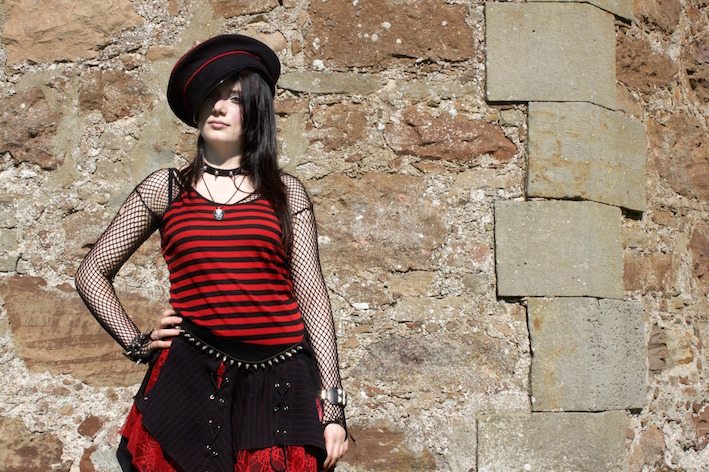
Another instalment of my 'Highland Goth' photography series. These were actually taken last summer, but I've been so busy with college that I haven't had the time to process the images. These are photographs of K. which, if you have been reading my blog awhile, will know is one of my good friends and also someone particularly interested in Japanese fashion. For the majority of her appearances on my blog, you will note that she is into Gothic Lolita fashion, but she is also into other aspects of Goth-related fashions, including Goth itself, and Japanese Goth. In these photos she's wearing an outfit that's very much based in the aesthetics of Japanese and Asian Goth brands; it's got the deliberately tattered look of punk, the bright colours and stripes from late '90s Burtonesque looks (I think there's Burton graphic on the skirt), and an hint of 'kawaii' about it. 


Photograph HouseCat

I did K.'s make-up, and lent her a few of my things as she was visiting us. I don't actually have an eye-shadow that red, so I used a little lipstick for a really vibrant red. The hat she's wearing is actually Raven's - I think he got it for a General Bison (Street Fighter) cosplay, but it wasn't quite right - not enough red. However, military style hats seem to be common Visual-Kei style headgear, and it went with the outfit, so it was donned. However, Raven is a lot bigger than K. so the hat is a tad large. K. is a keen cosplayer, so it also seems fitting that she wear a hat that was initially intended as part of a cosplay. 


Photograph by HouseCat

This particular photoshoot very nearly ended up quite badly because I managed to get a cut on my eyeball. Originally we planned to take this photoshoot in the underpass in Culloden that has a very psychedelic looking 'Alice in Wonderland' mural the local youth group did in graffiti style - it was done by teenagers, so they took a rather interesting and colourful approach to it. We went there, but I forgot that the school year is different to the university year, and that a lot of teenagers from the local secondary school were about to be funnelled through one narrow underpass... I was using my partner's camera, as mine was out of battery power, and his has a little sun-hood over the rear screen, and this is spring-loaded, with a little thumb-flick thing to release it. As I was photographing K., I was interrupted by a gaggle of teenagers, and tried to step out of the way of the flow of people, and moved the camera away from my eye, and just as I did so, accidentally released the sun-hood and a sharp plastic edge caught my eyeball. 

Photograph by HouseCat

Initially, I thought it was just a poke, and no real damage was done, so we moved on to the Doocot, where things were quieter, and I tried to complete the shoot - difficult as I had to use my other eye as my good eye was streaming with tears, and my other eye is always terribly out of focus without my glasses, and is it was bright, I had my sunglasses instead (I can see pretty well out of the eye I hurt without glasses). I'm surprised any of the photographs were even in focus! I finished the shoot, and started walking home, and was beginning to realise that it was more than an ordinary poke in the eye, and that my eye was really burning and streaming. It hurt pretty badly indeed, but I could see out of it. After consulting NHS 24 to make sure it wasn't a waste of hospital time, I went to the minor injuries unit at the local hospital, they put some yellow-orange dye in my eye and took a look - turns out I'd managed to scratch my eyeball - just on the edge of my iris. If it had been a few millimetres further up, I'd have scratched it on the lens of my eye. I have a friend who got a scratch on his cornea, and as the scar tissue is cloudy, he's now partially sighted in that eye, so I feel quite lucky, as it could have been much worse. 

Ducky and K. Photograph by HouseCat

The plan was to also do a photoshoot with K.'s partner, Ducky (also a good friend of mine).  I actually spent a while doing Ducky's make-up, but because of my eye injury, the photoshoot didn't work out. I did, however, get this photograph of Ducky and K. together. They're a lovely couple and I'm so happy for the both of them. In future I'd like to do a set of photographs of them as a pair - a proper 'couple' shoot.