My personal blog as a 'grown-up' Goth and Romantic living in the Highlands of Scotland. I write about the places I go, the things I see and my thoughts on life as a Goth and the subculture, and things in the broader realm of the Gothic and darkly Romantic. Sometimes I write about music I like and sometimes I review things. This blog often includes architectural photography, graveyards and other images from the darker side of life.

Goth is not just about imitating each other, it is a creative movement and subculture that grew out of post-punk and is based on seeing beauty in the dark places of the world, the expression of that in Goth rock. It looks back to the various ways throughout history in which people have confronted and explored the macabre, the dark and the taboo, and as such I'm going to post about more than the just the standards of the subculture (Siouxsie, Sisters of Mercy, Bauhaus, et al) and look at things by people who might not consider themselves anything to do with the subculture, but have eyes for the dark places. The Gothic should not be limited by what is already within it; inspiration comes from all places, the key is to look with open eyes, listen carefully and think with an open mind..

Showing posts with label Wales. Show all posts

Sunday, 12 August 2018

Cardigan/Aberteifi - Castle and Historic Church

As I mentioned in my previous post, I was in Wales a few weeks ago, visiting my Dad. While I was there, I visited three castles and a few old churches. I'm not sure quite how 'Gothic' in the spooky sense of the word this is, but it is Gothic in the architectural sense. It's hard to feel spooky on a day with such bright sunshine - glorious for many, but too warm for me!

This post does include a spider photograph, so if you're averse to spiders, then don't scroll past the ornate door. I have put it as the last photograph so you can still appreciate the others without having to look at spiders. 


Restored curtain wall, Cardigan Castle. Photo by me.
Cardigan/Aberteifi is on the River Teifi, and we went there to visit the indoor market, and have a look around. I had had been there before, and knew it had a castle, and it was restored in 2014 (which I had read about). The first time I had been to Cardigan was before that, and while I think local council owned it at the time, it was in disrepair after having been neglected by its previous owner and inhabitant for many decades. Unfortunately, while the entrance fee was modest, I didn't have enough money on me, so I didn't get to go inside the grounds. From what I gather, most of the buildings on site are later, but it has nice gardens, and I was hoping to at least look at the gardens, but it was not to be. I did take a couple of photographs of the exterior, however.

Secondary wall, embankment, and then primary wall with tower...
And a much later additional house/cottage, affiliated with the castle. Photo by me.
Another gem was a rather lovely medieval church that has been extended several times over the centuries. The church is The Priory Church of Our Lady of Cardigan (I don't know what that is in Welsh, although I did read it and I've since forgotten it). It is in a very beautiful graveyard, and next to a hospital but also next to a busy road. I did take some exterior photographs, but they didn't turn out very well. I apologise for no good overview photographs. My partner Raven also took some nice photographs, so with his permission, I have included those too. 


Photograph by myself. Gravestones in rows through yew trees.
The graveyard is mostly older graves, although I did not go around and get a particularly good average for the estimate age - looked like mostly 1700s and 1800s gravestones.They are almost all made of the same sort of grey stone as the church and the castle, and most are a slab given a roughly arched shape with text - not like some of the Protestant chapel yards, full of urns and obelisks, or a chapel on a hill we visited, which had a much wider variety of stones. (Unfortunately I accidentally deleted many of the photos of that particular chapel! )


Photo by Raven. 
This is the far corner of the graveyard. All along the back wall are grave-stones laid vertical, with the climbing plants sort of taking over in places. I don't know if they are memorials from plots that were re-used, or if this is just where fallen-over stones got placed, or if there were just a lot of people buried along the wall. 

I also think this photo goes to show what a bright and sunny day it was - very hot, a few wispy white clouds, and scorching brightness. Personally, I found it too hot; I overheat easily and get sun-burnt just as easily, so I prefer cloudier, cooler days. Some people love the sun, but I have to hide under hats, long-sleeved floaty clothes and lots of sun-screen.  
 
Dead Tree. Photo by Raven 
I'm not sure what kind of tree this was when it was alive. There were plenty of yew trees, but yews are poisonous to other plants, so I doubt that there would be other plants growing from it if it were a yew. The tree stump felt almost sculptural, and its timbers bleached grey-white seemed fitting with the stone and almost skeletal itself. 


Grave with ornate carving. Photo by Raven.
This gravestone near the entrance was interesting - it had some sort of crest surrounded by a laurel wreath or other foliage, but it has suffered the ravages of time - the central design, presumably a monogram, is pretty much illegible, and any motto or similar on the banner beneath the leaves has long since de-laminated. I think perhaps the topmost leafs have lost some mass, too. It's interesting to see a headstone carved in the shape of a Dutch gable, too. 

Architectural salvage. Photograph by Raven.
I'm not sure which part of the building this detail came from - I couldn't even figure it out by looking at it - it's some part of some Gothic details, but it's also a broken jigsaw piece of architectural history.  Raven took this photograph of it - I guess it looks sort of abandoned in this corner of the porch, but really it's a sign that someone's put it there so it doesn't get discarded. I don't know where on the building it used to belong - perhaps part of something that has since been altered, so it can't go back - but whatever it was, it is put there where it is not forgotten.  It's almost on display. 

Monk. Photograph by me
This monk's head terminates the arch over the porch. It looks like one of the more recent additions to the church. From what I gather of the church's history, I think at some point it was connected to a monastery as well as a priory (I'm really no expert on this), which I guess is why they used monks as a decorative motif. There's one at both ends of the archway, looking solemnly upon all those who enter the church. I don't know if they are representative of specific people or not.

Ornate ironmongery.  Photograph by me. 
Both Raven and I admired the ornate doors - I don't know how old they are, perhaps Victorian, perhaps earlier, but they have the most fabulous swirling ironwork on them.  I have a thing for doors and windows - maybe it's liminality of them. I also really appreciate when something that doesn't need to be ornate gets an artistic treatment. Plenty of church doors have much simpler hinges, some have fancier, but it's nice to see something like this. Someone put enough time, money and effort in for this to be not just an ordinary door - probably several people; someone to make the timbers into a door, someone (or some people) to do the metalwork, someone who designed it, someone who paid for it... Someone who checked that it would fit in the aperture of the door frame! It's not as common these days, to have such things made, and I think we're losing out. 

There are several stained glass windows in the church - framed by stone tracery that looks very, very old indeed - but maybe not as old as the apertures in the walls, as they look like they once had larger arches and arched tracery rather than arches in rectangles. I don't know exactly how many phases of construction and alteration there have been (I counted at least 5) but it's got so much history built into the walls. It was really quite fascinating. 


Spider, photograph by me.
I really like spiders. Raven, not so much. I saw this spindly one on its thread in the porch window. 

Tuesday, 26 June 2018

Castell Arberth/Narberth Castle

A few weeks ago, Raven and I went to stay with my Dad. I came across this castle by accident - My Dad got Raven to drive him on an errand, and the route went past this castle mound, which was partially obscured by how the road goes down a deep cut in the hill below it. I asked if we could visit the castle on the way back, and we did. If any of my readers are familiar with the Mabinogion, then they will recognise Castell Arberth as one of the chief courts of Pwyll, father of Pryderi. 

Narberth Cemetery

On our way to the castle we went into a cemetery by mistake - we were looking for the path up to the castle mound, and thought this might be through the cemetery, as the graveyard path initially seemed to slope up. The cemetery was founded in the 1930s, so most of the graves are 20thC, I think with some more recent ones. As it is quite a recently used/active cemetery, I only took one picture of the general cemetery area, rather than any of specific graves, and certainly no posing with the gravestones. 

Remains of the castle sticking up like fangs from the ground

The castle was up a different path. You can't see much of it from the road, only one of the towers, but once up there, a lot more of the castle is visible. It is hard, from what is left, to visualise that it was once a mighty fortress, at least the second built on that site, and was built sometime after 1246 (you can read the CADW page ::here::). There were signs around the place with artist's impressions of the original castle, but I think the windows in the paintings are a tad more Gothic than might have been based on the actual window shapes remaining. However, there may have been more pointed tracery in stone frames now long gone. 

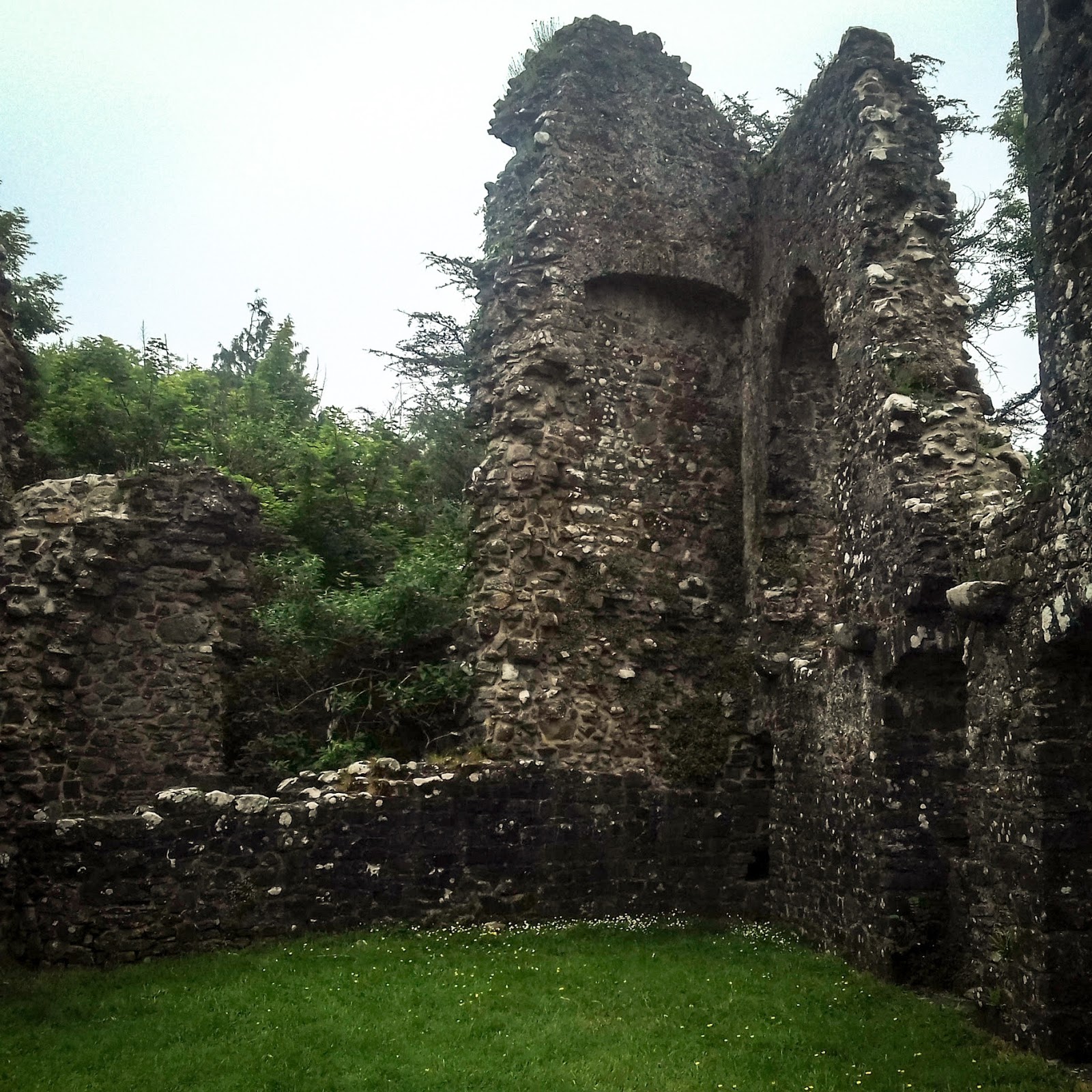
This is just part of a broken tower, once attached to a building
It was a damp, muggy day, with a dull grey sky, so I apologise in advance for the photographs being hazy and the skies being boring. I took all the photographs on my phone, as well, as I still haven't got a replacement camera. I'm currently unemployed, so it will be a while before I can afford a decent camera.

Raven was there too, and he took a couple of pictures of me.

Window into the cellar
The most complete part of the building is the pantry/kitchen cellar, with its tough barrel vault weathering the test of time. It's the building that Raven's standing in front of in the picture above. A lot of the stone from the castle was reused to build the town/village of Narberth (Arberth in Welsh) that surrounds. It's a very craggy-looking ruin, and the exterior walls, which would have likely been rendered and whitewashed to avoid the stone walls providing hand-holds, and to add an extra layer of protection from the elements, are now bare, with much of the walls' cores exposed. 

What is left of the great hall. 
The castle was built on a promontory, with a steep drop down to the graveyard below, and even further to the current road level. Geographically, it's quite a defensible location. I think the castle walls merge into a deliberate escarpment to the right of the buildings pictured above. Looking out over the trees now is quite magical. The vegetation there is very lush - West Wales is where parts of what is known as the 'Celtic Rainforest' grows - dense and green, watered by the decidedly soggy climate and warmed by the warm air currents that pass the West of the British Isles, brought by the Gulf Stream. 

Through the windows
The buildings were stabilised in 2005, after an extensive project to stop further ruination of what is left. Unfortunately, there has been graffiti since then, limiting what I could photograph (I don't want to put swear words, crudely drawn phallic images and suchlike on my blog) and also damaging the stonework as it would be difficult to remove the spray paint from the walls without also damaging the surfaces of the stones. It saddens me that I often go to castles and other ancient monuments and there's litter, beer cans (and sometimes worse) and graffiti - the results of people disrespecting their heritage. Ones that charge for entry tend to have less, but I think it's more the supervision of stewards than the price that changes things. 

I went through that doorway.
I did see a family taking their children for a stroll, which is a good thing - nice to see children being taken to such things at young age, hopefully to grow up more respectful of the castle than those who spray-painted the graffiti. I get really angry about people damaging historical buildings.

Inside what's left of the great hall
You can see corbels jutting from the walls where once sat the joists for the first floor. I don't know if there was a second storey on this part. The towers definitely had ground floor, first floor and second floor at least, probably with battlements behind crenelations. All of that is gone now. You can also see where they changed their mind about a window and walled it up into an alcove. 

Note corbel and hole in the wall where a beam once slotted in
I probably spent longer exploring and taking photographs than we really had time for. I find such ruins quite captivating. 800 years is pretty ancient in many ways, but it's actually relatively recent in Welsh history. Near Narberth/Arberth is a truly ancient hill-fort that is thousands of years old. It's somewhat overwhelming at times just how much history there is, layered all around us. I'll have to visit more of the really ancient stuff and blog about that, too. 


The arches are roughly Gothic, but it's hard to tell what the windows looked like with any more detail than that. The castle, like most medieval castles, also had a chapel, which I would expect to have church-like Gothic windows, maybe once having stained glass. Now there's just a hole in the wall. I wonder what happened to the glass. 

The hat and cloak make me look particularly severe.
Raven took a picture of me looking very serious by a window. I'm such a tourist sometimes - I want an 'I was there' picture of me at the places I visit. You can see how much better the resolution is on Raven's phone camera than on mine. I visited two other castles while I was in Wales, and I'll update my blog with those in the near future. 

Sunday, 13 March 2016

Newcastle Emlyn Castle

This is a post from March 2013 that somehow got relegated to a draft! I'm not sure how it never got published! Have a look at some castle photos from Wales! 

I went to where the last dragon was slain.

There isn't much left of the castle at Newcastle Emlyn (Castell Newydd Emlyn) but I have visited what remains a couple of times before. My most recent visit was on Day 3 of my holidays. 

I didn't get a photograph of the gate, but there is a rather grand wrought iron gate with a dragon breathing fire at the top, and an oak-leaf design. The dragon is painted gold with red flames. It is a modern tribute to both local legend and local history. 

Photograph of the castle by the HouseCat
Most of what remains are the two towers either side of the main entrance and the castle mound. The castle was quite small (by castle standards) when complete, and now that it is ruined it does not take long to walk around it. Or clamber. I must admit that I like being able to touch and clamber on my history, to explore every nook of it. I try to be careful, as although the walls are old and have remained for centuries, some bits are loose and I neither want to fall or damage the walls. 

It was a lovely, bright and sunny day, but cold. It was not as blustery as when I visited Cilgerran castle. I still ended up wrapped up in my long leather coat, but didn't need to wrap my hair to my ears with my scarf this time. We were there in the mid to late afternoon, and the sun cast strong shadows across the stonework. 

Inside of one of the towers.
Photograph by the HouseCat

The sky was a good clear blue and the surrounding countryside and river looked absolutely gorgeous. It was nice to just stroll around the grounds, take photographs and chat to Raven. 

See, I CAN take colour photographs of buildings!
Photograph by the HouseCat

There are quite extensive grounds about the castle, with nice gardens and a picnic area. We didn't, however, eat a picnic, but went to ::Pachamama Bistro::, which is in the town itself. I had this lovely goat's cheese and onion chutney sandwich in lovely crusty bread with salad (dressed with tasty dressing!) and a few crisps. It was really tasty. I also had a 'Mellow Mallow' hot chocolate which I can highly recommend as a delicious hot chocolate. As well as a range of delicious Western sandwiches and salads, they do a range of Thai, Chinese and Indian dishes. It's a lovely cosy place to eat and the staff are very friendly.

Light through the old windows of the castle.
I managed to have a rummage around a charity shop and  a browse of some of the other shops. Dave was very lovely and gave me a £1 coin (I was all out of cash as I rarely cary much/any, and it was too little to pay for on card) with which I bought a rather nice four-candle black metal candlestick. I also went to   'The Maker's Mark' which is run by a lovely lady called Nada (I hope I spelled that correctly) who remembered us from our last visit. I really enjoy shopping in Newcastle Emlyn; for a smallish town, it has a lot of good quirky little shops, more than Inverness, which is a city.


Friday, 29 May 2015

Carmarthen Castle/ Castell Caerfyrddin


During the Easter break, we went on holiday to visit friends/family in Wales. My Dad had never been to Carmarthen Castle before, so I took him to visit it. He's an archaeological geophysicist, so he tends to spend more time concentrating on burried ruins than on those remainign more vertical. I took most of the photographs on my camera-phone. My new smartphone is pretty dire for indoor photography, but actually rather good for outdoor photographs; the only problem I have is that it is hard to hold it still, especially as it is so thin and light.


Gatehouse. Photograph by the HouseCat

This photograph was taken from the city centre side of the castle, looking up at the imposing and sturdy gatehouse. In its heyday, it would have been a true stronghold, well defended against attackers with vast walls and a garrison of knights and warriors. I'm not sure what sort of roof the gatehouse would have had, but I imagine it once loomed even taller. All the walls are hugely thick and very sturdy. Apparently, there are further remains of fortifications and associated buildings outwith the curtain wall (big perimeter walls of the castle compound) underneath parts of the city's central shopping district!

Large round tower, looking up. Photo by HouseCar


Carmarthen Castle is rich with Arthurian legend, and according to legend, the town is named after Merlin, or Myrddin (pronounced something akin to "Merthin" - I am not Welsh, and that is my attempt at writing how my Welsh-speaking friends pronounce it, in English phonics. Natively speaking and flluent Welsh speakers are free to correct me :) ), but actually, Myrddin was named after the town, as he was supposed to have been born near there, and the city was named after one of fortresses that have stood there, which overlooking the estuary, was called Moridunum by the Romans - a Latinisation of even older Brythonic, and basically, it meant 'Sea Fort'. The castle, being one fortification in a long history of fortifications there, is part of that history, and is situated on a prominence overlooking the river, and where the bridge now is. It would have once been guarding the way in from the sea. The road now runs directly below it, and beyond that the railway comes in.

Trefoil Gothic window. Photo by the HouseCat

Merlin is supposed to be trapped in a nearby hill, within which the Crystal Caves are supposed to be hidden. The shopping precinct there is called Merlin's Walk in English and Maes Myrddin in Welsh, and there's some interesting public sculpture in the city on an Arthurian theme. Considering the connection to Merlin, most famous of British mythological wizards, I am surprised there are not more local metaphysical shops and Neo-Pagan suppliers capitalising on that theme; perhaps this is a good thing as in other places with Arthurian connections such as Glastonbury, some of that can get a bit tacky and 'touristy'.


Part of castle keep. Photograph by the HouseCat

The road is significantly below the castle walls, and you have to walk up steps to reach even the bottom of them. This photograph is looking up from those steps, towards one of the towers. Until fairly recently, it was possible to walk up one of the original spiral staircases, but unfortunately it appears that there has been instability and partial collapse, so that staircase is now barred up. There is not much left of the castle above ground, but next door is a building that was once a prison, and is now council offices (and which was built in a style that certainly took aesthetic influence from the neighbouring castle) and what is now the carpark has a massive stone wall around it. Within that wall are still visible portions and traces of castle architecture, but it was hard to get a good photograph, and as the council carpark is private, I coul not just go down and take pictures. 

 Links/References:
::Carmarthen Castle at Castles of Wales:: - I recommend this link because it shows the extent of the remaining castle with large size photographs, clearer than mine. Includes picturess from the carpark.
::Carmarthen Wikipedia Page::
A lot of what I have learnt about the castle is from the signs there, and from talking with my friends and relations local to Carmarthen, especially Kate B. and Raven's father.


Sunday, 14 April 2013

Cilgerran Castle & Teifi Gorge

I've been on holiday! 

Day 1 of my holiday was in Wales, in the South West of the country. I visited Cilgerran Castle in Pembrokeshire with Raven. Raven, though Irish, lived in Wales for over 20 years and has been teaching me snippets of Welsh vocabulary. 


Afon - River
(Hence the River Avon in Somerset, West England, as 'f' is pronounced like 'v' in Welsh)
Pysgod - Fish

Raven drove in the sunshine across the Welsh countryside along narrow winding roads with spectacular views until we got to this small village above the Teifi Gorge. We went down a particularly steep and narrow lane to a car-park down beside the river where there were some remarkably posh stone-built public toilets with a sheltered display on the outside wall of informative plaques telling of the river's history in both Welsh and English. As it was Easter Sunday afternoon and actually sunny, it was quite busy with families out to enjoy the outdoors.
Path above the River Teifi
Photograph by the Housecat
We strolled along the riverside and up the wooded slope, and rapidly I figured that a long skirt and even low-heeled granny-boots were both a bit impractical as I snagged my skirts on brambles and walked very carefully up the many steps indeed. Raven rather enjoyed photographing every interesting thing he came across, as did I. In the end I took over 100 photographs that afternoon, even if I am only showing a few here on this blog entry - things could get rather slow on the loading time otherwise! We walked past an old slate quarry and up alongside the river. 
Taking notes
Photograph by Raven of Chance Photography
I sat for a bit in this wonderful slate-encircled seating area amongst the trees, which if I go again I will note as a nice picnic spot. In the photograph I am writing in a notebook I bought especially for this holiday, to take notes for both my diary and my blog. 
The Sally Gate
Photograph by the Housecat
We walked beneath the castle for a bit, looking up at the towers and in through the 'Sally Gate' as I heard someone call it. I over-heard a father tell his son that it was not named after a woman called Sally but thus called because one sallies through it! I took several photos of the gate, but I liked these two detailed photos most of all. 
A closer detail of the gate.
Photograph by the Housecat
At this point I could hear distant strains of music on the wind. I couldn't make out quite what it was that was playing (I presume it was a radio or other recorded music) but it sounded like a woman singing in Welsh. It seemed quite beautiful and a bit magical to hear just these snatches of wonderful singing. Anyway, around this point I dropped the pen I had borrowed off Raven, so I didn't take many notes for a while! 

Castell - Castle
Tŵr - Tower
(These two are quite similar in both languages)

We then walked a bit further along and down to the river at a different point. Raven skimmed stones and I walked on the shallow shores where the water was an inch at most above the water and had a go at skimming stones too, but I am quite useless at this! 
Raven at the River Teifi
Photograph by the Housecat
I was wearing a scarf about my hair because even though it was sunny, it was a bit breezy and my hair kept blowing into my eyes. At least you get to see the skull scarf I was wearing, which is a cheap one from Primark, but does have a nice lace-like skull pattern on it. 
Looking out across the Teifi
Photograph by Raven of Chance Photography
After a brief hunt for the lost pen, we walked up to the castle and entered it properly. The castle is pay-to-enter and owned by the National Trust. Raven paid for my entry and I used my entry money to buy my little niece a children's book called 'The Little Dragon' and deep plum-coloured quill to carry on my note-taking with. 
Tower and cloudy sky
Photograph by the Housecat
There has been a castle on the site since around 1100CE, but the castle in its present form was built between the 13th and 14thC, with a lot done in 1223 by William Marshal Jr. (See, reading those plaques in the Castle grounds is educational!).
Walkways within the castle
Photograph by the Housecat
One of the wonderful things about visiting the castle is that you can walk inside the buildings as it is reasonably well preserved for a ruin, and as bridges have been built between the remaining stairwells. Raven took a photograph of me from above - he on a walkway, I in the base of the tower.
The Housecat with camera
Photograph by Raven
All the roofs are gone, as is often the case with ancient buildings as the timber rots once the slates or tiles fall or are salvaged (I would imagine slates at this castle, as there is so much of the stuff locally) but the stone, if built well, seems to withstand the centuries so much better. I took the photo below looking upwards in one of the towers. 
Into the light!
Photograph by the Housecat
One of my favourite things about looking at ruins is it gives such a glimpse into how the building was built. The rows of holes in the wall of this tower are where huge wooden beams would have once kept the floors up, for example. The whole castle is built of quite small (relatively) and flat blocks of slate - the local stone - and it is interesting to see something other than roof tiles as an architectural use of slate. I also like seeing the 'fans' of slate above the windows - you see that done nowadays still! Slate is quite an interesting material, with a good variety of uses. 

Anyway, I hope the castle photographs are pleasing, as there is another castle post on its way tomorrow.