My personal blog as a 'grown-up' Goth and Romantic living in the Highlands of Scotland. I write about the places I go, the things I see and my thoughts on life as a Goth and the subculture, and things in the broader realm of the Gothic and darkly Romantic. Sometimes I write about music I like and sometimes I review things. This blog often includes architectural photography, graveyards and other images from the darker side of life.

Goth is not just about imitating each other, it is a creative movement and subculture that grew out of post-punk and is based on seeing beauty in the dark places of the world, the expression of that in Goth rock. It looks back to the various ways throughout history in which people have confronted and explored the macabre, the dark and the taboo, and as such I'm going to post about more than the just the standards of the subculture (Siouxsie, Sisters of Mercy, Bauhaus, et al) and look at things by people who might not consider themselves anything to do with the subculture, but have eyes for the dark places. The Gothic should not be limited by what is already within it; inspiration comes from all places, the key is to look with open eyes, listen carefully and think with an open mind..

Tuesday, 14 October 2014

Being Neo-Pagan AND Goth

The problem with being a 'Witch' and vaguely resembling a fantasy witch is that people assume that I'm a witch based on how I look. The problem with that is that their version of 'witch' is often an assumption quite far from what I actually am, and that Goth and 'witch' are not synonyms.

There's several versions of this, and it comes from different mindsets and different assumptions, so I don't want to tackle this as if it is all the same thing. 

The first and most obvious is when non-Pagan strangers ask me if I'm a witch. There are two general versions of this; the one where the asker does not sincerely believe that I am a witch and is asking me it as a mocking question, and the one where the stranger has correlated my outfit with the idea of the fantasy sorceress and genuinely thinks that I might be a practitioner of the occult; and the rarest sort is that some have a vague idea about Wicca and modern Witchcraft and have spotted a pentacle or moon symbol somewhere upon my person, but most of those that ask are of the first two sorts, and of the second sort, they seem to think that I spend my Saturdays sacrificing goats on windswept hillsides or something with the look of fear they give me, and there's a subset of this group who are very intent on saving my soul from the Devil. 

Goth is not a religion, it does not require being a member of any religion, and you get Goths of all religions (Go look at ::Priestly Goth:: and its sister site, ::Priestly Goth Blog:: - the pages of a Pastor, painter of icons, Goth and political blogger. Not the only person who has chosen a Christian religious life that I know that also has a Goth streak!) and of none. I do think that as Goth has a Romantic aspect to it, that it tends to attract people who have a spiritual nature about them, and while yes, there are higher percentage of Goths who are on mystical and occult paths than in the general population (and I include in that Goths who follow the more mystic aspects of mainstream religions, too), it is by no means that all Goths are Pagans. 

I always find it hard to deal with these situations; I usually start with "that's an unusual question" - after all, how many other people has this person asked this question to? Probably not many, if any - and then try and figure things out from there. I don't use the word "witch" very much anyway, as I have explained in ::this:: earlier post, but my answer is going to be very different between someone who says "I noticed your pentacle ring and thought you might be Wiccan" and someone who says "Don't you Gothics (An aside: Gothic is an adjective, not a noun! People need to learn this!) worship the Devil?" I never lie, but I tend to word things carefully to neither confirm nor deny and to steer things away from me, personally. If people are ignorant but genuine curious, then I try to politely explain that they've been misinformed, if they're judgemental and going on a religious tirade, then I extricate myself from the situation. Whatever I do, I'm conscious that it will reflect on Goths as a whole, and therefore try and be as polite (but sometimes firm) as possible and make sure I do not let things devolve into an argument. 

Those who think I am some kind of crazy person and that my clothes and religion are both signs of this probably are not going to listen to any protestations otherwise, so I feel the only answer is to be a calm person and let my actions, and for those who are more than just a judgemental stranger, my life demonstrate that I am not some person wildly disconnected from reality and trying to live some delusion that they are in fact Morgan La Fey or something (there's nothing wrong with the occasional bit of dressing up as long as you're fully aware it is only a costume.) and that I am no crazier or more deluded than any other religious person may be, as there will always be the more militant atheists who try and make an issue of any religion, especially fringe religions. I am of the opinion that as long as a person is not hurting others or themselves through their religious choice, it is of no concern to others and that if you wish to engage in religious debate, it ought to be a polite discourse and not a personal attack. 

Prejudgement from Other Pagans
The Curious Professor Z wrote ::this:: very well-written, researched and thoughtful article on this topic already, and I encourage you to read it.

The most frustrating is probably when other Neo-Pagans think that Goths who are involved in Neo-Pagan spirituality, the Occult and Witchcraft are not sincere about their beliefs or, are coming at it because it is 'spooky' rather than because it connects with them on a deep and spiritual level. I find it frustrating because both Goths and Neo-Pagans are groups who have made choices that have separated them from the mainstream and opened themselves up to the assumptions, prejudice and bigotry of the ignorant, and so I'd hope that from the experience of having been judged and assumed about, that Neo-Pagans who are not Goth would be more inclined to ask questions and judge the sincerity of a person's belief on their actions, not on what subculture they are part of.

I am certainly not into Neo-Paganism as a way to deeper entrench myself in the 'spooky woman' role; this is not some blurring of the lines between everyday life and L.A.R.P. I was pagan before I was Goth, by about three years, although I definitely had Pagan attitudes and ideas that aligned with Neo-Paganism long before that, right from when I was a small child, although I did not know what Neo-Paganism was then.

To be fair, the Neo-Pagans I am currently involved with in my local area seemed pretty open and willing to give me a chance when I joined groups and starting getting involved with the Neo-Pagan community here, and I think that's partly because as the Alternative community in general is small here, people who stand out because they act and dress differently and their thoughts do not align with those of the majority, stick together, whether they're hippies, Neo-Pagans and Witches and other people who practice Alternative spiritualities, Metalheads, Goths, or any combination of the above or people who I haven't mentioned yet. My encounters with Neo-Pagans who have been judgemental have primarily been online. I think the internet is a medium through which some people forget their manners, as there is a distance in typing at a screen that can make people fail to realise there is still another human somewhere reading a different screen at a different keyboard, but not that unlike them.

The other assumption about being a Goth and a Neo-Pagan is that there are other Neo-Pagans who think that we practice curses and magic for evil purposes, that we sacrifice living things and are liable to commit some kind of sacrilegious practice or whatnot, and I think that comes from the same misinformed place as the non-Pagans that think this; they think Goth is somehow linked to 'black magic' (side note: magic does not come in 'black' and 'white'; a growth spell or a love spell can be just as destructive as a diminishment spell or separation spell, and the latter two can actually be used helpfully) and evil practices, and it just is not! It is a common misconception, but it just is not true. Goth does not have any religious affiliation, and does not involve a deliberate desire to be purposefully immoral in any spiritual or more mundane way.

As per usual, I remind people to check their assumptions, or rather, to try and avoid assumptions and to approach things from a place of learning. Goth is a subculture encompassing fashion, art, music and an appreciation for darker things; it is not an anti-moral code, a religion or a cult and has no bearing on what a person choses to be their religious, spiritual or atheist path. 

Monday, 13 October 2014

Alternative X - The Last One At Karma!

As readers may know, Inverness has - or possibly had - two different club nights specialising in alternative music: Rapture, which was metal and rock, and Alternative X which was more diverse, also including Goth, Industrial, EBM and Punk music. Recently the Karma Lounge, which hosted these events, closed. As yet no new venue has been announced for either, although there have been various suggestions from within the community. 

Pre-clubbing selfie. Note swirls and bat hair-clip! 

Raven and I went to the last Alternative X hosted at Karma, which was also a celebration of one of the organiser's birthday (Debra's). This was back in early September (5th), but sadly my computer broke (rather literally; mechanical hard-drive failure) shortly afterwards and I did not get this blog post finished. My apologies for this event review being so long after the fact!

 
My "how do I get the webcam to work?" face


It was a busy night by Alternative X standards, and I got to spend a lot of time with good friends. We stayed out pretty late! I can't remember how late. I drank more than I usually would hence the ridiculous poses in the coffin booth - at least it shows how green my hair was (Stargazer's UV dye range glows pretty well under a UV light, I found out!), we took a taxi back home rather late indeed, and fun was had by all. My favourite thing about Alternative X and the other Goth nights is that I get to see all the friends who live too far away from either my home or the city to see regularly, which is always nice. The Highlands are quite a sparse area, and those in the scene here are quite spread out over a wide area; it can be hard to keep in touch in person.  I really wish I had a couple of photos of Raven, because he wore a black kilt out clubbing!

I hope Alternative X and Rapture find new venues; it's nice to have at least one night every month or two where I can go to a club and hear music I like and dance, drink and socialise with other alternative types! Inverness and Highlands don not have much in the way of alternative events and it would be a shame to loose what we already have. 

Sunday, 12 October 2014

Edinburgh City Part 7: Edinburgh Castle (Interior)

In yesterday's post I covered the castle's architecture and exterior with a series of black-and-white photographs. Today I'm going to show a few photographs of the interior. In colour, to show the rich warm tones of the decor - I guess an antidote to how grey and bleak the weather can be high on the castle crag. 

Royal Palace

A big warm fire! Just not with much actual fire in it.

Apparently the room above is part of a suite of rooms which are still, to this day, used as state function rooms. I wonder if dinners are served here, or if antique furniture is brought out for people to sit around some grand table. One thing I observed was that, apart from the paneling and built-in furniture, there rooms were quite bare of tables, chairs, cabinets, etc. and I wonder how much more homely and also how much grander the rooms would have been when they had chairs on corners, tables, beautiful items on display, etc. Some of the rooms have portraits and paintings on display, but most do not. I wonder if this is because for a long time the castle was used as a military fortress rather than as a royal residence. 

Gilt panelling with fluted

I'm sure all the polished wood and gilt, as well as the polished brass plates behind the 'candles' (now replaced with electric lights designed to look a bit like candles of you squint sort of side-ways...), are all part of a carefully thought-out attempt to give the rooms a sense of brightness and warmth. My interior photography, especially with a point-and-click camera and inadequate lighting, does not do the richness of the wood justice; I presume it's all oak, and the grain has been polished (or oiled?) to perfection. 

Great Hall
The great hall was the heart of most castles, and even Edinburgh Castle, so modified for changing times over the centuries, still has its. Most of the hall is decorated with the contents of an antique armoury; swords, halberds, armour and suchlike cover every wall, some in mountings that almost seem like they're part of an actual armoury if it wasn't for the elegance of the wood-work, and some arranged in fanciful patterns on the walls. Somehow it made me think of Raven, and his collection of knives and swords (I have my own collection, too, but his is more expansive!) but this collection of matched weapons was clearly meant for a lot of guards rather than one man! There were some miniature cannons, too - I'm not sure if they were actual weapons, or symbolic decorations. The armour below is part of this display of militaria (and there's one of the mini-canons!). 

I apologise for the blur and camera shake!

Of course, the hall was not built as a military museum or an opportunity to show off a vast number of swords. People would have met here, feasted and banqueted, got tangled in the complex webs of high society and politics (very much the same thing in the times of monarchy and feudalism) and suchlike. Even dressed in my Gothic Lolita frills, I felt under-dressed for the venue (despite all the other tourists in their casual, ordinary clothes...) and sort of wished I was wearing something a bit grander - in retrospect quite a silly thing to think!

I want to sit by this window with a warm cloak and good book!

I like this window. I like the geometric pattern for the leadlights that is not just rhombuses of glass, and I like the stained glass heraldry inset, as it is colour, but not overwhelming colour that will reduce some of the light coming in (as can happen in churches, and partly why later Gothic architecture had such an emphasis on huge windows; it maximises the light AND allows for glass that does not have the clarity of modern glass, and also for stained glass). Maybe it was the weather, maybe it was reading the accounts of past resident royalty who thought the castle a cold and drear place, but I was acutely aware of how light worked in the building that day.  I quite like this nook, too; the way there's private seats in the window bay. 

I wish I had captured a few more photographs of the great hall, especially the amazing roof beams and the screens and ornately carved panelling. It is a really splendid room and I wish I had more to show my readers!

I find interiors like this and that of the National Portrait Gallery very inspiring, but it's hard to channel that inspiration when I don't live in a grand house with high ceilings and I do not have seemingly inexhaustible wealth to fund such grand things. Maybe one day, with enough time and enough patience and enough skills learnt, I could learn enough crafts and spend enough time decorating to have something splendid, but it is really nothing but a dream. 

Thursday, 9 October 2014

Edinburgh City Part 6: Edinburgh Castle (Exterior)

PICTURE-HEAVY POST

One of the main reasons I went to Edinburgh was to photograph the castle. As Scotland's largest castle, and one of the more impressive, situated as it is on a rocky volcanic crag high above the city, looming over everything as a stony sentinel, it seemed the perfect subject for a display on castles for the Primary 4 class at the school I work at, and I personally adore castles and want any excuse to visit one. 

Looking left from the entrance bridge.
The guttering looks a bit like cannons.

Once at the castle itself, the city seems opened out all around, and just how high and isolated an outcrop the castle is seems very apparent. The views are amazing even on a dull and hazy day like the one of my visit. I am sure that on a clear and bright day that one would be able to see for many miles in any direction. I tried to take some photographs of the view, but they were mostly quite hard to make out, so none of them will go on the blog. 


Looking up from the entrance gate to the
Half Moon Battery, built for huge cannons.

So much of the rest of Edinburgh seems to have been built with at least some inspiration from the castle; all the castle-like details of the Scottish Baronial buildings that seem everywhere, the vistas that seemed planned to give you a good view of the castle, the gardens between Prince's Street and the railway that make the castle seem somehow separated from the city itself, etc. etc. Not many British cities still seem to have their old castle at their heart. Only Stirling, which also has its grand castle perched high above a steep rocky outcrop, seems to have some of this, but Edinburgh certainly seems built around its castle more than just geographically. Oxford, for example, still has its castle, but that castle has been swamped by the far grander buildings of the university and re-purposed so many times; it feels like it has been subsumed by its city.

Where the gates had once been underneath the Argyle Tower.

I took the photograph above because even before I read on a plaque that there had been many gates (five, if I remember rightly), the ribs in the vaulting made it clear that there had been defenses there before. I was surprised not to find holes of some sort to shoot down upon, or pour boiling liquids upon, invaders as I have seen this in other castles. Medieval warfare was grim, bloody and painful. Combined with the steep rocky crag the castle is built upon, the one main road up to the entrance, and the terracing that would make it so easy for archers or muskets to shoot down upon attackers, the castle is certainly not a structure that would have been easy to get into!

Looking up to what is now the castle shop!

Entry to the castle is not cheap. I think it cost me £16 just for myself. I then purchased a guide book, a few history books, post-cards and snacks all on top of that, making it quite an expensive visit. I am quite glad I had money saved up as otherwise I would not have ordinarily been able to afford such a trip. I think it is cheaper if you are a member of Historic Scotland - something I am seriously considering doing as I am quite fond of visiting historic sites (as visitors to my blog should know!). 

Staggered walls of castle shop.
Looking up at some clouds being interesting!

As I mentioned in yesterday's post, the weather was grim, bleak and windswept. The skies were grey, pale with wan sunlight and the wind made the day far chiller than the the day before, when it was sunny, warm and humid enough to have me nearly fainting. It was not the prettiest day for taking photographs; I prefer it when it is partially cloudy so that I get interesting contrast with the clouds, or at least when the clouds are being dramatic. The sky that day was dull, often quite flat, with the occasional interest of denser, darker and more leaden skies that came with unfulfilled promises of rain. Every now and again there was a slight break of blue through the cloud, but very little. 

Rear view of the shrine of the Scottish National War Memorial

One of the more recent buildings is the Scottish National War Memorial, built over what, if I remember rightly, had once been both a barracks and a church at different periods. I don't know how much of the architecture is 20thC and how much is an adaptation of older buildings, but I do know that it is a place of reverence and remembrance. Photographs are not permitted in the Shrine itself, to preserve the dignity and attitude of reverence, but I can say that it is both somber and beautiful, with the names of the war dead from all three branches of the military kept in a metal box designed to resemble the Ark of the Covenant. 

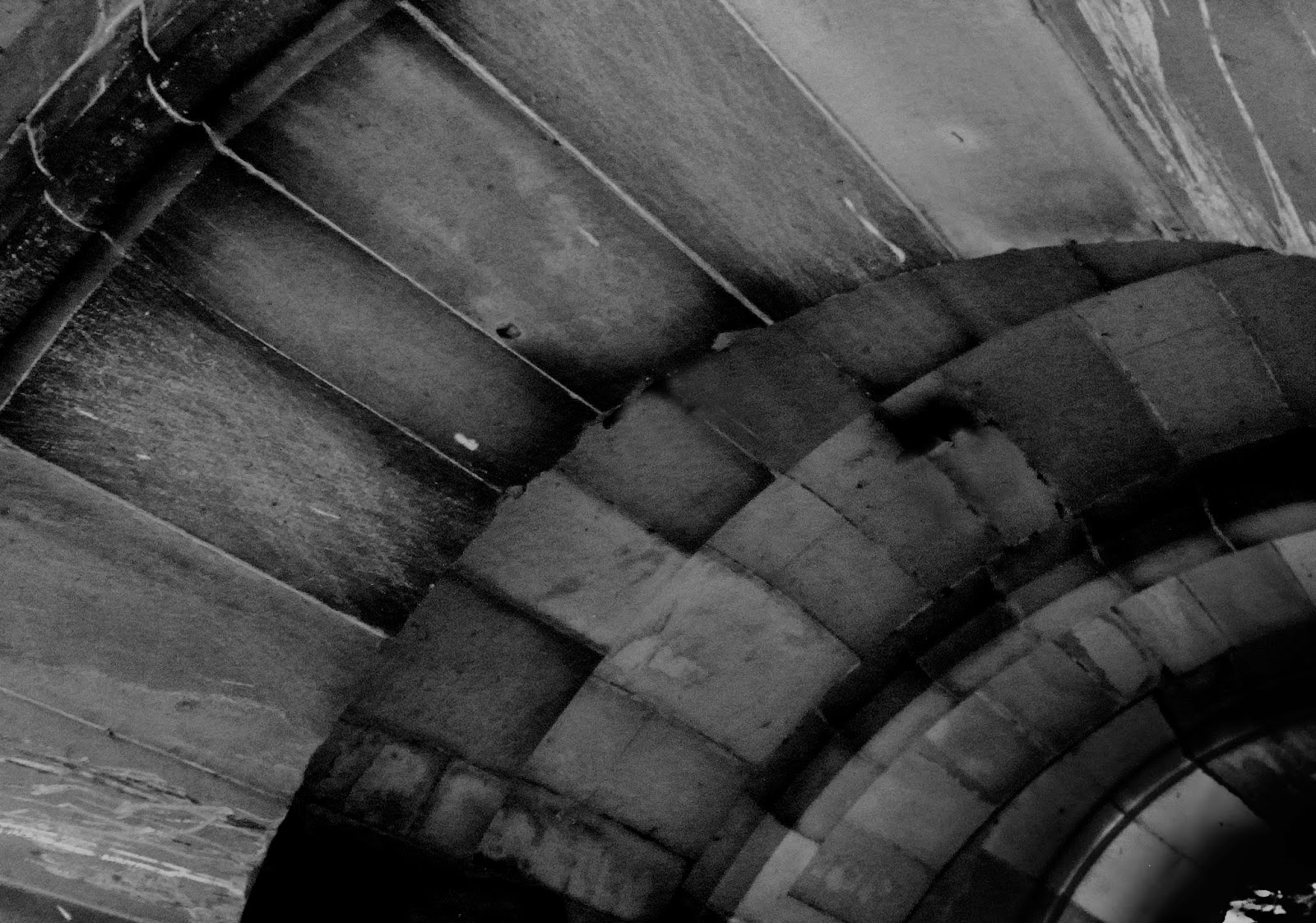
The archway, looking in from the approach.
The shrine is accessed via the inner courtyard, and under this arch. I don't know if this arch is a structural brace between the two buildings, or if it is a walk-way for uses I cannot fathom, or part of a tall gate that once sequestered off this royal section of the castle. Anyone who can explain it to me has my gratitude if they do so. 

The same archway, this time looking outwards.

Through this archway, inwards, is a courtyard. The inner courtyard is called the Royal Square, and it is surrounded by the Great Hall, the Scottish National War Memorial, and the Royal Palace (which holds the Honours of Scotland; the nation's crown jewels, comprised of a rod, sceptre, crown and sword, and the Stone of Destiny). This was not quite as grand as I had imagined, but Edinburgh Castle, with all its military architecture, cannons and defensive location, was primarily a working fortress and not decadent palace. That's not to say the interiors are not sumptuous - I will post later another blog entry with some colour photographs of the interiors - just that I have been to fancier places. It was a dreary day when I was visiting, and it lent the castle interiors a dreary atmosphere, even with their warm simulated candles. I suppose with fewer visitors, more comforts and all the big stone fire-places containing a lit and roaring fire, it would seem a lot more cosy.


The Royal Palace. At four storeys and with a tower, it's quite tall.
I visited both the Royal Palace, some rooms of which are apparently still used for state functions (I can assume only small ones, though) and are finely wood paneled and luxurious. There's a lot of heraldry about the place - I guess that sort of decor was done to impress visitors (the nobles that once would have come, not present day visitors) with the long hereditary claim to the throne, especially as it was a rather contested throne.

Mary Queen of Scots gave birth in rooms in the older parts of the building, to the boy that later became King James VI of Scotland and I of England, and a few Kings later, Mary and William of Orange became King and Queen and it got complicated, Jacobites and Hanoverians fought over who would be King, and whether parliament could interfere in the succession and 'divine right of kings', quite literally with battles and suchlike, culminating in the Battle of Culloden (not to far from where I now live) in 1746. Politics then was more complicated than what you get in a George R.R. Martin book, and just as deadly, even if with fewer dragons.  The depute head at the school I work at has tried explaining the complexities of the Jacobite uprising to me, but I must admit I lose track of which factions were on which side, and why, and the complexities of fractioning Christian sects of the time that underpinned a lot of the conflict confuse me utterly. As with most conflicts, I am at a loss as to why all of it should have escalated as far as lead to murder, death and battle. 


I have forgotten exactly where this door is, but I think it is
an entrance into what is now the Visitor's Information Centre

Edinburgh Castle is on an ancient site, apparently used as some that could be fortified from as far back as the Iron Age, and still in use a while later, as Edinburgh is mentioned (as a large banner at the castle proclaims) in the Y Gododdin, some of the earliest Welsh poetry, as where warriors feasted for a year and a day before going off to die in battle. A quick hunt of the internet makes it seem an epic poem worth reading - in English translation for me, perhaps in modern Welsh for Raven. It's a lot of history; more than I could take in through only one visit; I'd have to read more books and visit a second time at least, to even start making sense of it all. A lot of the castle's history is military history as it was an army fortress for just about as long as Britain has had a proper army rather than just those called up to fight for local lords, and before that it was a fortification too. It's still a military place now, though now one of museums and offices, the annual Royal Military Tattoo (for those who don't know what that is, it's about marching bands, dance and pipers, not about getting inked!) and suchlike, rather than a working fortress. Military history is not really my area of interest (unless you count the 'Sharpe' novels by Bernard Cornwell. I'm pretty sure that does not count, though!)

I think this is the Argyle tower and junction with the top
of the Laing Stairs, but I am not entirely sure. 

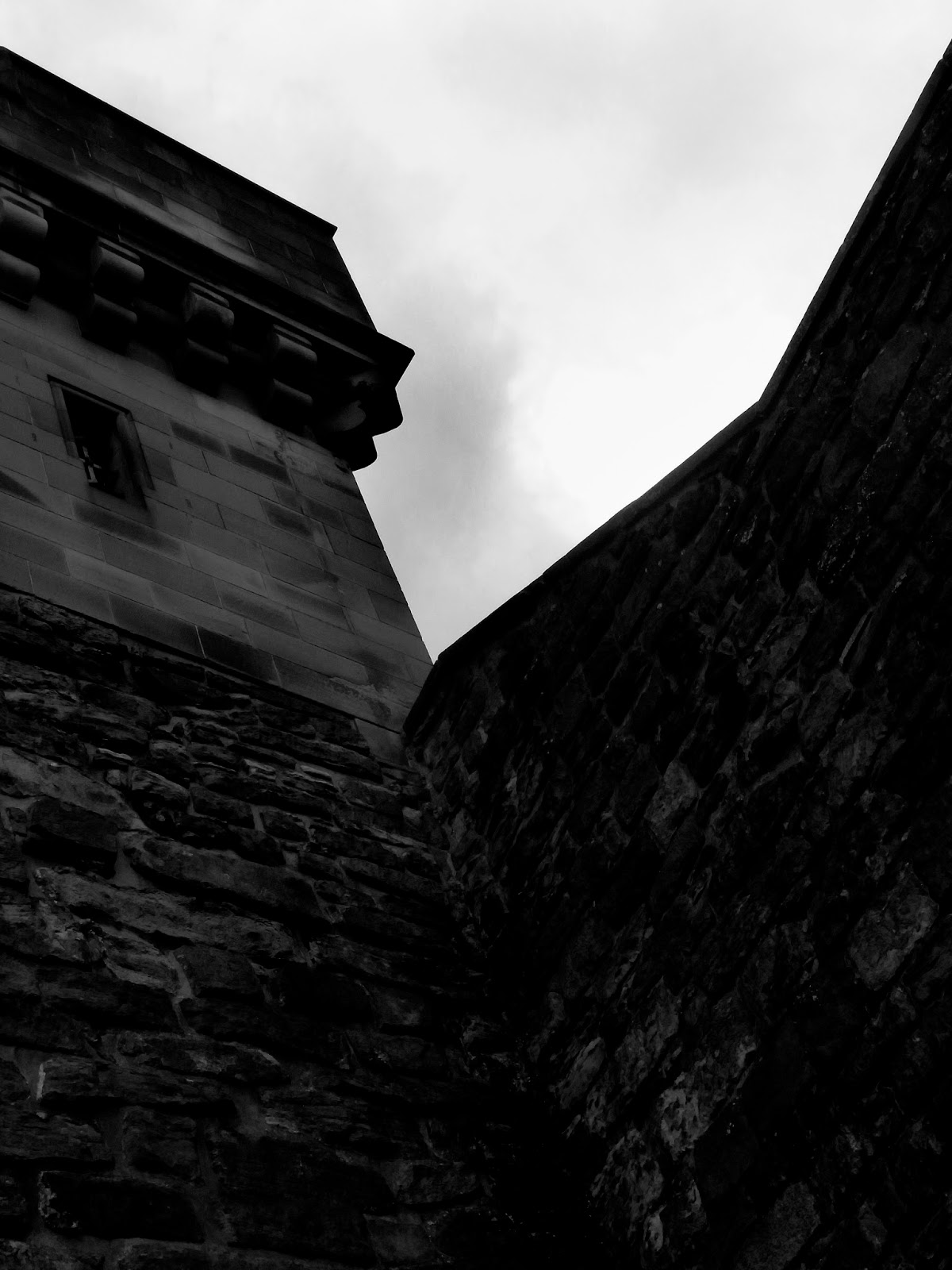
I enjoyed myself and I really enjoyed the architecture. It's a pretty large complex, the sort that brings to mind the epic 'Gormenghast' of  Mervyn Peake, but less malevolent in architecture, yet with the slopes of the hill up to the crag all covered in old stone buildings, some more Gothic than others. I took so many photographs while I was there, but many of them ended up relegated to my discard pile. I hope you enjoy the exterior photographs here - later I will display some of the colour interior photographs. I think the autumnal grey of the weather just made the place seem colder and learning its conflict-ridden history just makes it seem a place full of the blood and sweat of warriors and soldiers from centuries past. The stones are greyed and the sky is greyer; monochrome photography seemed fitting. 

Wednesday, 8 October 2014

Edinburgh City Part 5: The Hub and its Spire

This really is a fabulous building. I was walking up the hill to the castle and could not help but be stopped, transfixed in awe at it. I was already running behind schedule for the day (with my mission being photographing the castle thoroughly to produce a display for the school) but still had to stop and take pictures. 

I have a fondness for setting spires diagonally.

When I went on the ::history:: page of The Hub's ::website::, and read that it was a collaboration between James Gillespie Graham (who designed St, Mary's Catholic Cathedral, featured yesterday) and the famous Augustus Welby Pugin (Think 'Palace of Westminster') and I was both delighted and not entirely surprised. Everything about this building is wondrous, and the more recent conversion and restoration have been done most tastefully and include the work of a lot of modern crafters of great skill. 

A sense of verticality.
Photo taken after castle visit, hence duller sky.

It's dominating spire and wonderfully vertical architecture draws one to look upwards to he heavens and even on a cloudy, awful and drizzly day like the day I was there, it is beautiful. The page says the spire is the highest point in central Edinbugh, but after walking uphill into the castle and looking up at some of its towers, they certainly seem higher up, even if they are shorter towers. I am not a surveyor, though, and appearances can be deceiving. 

The sky was white with cloud, but weirdly bright.

The Hub is currently a venue associated with the Edinbugh International Festival (an arts festival) and includes a cafe. When I was there, the entrance was lit by flaming torches flickering in the wind (it certainly gets breezy on that hill, even if all the buildings make it look less exposed) and a piper was standing by the door. The next time I go to Edinburgh, it will certainly be somewhere I will have to visit the interior of, rather than just walk past.

At least the clouds were vaguely interesting here.

I'd like to visit this building again when the weather is more conducive to good photographs. The skies are dull and white here because they were dull and greying white with cloud on the day. It was also a rather windswept day. A calmer day with more varied and interesting clouds would be preferable. 

Tuesday, 7 October 2014

Edinburgh City Part 4: Pictures of Us

St. Giles' Cathedral is in Parliament Square in Edinburgh, and I was posing in Parliament Square, trying to get the beautiful Gothic (and it is original Gothic, not Gothic Revival) architecture of the cathedral in the background. 


I was going for a classic Lolita look, just in black, with my Baby, The Stars Shine Bright dress, a velvet blazer and two different cameo necklaces. The fingerless lace gloves were so that I could fiddle with the camera and keep my fingers warm at the same time, and the head-dress is a rosette style one by Alice And The Pirates. The waist-ties are undone on the dress because I didn't find out until after I had gone out just how uncomfortable it was to have them tied under my blazer!


Both of these photographs above are by K., just taken on my camera. I did the re-touching afterwards. The following two photographs are of K. by me. I'm usually the one wearing Goth, and she's usually the one wearing Lolita, but for a change that was swapped that day. I think K. is the better photographer! 

The next time I go to Edinburgh (and there has to be a next time!) I will have to take some proper photographs of St. Giles' cathedral - especially the famous lantern spire. There are several other beautiful churches and other buildings on the Royal Mile that deserve photographing too. I was in Edinburgh for only 2 days and took so many photographs as it was - another trip with more photography time would be even more productive, although I think I would have to be much pickier with my photographs and write my blogs as a travelogue; I have written four blog entries about my Edinburgh travels already, and that's before getting as far as the castle!


Many thanks have to be given to K. for letting me stay in her apartment in Edinburgh, for being an excellent tour-guide, and for helping me out when I lost things and thought I would not be able to get home. She is a fabulous host and very kind. 

Monday, 6 October 2014

Edinburgh City Part 3: St. Mary's Catholic Cathedral

A Cathedral for a Sunday

Old residential style buildings are visible on the right.

I was actually on my way to take a short-cut through a shopping mall, being lead by K. to the castle, and insisted we stop so I could photograph some of the architecture around the road junction as I could see this Cathedral, something that looked like a very fancy Gothic Revival church in a late Gothic, almost Tudor style, converted into a restaurant called the Glass Box by the use of much modern glass and steel, and another church with towers done as open lanterns (which I took a photograph of that as at the end of this entry), and a few other interesting things.

Rock doves, I think, perched on an artificial cliff...

Edinburgh city has an over-abundance of glorious architecture. I tried to take as many photographs as I could, but I simply did not have time to photograph everything I saw that was interesting. Much of the beautiful architecture is Gothic and Gothic Revival - my two favourite styles, especially in their more elaborate variations. This is not the fanciest building in Edinburgh by any means, but it was fancy enough to catch my attention - as were several in the immediate vicinity. I will have to go back there and take more photographs because with cars and pedestrians and buses and lorries all getting between me and good photographs the last time, a trip on a quieter day is in order. I do hope to go back to Edinburgh because I only had chance to explore a small fraction of the city, and I didn't get to go on any ghost tours, nor visit the dungeons, nor visit any cemeteries or necropoli (and most cities for the living have their cities for the dead). 


Some lovely Gothic grandeur for an entrance. 

The sign at the right of the entrance relates some of this building's history (although with photographs taken at that distance it is quite unreadable here) and says, among many other things, that it was built in 1814 and designed by the architect James Gillespie Graham, and that it had originally been surrounded by residential buildings to keep it tucked away from anti-Catholic vandals, rather than the being in broad view at a busy road junction as it is now. I guess trying to remain hidden to a degree is why it has no tall spire or tower. I did not go into the Cathedral, being an apostate that left Christianity for Neo-Paganism, and feeling somewhat awkward actually in places of Christian worship. I always feel like however beautiful it is, it is sacred to someone else's God, and I don't belong there. 


Lovely lantern towers on a church I spotted across the road
 from the cathedral. Not sure which church, though.


Edinburgh has so many beautiful buildings that I could probably stay there a month and not photograph all of them. I hope my readers don't mind how much I am posting in the way of architectural photography. October is going to be a picture-heavy month, and Gothic and Gothic Revival architecture is going to feature quite prominently. 

One of the fascinating things about cities is how much history every single building and square foot of land has - even newer buildings are often built over older buildings, and in some places you get catacombs as buildings are built over the cellars and sub-basements in increasing levels, with the newest buildings not always having access to their own cellars, I would not be surprised if this is not the case in some parts of Edinburgh; I certainly went to enough buildings where because of topography and various extensions, what is ground floor in one place would be basement to another in the same building - "upper ground floor" and "lower ground floor" being common stops on lifts! I know London has 'lost' underground buildings, some being branches now disconnected of the London Underground Railway, some of them cellars detached from their parent buildings, and some of them parts of old sewerage and drainage systems, and Paris is famous for its catacombs, but I don't know about Edinburgh. If any Edinburgh readers can shed light on this (pardon the pun) then I would be very interested.