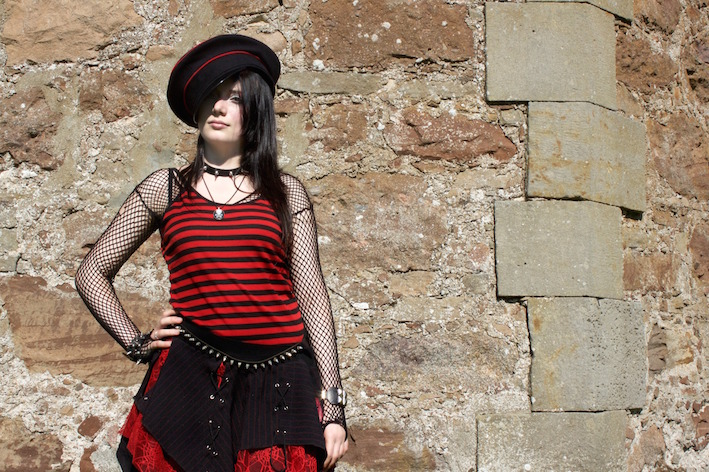
Goth has often, in recent years, been divided into 'subcategories', and some of them relate to fashion taxonomies - descriptions of what kinds of clothes someone wears - but I think that some of them are more than that. I will open with saying that this is just my opinion on the matter; it is not absolute fact, and this is based off my personal experiences with the scene rather than any concrete research. Whether or not there actually are subcategories, and whether there should be, has been a topic I've seen debated recently, so I thought I'd break down how I have observed this playing out.
The first question is, however, are they all more than just fashion styles?
For some people, of course, they are all just fashions, different ways of aesthetically expressing their Goth tastes, and they might dress Trad Goth one day, and Romantic the next, choosing outfits based on the events they're going to, or their mood that day, and they like a lot of different styles of Goth fashion, and those fashion styles might not reflect anything of what aspects of Goth culture they're into at all. There are, of course, plenty of Goths that are into a an eclectic collection of non-fashion aspects of Goth, too, and there are those that switch their aesthetics to express all of those aspects in turn. However, I think in many cases the fashion taxonomy reflects more than just what clothes they felt like wearing that day, but reflects visually what aspects of Goth culture they are into.
For some people, of course, they are all just fashions, different ways of aesthetically expressing their Goth tastes, and they might dress Trad Goth one day, and Romantic the next, choosing outfits based on the events they're going to, or their mood that day, and they like a lot of different styles of Goth fashion, and those fashion styles might not reflect anything of what aspects of Goth culture they're into at all. There are, of course, plenty of Goths that are into a an eclectic collection of non-fashion aspects of Goth, too, and there are those that switch their aesthetics to express all of those aspects in turn. However, I think in many cases the fashion taxonomy reflects more than just what clothes they felt like wearing that day, but reflects visually what aspects of Goth culture they are into.
I will have to say I am a little biased in this case - I identify as a Romantic Goth, and was into Romanticism before I was into Goth, and am firmly based in Romanticism, Sturm-und-Drang, Gothic Revivalism, and other related artistic and literary movements such as Gothic Literature, the Pre-Raphaelites, etc. I came to the Gothic before I came to Goth, and my fashion reflects my interests [I wrote about why I wear Romantic Goth ::here:: a few years back, and while my situation has changed since then, my fashion is similar]. I am also the sort of Goth that loves the atmospheric and ethereal branches of darkwave: music like Dead Can Dance, The Cocteau Twins, Sopor Æternus and the Ensemble of Shadows, and This Mortal Coil - plus a lot of classical music of the atmospheric and passionate sort! I have an extensive collection of Requiem Masses, my favourite being Faure's... [I have written about my love of choral music ::here:: ] My interests lean towards the Romantic and the Gothic and I spend a lot of time in nature, seeking an experience of the wilder, more awesome places of our planet, I find my peace and quiet in graveyards [why I spend so much time in them is something I wrote about ::here::] or wandering around ancient ruins and decrepit castles. My engagement with Goth is primarily with its Gothic and Romantic aspects in the art-history sense of the word. For me, 'Romantic Goth' is describing far more than my fashion taxonomy; it's describing my mindset, the literature I read, the music I listen to, and generally the perspective from which I interact with the subculture.
I know, however, that the plural of anecdote is not data, and that my own life is just the experiences of only one person - however, it does at least seem that this is often a more general phenomenon, and that people describing themselves as a 'Trad Goth' and a 'Romantic Goth' as more than a description for their outfit of the day is a valid description. I'm sure it's something that could probably be actually studied, but I've enough work to do figuring out how to attach a water-tower to an eco-friendly moveable classroom for my uni project, and I'm not a sociologist, so all I am going on are my experiences and my observations, so I'm not presenting this as any sort of definitive truth on the matter (and I'm fully up for debating this).
When the (controversial, and originally intended as humorous!) ::'Goth Stereotypes':: (which I am mentioning because a lot of people feel like these pseudo-infographics inspired a generation of younger Goths to start labelling or even pigeon-holing themselves) by Megan Balanck at Black Waterfall (and I think originally on DeviantArt) were written, they all included a lot more than just what clothes were worn; they included interests, attitude and music - even if they aren't necessarily accurate, and with the graphics being deliberate stereotypes, they are intentionally narrow. The 'stereotypes' described also include a lot hybridisation and diversion from what seems to play out in real life - according to them, I'm a mixture of Victorian, Romantic, Medieval, Vampire and Faerie! The stereotypes Megan Balanck wrote and drew were intended as more than just fashion taxonomy, and this came about for a reason - there really are people who are more into some aspects of Goth culture than others, and for a good few people, what aspects they are into form a fairly cohesive set of related interests. I'm not going to say that her stereotypes are definitive categories or necessarily accurately reflect how subcategories work in my observation of the scene, however, because I could critique them.
The Subcategories of Goth
From what I have observed in the scene, there is often more to these labels than just clothes; these are the subcategories which are about which aspects of the subculture you primarily engage with, what sort of attitude to Goth you have, and perhaps what sorts of music you listen to, too. To be a subcategory of Goth, something has to originate from, and stay within that which is Goth - the music, attitudes, the aesthetics which in combination make Goth, and just be a direction from which those things are approached or an alignment of which things within Goth someone likes, and it has to be more than just an aesthetic.
Romantic Goth is definitely a nice black parasol under which many adjectives gather; we're the ones that, like my little self-description includes, are interested in a more Romantic aspect of Goth; we like the Gothic - we're often the ones reading 18thC Gothic novels, appreciating ruins and cemeteries, and combining morbid fascination with a touch of decadence, and living a life of rich experience, and thoroughly appreciating things. We tend to like the memento mori lockets, the gravestones with rich symbolism; we're the ones who go through the bother of having an absinthe fountain with the glasses and spoons, or drink red-wine from elaborate goblets; we're the ones fantasising about living in a period home that's something like 'Crimson Peak'...
Trad Goths. People who call themselves Trad Goths, or are referred to as so by others tend to be very music focused, especially following the original '80s bands, and the subsequent musicians that work with a very '80s post-punk, cold wave or similar sound, having more of a focus on club culture, and also coming with a distinct fashion style, as I described above. A lot of Trad Goths seem a bit closer to Goth's punk roots in their fashion - more spikes, more Post-Punk music where the sound is closer to Punk, and sometimes more of an attitude of rebellion, or at leat defiance of the norms imposed.
J-Goth or Japanese Goth is certainly its own subcategory, too. Non-Japanese J-Goths tend to be into more of contemporary Japanese culture and the Japanese take on Goth than only wearing the street-styles, and often have an interest in anime and manga - especially those with darker, Gothic and morbid themes - and also Japanese bands that either have a Gothic aesthetic with a metal sound or are outright Goth bands from Japan. There's obviously Goths in Japan, and they invented this; they've been doing Goth with their own twist for decades, as Goth is always a subculture and Japan has its own culture to be the 'parent' culture, and through cross-cultural pollination (for example Westerners reading 'Fruits' 'Gothic Lolita Bible' and seeing blogs from East Asian and Japanese Goths, reading manga or seeing anime with Japanese takes on the Gothic, as well as Goths physically travelling) it has spread to influence Goths outside of Japan. There are other things, however that don't seem, in my opinion reasonable as a sub-category.
Deathrock is something I am not sure whether to classify as a subcategory of Goth or its own thing. It formed America in a parallel evolution to Goth forming in the UK, and is closer to its punk roots. I am not familiar enough with Deathrock to classify it - I don't know whether, like J-Goth, it is a geographically based approach to the same core thing as Goth, or whether it is a separate entity, and I think such a classification is probably better made by someone more familiar with it than I am.
Some things get categorised as 'subcategories' of Goth, when they're not. Some of them, like Emo, are other subcultures, and some, like Cyber-Goth, are hybrids, and others are just aesthetic descriptions.
Other Subcultures
There are a few subcultures that often get mixed up with Goth. Rivetheads (fans of Industrial music), Steampunks, Metalheads and Emos are all members of separate subcultures, and while many of those subcultures have cultural and aesthetic similarities, they are distinct entities unto themselves, and not subcategories of Goth.
Goth-Hybrids
Some kind of thing aren't really a subcategory of Goth itself, they're more what happens when elements of Goth is hybridised with elements of a different subculture.
Vampire fan(g)dom Goths are pretty common, and there is significant overlap between passionate fans of all things vampiric and Goth, but there is a vampire fandom subculture that is its own thing, and members of it who aren't Goths. Most Goths (but not all!) seem to like vampires in varying degrees, but not all of them partake in the fandom as a subculture/community. Going for a 'vampire' lifestyle such as having a coffin to use as a bed, getting permanent fangs as veneers or implants/crowns, wearing theatrical contact lenses everyday, and even being nocturnal are not things all Goths do, and they are also things that some non-Goth members of the vampire fandom/subculture do.
Cyber-Goth is a hybrid of Industrial, Rave and Goth and probably actually owes far more to the Industrial music subculture than the Goth subculture.
Gothic Lolita is a hybridisation of Goth and Lolita, and often just Gothic fashion and Lolita, as while there are plenty of Gothic Lolitas that are also interested in the rest of Goth culture, there are also plenty who are only interested in it as a wardrobe option and are themselves primarily Lolitas or into other forms of J-fashion. Goth culture is certainly pretty strong in Japan, and there is a local cultural difference in how Goth is in Japan, but Gothic Lolita isn't 'Japanese Goth'; that is a different thing, and while designers like Mana of Moi-Meme-Moitie are both, and there is definitely a blurry area of overlap, they are still different things.
Goth-Metalheads are those, like my partner Raven, and several members of my local scene who like both Metal and Goth, and often especially like Symphonic Metal bands that go for Gothic imagery and lyrical content, or the genres of metal that borrow from Goth rock musically. There's a lot of aesthetic similarity between the two subcultures, and lot of overlap in terms of subject matter for lyrical content, so it's no surprise that a lot of people like both.
Hippie-Goth is a hybridisation of Hippie and Goth, not a subcategory of Goth; these are often people whose musical tastes are a lot more diverse and include folk, psychedellia, stoner rock, prog-rock, etc. as well as Goth genres, and whose interests are equally a mixture of both.
Gothabilly, Psychobilly, etc. all seem to be more about a mixture of Rockabilly and Goth, sometimes with other influences, and are again more hybrid than subcategory. It is something else that I don't have much experience with either, so for those who do, feel free to educate me.
In my opinion, hybridisation is great for Goth is it introduces ideas from other subcultures into Goth and keeps things fresh and interesting. I know some people see it as 'diluting', but the thing is that as long as the core of Goth remains strong, it can be mixed with as many things as imaginable without vanishing; the only time things become muddy is when things are improperly labeled so it becomes unclear where things have come from, and in what direction they are going. One does not have to be subculturally 'monogamous' - you can be interested in more than one thing without it being somehow disloyal to either subculture, or being somehow not truly part of either.
Fashion Taxonomy
Some things are probably just a fashion taxonomy, and are primarily an aesthetic rather than a reflection of how a person approaches the subculture, and therefore aren't subcategories, but aesthetic desciptions:
Victorian Goth, Medieval Goth (or any other specific period). I would say that 'Victorian Goth' is a fashion taxonomy (one often misused to refer to people in historical attire from other periods, too!), and for the people themselves, "historically inspired" or "anachronistic" would be a better description than only 'Victorian', as most of the Goths I know that like Victoriana and the 19thC are also interested in other periods of history, and that historically-minded Goths tend to have interests that overlap, and like mixing periods as well as sometimes going quite intently with historically accurate period garb and re-enactment. You also get people whose period is not Victorian, but also not Medieval - they like, for example, the Baroque, the Georgian, the Belle Epoque or Regency. There are also historically minded Goths whose culture or interests aren't European; I've seen pictures of Japanese Goths who dress in the mourning clothes of their culture with sombre black mofuku kimono with the only adornment being the silver of the family crests, rather than the veils and crepe and black gown of Victorian mourning. I would also see it as related to Romantic Goth rather than necessarily a completely new 'sub category'.
Nu-Goth seems to be both worn by hipsters who just like the aesthetic, and regular Goths seeking a more modern and minimalist aesthetic - perhaps a little more practical and comfortable for the day-to-day. It seems to mostly describe fashion, and while some associate it with 'Witch House' music, I'm not sure if this is really apt, as I haven't seen that connection play out in practice.
Pastel-Goth is an aesthetic, and while some people who wear it are into Goth culture and the contrast between the sweet, cute things and the dark, macabre iconography (and this is something that has existed in Goth for a while; '90s kindergoth used it in a 'ruined innocence' aesthetic, and I've met plenty of Goths over the years who like cute things as well as dark things, plus the influences of Emily Autumn, Tim Burton and Kerli have all brought aspects of cuteness, cartoonishness, childishness and pastel colours to the Goth aesthetic, as has the influence of Adora Batbrat), some people just like it as an aesthetic with no connection to Goth culture; they're just into 'creepy-cute'. The fashion seems to be based of J-fashion/Japanese street styles like fairy-kei, and the mix of 'kawaii' and 'kowai' (cute and creepy), but as it's not something I am into, I can't really say if it's actually a subsection or hybrid of Japanese street fashion or not.
Ice-Goth/Reverse-Goth, or whatever else you want to call Goth in an inverse, all-white colour scheme. I think this has always been done, right since the '80s. Some people have always worn Goth in all-white instead of all-black. I'm pretty sure this just an aesthetic choice. It's a fun one, and I'm sewing an outfit like this right now, but I don't see it tying into any specific aspect or aspects of the subculture.
There are plenty of things that clearly are primarily an aesthetic based on perhaps a musician or a film - 'Burtonesque' as an aesthetic derived from the stop-motion animations of Tim Burton and his illustrataions, Emily Autumn's fans emulating her stage costumes with the white and crimson and stripes (she even sells tights or leggings based on her set designs, I think... I'm not a fan of hers, but I remember seeing something like this.), all the horns, purple and green being worn after the Maleficient film came out, etc.
One thing I'm not sure how to really classify is the witch aesthetic and the surrounding the current popularity of the intersection of the popularity of modern Witchcraft and Goth. While Nu-Goth could be linked to the 'occult trend' and perhaps Witch-house' music, I'd say that the popularity of all things 'witchy' is perhaps its own thing, rather an aspect of Nu-Goth. It's also referred to as the 'Occult Trend' and the fashion dominated by the use of white graphics taken from Neo-Paganism, Satanism and the Occult and printed onto clothes, often black and of a fairly mainstream cut/design (hoodies, tank-tops, leggings), harnesses that form pentagrams, and silver jewellery with occult motifs. and while some people just co-opt the symbols for the aesthetic, a lot of people, especially young women and teenage girls, are getting into practising actual Witchcraft, which I think is good as long as they're respectful of the traditions they are entering. Some people who are into it also like Witch House' music, and I think it could be bordering on being its own thing, perhaps a subcategory, or perhaps a hybridisation of Goth and Witchcraft/Occult culture. There has always been a higher percentage of Goths interested in the occult than of the general population, too, and an embracing of occult, supernatural and witchcraft-relatd themes. With witchcraft and the occult being a central theme in a lot of recently popular television series and films, it appears to be having something of a trendy moment - similar to when The Craft came out! [I think that its more commercialised aspects, and the aspects that play on how 'edgy' witchcraft is supposed to be according to popular misconception (but isn't) is mis-appropriative, as are those that try and conflate disparate religious traditions such as Wicca, Satanism, Hermeticism, etc. and plays into negative stereotypes that many Witches, Occultists, Wiccans and Neo-Pagans face, something I wrote about ::here:: ]
Now I've done what the subcategories might be, and what is not a subcategory, I'm going to tackle the other question, and probably the more important one. Are these categories limiting?
Don't Box Yourself In
The important thing is not to feel like you have to pick a specific category of Goth, and then limit yourself to what is in that category. I think you should not do that with Goth as a whole, either - you don't have to disavow anything that isn't jet black and spooky to be a Goth. Being a Goth, a subcultural hybrid, or a specific subcategory of Goth shouldn't come with any value judgement, either [something I wrote about ::here::]. These subcategories aren't concrete, they are just descriptions to either indicate what things you might like within Goth, or maybe for what your outfit is like. A lot of people are into a broad variety of different aspects of Goth, and that is great. Some of us happen to like certain aspects more than others, and that is also fine.
One of the things with the 'subcategories' is that some of them are rather heavily commercially marketed - the most recent trends of the occult trend, pastel Goth and nu-Goth have coincided with a real increase in marketing via social media - I'll admit that every sponsored post I do is part of that! - but it does mean that what hashtags and labels things are given has become even more important to those who are commercially minded when it relates to page views, search terms, and internet marketability. Sometimes this leads to people mislabelling things (just search "Goth" on any retail or auction platform and see how much Grunge, Metal, Emo and "celebrities dabbling with a dark aesthetic" turn up...) and sometimes it also leads to adjectives and descriptions appearing to be rigid concrete categories, and the appearance that these categories are essential, that everything needs to be labelled - but this isn't the case! The only reason they are labelled and tagged so much online is to make sure relevant items appear on people's feeds and search algorithms as intended; offline the labels are a lot less necessary.
These are also not concretely defined terms. There's often a lot of fuzziness as to how to categorise things, especially things that fit into more than one category or which borrow aesthetics, musical style, etc. from many sources. Most Goths tend to like things that can be described in a wide range of ways, and have at least some eclecticism to how they approach Goth. Even, I who self-identify as a Romantic Goth, like things outside of that, and also outside of Goth entirely (like the classical music!).
You do not need to pick a category, you do not need to fit a category, and it is far more important to be true to yourself than to be as Goth as possible, or as <insert specific type of Goth here> as possible. It is healthy - and good for the subculture- for us to be diverse people with diverse interests, and to not just be clone-like and striving to fit in to some social group as neatly as possible.