My personal blog as a 'grown-up' Goth and Romantic living in the Highlands of Scotland. I write about the places I go, the things I see and my thoughts on life as a Goth and the subculture, and things in the broader realm of the Gothic and darkly Romantic. Sometimes I write about music I like and sometimes I review things. This blog often includes architectural photography, graveyards and other images from the darker side of life.

Goth is not just about imitating each other, it is a creative movement and subculture that grew out of post-punk and is based on seeing beauty in the dark places of the world, the expression of that in Goth rock. It looks back to the various ways throughout history in which people have confronted and explored the macabre, the dark and the taboo, and as such I'm going to post about more than the just the standards of the subculture (Siouxsie, Sisters of Mercy, Bauhaus, et al) and look at things by people who might not consider themselves anything to do with the subculture, but have eyes for the dark places. The Gothic should not be limited by what is already within it; inspiration comes from all places, the key is to look with open eyes, listen carefully and think with an open mind..

Showing posts with label Scotland. Show all posts

Saturday, 23 June 2018

Cawdor Castle - 2017 Visit

Last year, Raven took me to Cawdor Castle for my birthday. I wanted to post about it nearer the time, but I lost my SD card with the photos I'd taken. I've been there ::before::, and the first time I was there, it was with the HTC smartphone that didn't have a good camera at all, no proper camera, and in dreary weather. This time, it was May, the weather was bright and sunny, and I made sure to bring a camera with me. Raven also took a lot of photographs while we were there, so there's plenty of photographs from him in this blog! If I find my SD card, I'll do a second post about this trip with my photos on it. I'm really grateful to Raven for letting me use his photographs; I'm really sad about having lost my SD card, especially as it had more than just Cawdor Castle on it. I took a LOT of photographs of the castle building itself, and I really wish they weren't lost.

Photos in this blog-post are in a carousel gallery - if you click on a photo, it will enlarge, and you can navigate between photos with the arrow keys. I've had a couple of messages about 'tiny pictures' so I thought I would clarify. 


Photo by Raven of me walking up to the castle
Cawdor Castle was initially built as a defensive castle in the 14thC by the Thanes of Cawdor. It's since become more of country mansion house with later, less defensible extensions, but it has a rich and interesting history. This time, we went inside the castle as well as seeing the grounds, paying the extra entrance fee, so I got to see more the castle and learn about the castle history - which is my favourite reason to visit castles! You can visit the official Cawdor Castle website ::here::

When I temporarily had blue hair!
Selfies by me. 
I went on the trip during the time I had ::temporarily blue hair::. I keep ending up with unintentional blue hair - I've currently got unintentional blue highlights in my black hair because the black dye is not quite as opaque as I imagined, and also doesn't adhere so well to where my hair was previously green. However, in this instance, my hair turned blue after I washed it, and had originally been green and purple. My current theory is that it's because I'd been using dandruff shampoo, and some ingredient in that caused it to wash out certain pigments from the dye, leaving the blue. 

The first thing I did at the castle was go and get a hot chocolate, and I think either a pain-au-chocolat or a savoury muffin - it's been over a year, I can't remember what I ate. I do remember that whatever it was, it was tasty! The hot chocolate was rather yummy, with frothy cream and marshmallows - a more luxurious hot drink than my usual tea as a birthday treat. 

My hair nearly matched the cup. Photo by Raven 

Photo by Raven, edits by me.
Once thoroughly refreshed, we went for a wander around the castle. Near the entrance to the cafe, I spotted this alcove. As well as looking out of the window at the castle grounds, and being impressed by the immense thickness of the walls, I persuaded Raven to take some aesthetic pictures of me.

The gatehouse has had to repel those who would attack the castle, so its sturdiness is not just for show. One of the daughters of the clan at Cawdor - 9th Thaness Muriel - was at the centre of a lot of clan dispute when as a teenager she was married off to Sir Campbell. It got very 'Game of Thrones' with battles, kidnaps, plots and Thaness Muriel surviving her husband, living 30 years longer than he did. (You can read about that ::here::, just scroll down to Muriel Calder). If you think the fiction of Macbeth is dramatic, then just look what was actually happening in Cawdor a few before Shakespeare.

I actually don't remember this part of the castle, but it's pretty
Photograph by Raven 
We went around the castle interior first. The castle is still lived in - by the current Lady Cawdor, so not all the rooms can be visited. There's a route through some of the castle that is opened up, with guides at various points who can be asked questions about the castle. I remember we bumped into some American tourists who were just as excited about the castle as I was (and who liked my outfit; I think I got called' Lady Macbeth' in a complimentary way.) and both they and I asked the guides plenty of questions. There was an older chap as a guide and he was incredibly knowledgeable about the castle. I perhaps asked too many questions, but I'm a glutton for knowledge.

Palantir-esque orb
Photo by Raven.
There are a lot of spherical ornaments in Cawdor Castle - I think this is an aesthetic choice of the current lady Cawdor, as she commissioned several of the spherical statues in the castle grounds, and it is by her desk that one of the larger stone/crystal orbs resides. Raven took a photograph of it (to the right, click to enlarge thumbnail image). There's also one in one of the visitable bedrooms that is in a stand that makes it look like Palantir from Middle Earth. There's also an ORIGINAL Charles Addams drawing which I got completely over excited about. I don't have a photograph of that. (Lady Cawdor's art collection is intriguing, and I have so many questions in my head from it!)

There's a really fabulous room, with a tree growing in it, and an adjoining 'secret' other room that had been walled up for a long time. I don't have a photograph of it - it's something I tried hard to photograph, and there might be pictures of it on my SD card, but in the meanwhile there's a picture of it on the ::Cawdor Castle website::, second one along, click to enlarge. The tree is part of a legend about the founding of the castle. The Thane of Cawdor, whose earlier medieval castle was not too far away, wanted to build a bigger and better, stronger fortification. He had a dream in which he was instructed to put a chest of gold upon a donkey's back, and then to follow it to where it lay, and build his castle there. He did this, and the donkey went to lie down under a hawthorne tree, which the castle was built around - the tree is still there, growing through the castle basement, protected as the family's prosperity is thought to be linked to the tree. I keep saying British history is very much like Game of Thrones, but in this case it's more like the Shannara Chronicles.

Historic Kitchen at Cawdor Castle, photo by Raven

Photo by Raven. 
Looking at the historic kitchen was interesting. All those copper pots and pans! It's intriguing to see what utensils they had then compared to now - some things I have no idea what their purpose is, some things that haven't changed much, and some things that seem obvious by their absence. What was even more interesting is that one of the last things you go through in the castle, once you've been through the historic kitchen, is the modern kitchen - presumably for when there are private functions (I'm going to guess Lady Cawdor doesn't let hundreds of visitors walk through the same kitchen her dinner is cooked in each night!).

I really like the recessed windows from an aesthetic perspective - I'm guessing they are small and in such deep alcoves because the kitchen is in the basement, and the castle needs really thick, sturdy walls at that level to hold up everything that is above it, especially as it was defensive. Small windows means less of a void in the wall, and less of a space someone could climb in through - however, wide alcoves means more light as light can enter the room from a variety of angles in relation to the window.  
Modern Kitchen at Cawdor Castle, photo by Raven

Photo by Raven.  Click to expand
In front of historic kitchen window
The comparison between the two definitely makes you think about how much the functional aspects of the castle have changed, and the expected requirements for a kitchen. As an architectural technologist, and one that would like to work on residential properties, things like the types of room that have been used for kitchens over the centuries is something that interests me - for example, the historic kitchen is long and linear, almost in a basement, and with the well in the room, (Not visible in the photograph, Raven would have had his back to it when he took this picture) whereas the modern kitchen is in a much squarer room, and a storey up from this kitchen (I think? It's hard to judge when the various phases of the building aren't all on the same set of levels) - both rooms are relatively bright, with lots of white, but the modern kitchen seems much airier, even though it has dark wooden panelling - perhaps because the ceilings are much higher (high enough to be out of shot!). It's also interesting to note the HUGE copper canopy for the extract fans in the modern kitchen - no such thing centuries back, so it would have been much steamier to work in! 

Raven's really into cooking, so I think he also found the two kitchens quite interesting.


Maze with minotaur (left) and castle (right). Photograph by Raven.
There's a hedge maze (or labyrinth?) at Cawdor, but when we were there, it was closed to visitors because the roots of the shrubbery needed to recover from repetitive trampling. However, it was visible from outside, as was the mythologically suitable minotaur in the centre!

Formal gardens, before their peak, in a cloudy moment. Photo by Raven.

Walking with parasol
Photograph by Dave
After we looked around the castle as much as we could, we then went out to the grounds. Last time I went to Cawdor Castle gardens, we walked mostly through the woodland walk area and didn't go through all of the gardens, but this time we went to the gardens. In the Highlands, early May is more springtime than summer, so the gardens aren't as green and luscious as they probably are in later months. I should probably actually go there around this time of year to best appreciate the gardens! That's not to say that there wasn't greenery - as there was, it's just that the trees, hedges and shrubbery weren't at their maximum foliage. 

The weather was quite bright - not hot, but warm enough that a lacy shrug was enough to keep away the chill. However, it was definitely bright enough for sunglasses and parasol (well, to me at least, but I think I have a low tolerance for bright light.) for most of the day. There were cloudier moments, too, but when the sun came out again it was really quite bright.

Spherical fountain, photograph by Raven. 
As mentioned before, there were several spherical garden statues/fountains at the ground. A really interesting one was made of shards of stacked glass, but I lost the photographs I took of that. The stone sphere fountain in the photograph was made by a Japanese sculptor, and there was a matching crescent moon shaped statue - I think the fountain represents the sun. It's an interesting mixture of modern art and a historical castle and grounds. I think the natural stones helps keep the fountain fitting to the site. 

Pond opposite ticket booth/entrance. Photograph by Raven
Cawdor Castle has two main areas of laid out gardens, and then plenty of grounds, wooded and more pastoral, beyond that. There is a lovely pond near the drive and ticket booth, which Raven photographed. It looked most picturesque, a wonderful capture of springtime, especially with all the white tree blossoms. There are more ponds in the woodland area, but I didn't go there that time - they are also very pretty, especially when viewed from the wooden bridges. 

Photograph by Raven, edits/filters by me.
The last photo from the Castle is me sitting at a small picnic table near the ticket booth, I think having just finished a carton of apple juice or something, and discussing with Raven what the rest of our plans would be. For some reason, sitting there was probably the thing that stuck most clearly in my head. I think it was because I looked up at the new leaves on the tree above me, and the sun, which was quite bright, was glowing through them, so they seemed so incredibly vibrant, almost glass-like. It was later in the afternoon by that point, as we had spent a good few hours at Cawdor Castle, and I tweaked the colours in the photograph just a little to try and best capture what the light felt like when I was there. Sometimes you have to bend reality a little to capture what something feels like.
 

Raven and I together, phone pic by me. 
As far as birthdays go, I think last year's was one of the best. Sometimes a trip out is better than a party (especially if you're more introverted like me. I end up poking my phone at my own parties because I get 'peopled out'!). Going to Cawdor castle was Raven's treat, so I'm very thankful to him for taking me (even over a year on!). He took me out to dinner, too (which, just before, is when I took the selfie of us together - hence the different makeup and outfit). Raven is very much the romantic, and I'm eternally grateful to him for all these years together - as well as Birthday trips out!

Also, this blog would be much less aesthetically pleasing without his photographic talent! Not just this specific entry (which would just be a big wall of text about how much I like Cawdor Castle otherwise), but in general - he's taken so many of the photographs of me for this blog over the years, and they're always really flattering. I don't look half as good in my own selfies - let alone real life - as I do in Raven's pictures of me. He's got a knack for composition and posing that does well to minimise my many physical flaws and highlight my better features (so, less turkey neck, more cheekbones) and even manages to take pretty pictures of me when I'm not trying to pose (those probably turn out better; I pose awkwardly when I know I'm being photographed) 

Sunday, 23 July 2017

Spynie Palace Castle I: The Castle Ruins

On the May Bank Holiday (1st May), I went to Spynie Palace Castle with two local Goths and the lady behind ::Superstitchious::, who was there for a rather thorough photo-shoot of herself modelling a new gown design for her shop.  You can see the results of that photoshoot ::here::. While the others were working on the photo-shoot, I took the opportunity to explore the castle and learn a bit of history, and generally get rather excited about visiting such a fantastic ruin. As all my long-term readers will know, I love castles. This post is about the castle, I will do another one about the photoshoot, especially as I got photographed too. 

Spynie Palace Castle from the approaching driveway.
The first thing I will point out about the castle is its situation. It's on the edge of a hill, just past its crest - and not a particularly high hill - with a steep valley visible on the left of the image above (that curve just gets steeper!). That descent leads to a boggy wooded valley with streams snaking across it and lush ground-cover vegetation, and many hundreds of years ago was actually part of a firth, opening out into the greater Moray Firth near Elgin. The castle guarded a port, with parts of it not quite visible in this image that actually backed straight onto watery bits! However, since then land has both been artificially reclaimed, and the coastline has risen slightly. The whole of Northern Europe was weighed down during the last ice-age by the immense pressure of all those glaciers, and since then, northern places have slowly risen back up! Eventually the valley dried up entirely and is now woods and farmland and does not even remotely resemble an inlet, except for the boggy ground, and the river is now a stream. I am so used to places down in Southern England where the fens are getting wetter, the cliffs are washing out to sea (and ending up as sandbanks in continental Europe), and flood risks seem to be increasing, that for somewhere to dry up - especially in a climate as soggy as the Scottish one - is quite remarkable! 

Windows in windows
I can't resist an interesting window (my trips to ::Rait Castle:: and ::Wester Barevan Churchyard:: are testament to that!), and I especially can't resist one in a wall that tells a story like this. The hall it backed onto was repurposed and resized several times. The rectangular apertures of early windows frame both the smaller Gothic window on the left and the tiny rectangular window on the right. Walls like this - where repairs and alteration are even more evident in colour, as different sandstones were used - tell a story, they're a monument to architectural changes - changes in status, purpose, taste and style. Rectangular windows are Baronial, but this was a Bishop's palace, and Gothic arches are ecclesiastical... 

A ruined wall with window-holes, tower in the background.
As is clear to see, the castle is in a state of ruin - the tower is still standing, but the rest of it just a collection of ruined walls, window apertures and earthworks. It was apparently rather magnificent in its time, but the waterway dried up, the castle lost its purpose, and eventually it fell into disrepair and then disarray. A roof was put back on the tower to try and halt the process of disintegration, but apparently it caused more problems than it solved and was removed. In some countries, apparently ruined castles get rebuilt, and the (very helpful) information guide was telling me that some tourists complain that the castle hasn't been rebuilt - but I can see the reasoning behind leaving it as a carefully preserved ruin rather than rebuilding. 

I have a window obsession.
Photos through windows will always be one of my favourite types of architectural photograph. In this case, I was using the bright spring sky to make the form of the window the focus, with the second thing of interest being the ruined stone wall through which it cuts, and the patch of haze - I think more a camera artefact that any actual dusty or misty air - I need to clean my lens! I think this window has ended up looking Gothic in both the terms of it being a pointed arch window (see the first black and white image) and it having an eerie, almost supernatural quality to it in this picture. I think this is one of my favourite photographs from the trip. 

Ruined wall re-imagined as craggy cliff
The picture came about as I saw the tree behind the wall, and was given the idea of the wall as a craggy cliff, now that it is rubbly and jagged, with stones jutting out at dramatic angles. I liked that part of the wall was dressed and neat, and that part was rough and irregular, and waited for the light to catch it just right. I just wish the sky had been a little bit more dramatic, but this isn't the end of the universe. 

This blog may contain excessive levels of fenestration.
This is an alcove in what was - I think - a hall or a chapel. I sadly didn't have enough money to buy a guide book, and my search on the internet for a legible floor-plan of the castle hasn't really worked out. There's a nicely visible corbel up in the top left corner, which would have supported a sturdy roof beam. I imagine this part of the castle would have been quite splendid in its heyday. I also like how this image shows the contrast between smooth facing stones, and the more uneven stones on the interior of a wall. 

A very tall wall

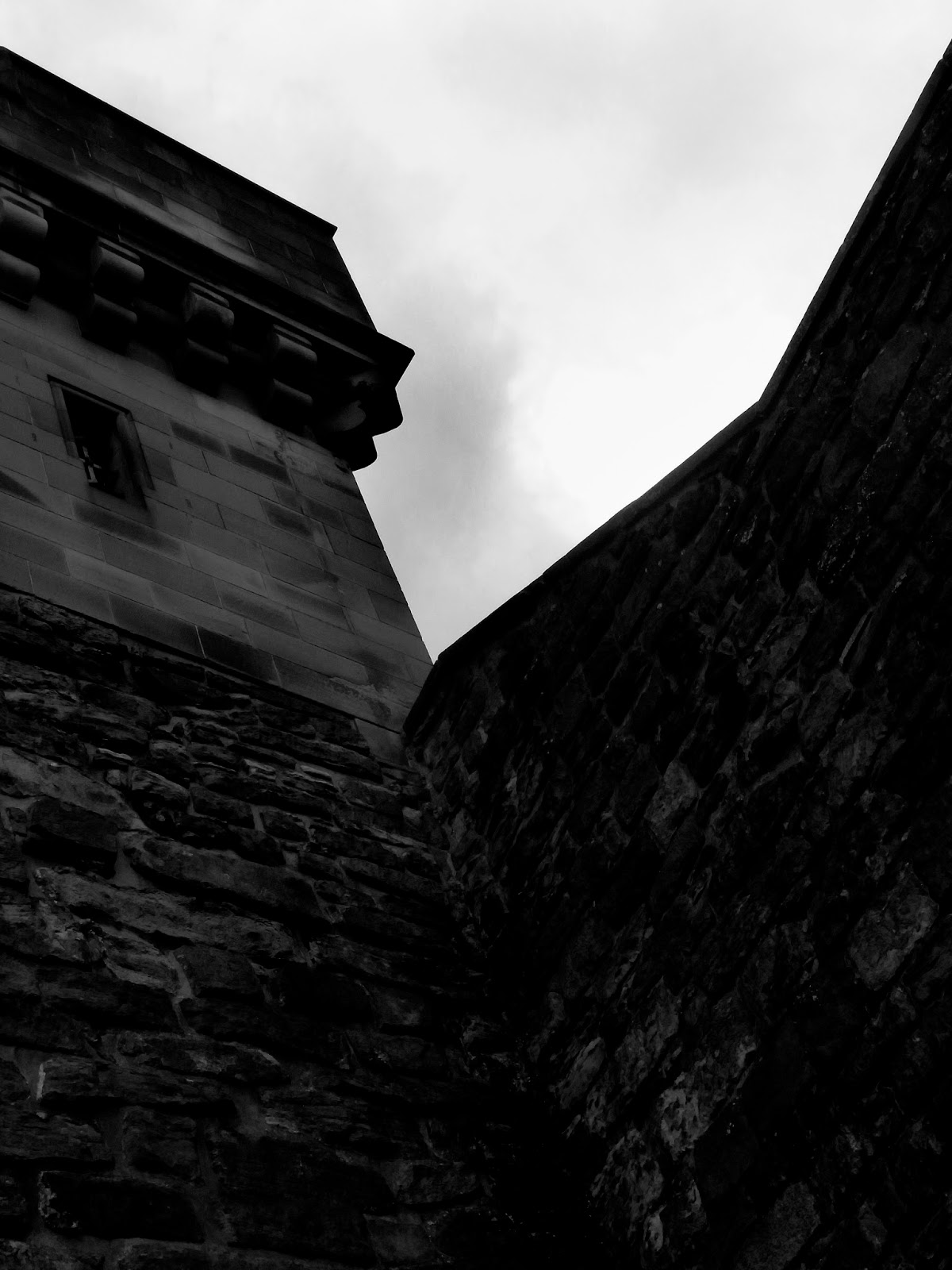
This is a picture I took to emphasise the verticality. I'm a rural sort of person, and the castle tower is still a legitimately tall building to me! It would probably be quite tall if transported to the city of Inverness, if in comparison to other buildings there - even their tower-blocks are 7 ordinary floors in height, and the hospital 7 extra-height floors with an 8th level of rooms on the roof for services, and this castle is 6 floors above the basement, and then the remains of a roof-space which is another storey, making it quite a tall building even for the modern Highlands. Obviously, quite short if you live in a city with skyscrapers, or even just lots of buildings taller than 10 storeys. (I think I would find actually being in somewhere like New York or Shanghai with lots of tall buildings quite strange! I found myself quite daunted by the taller buildings of Glasgow...)

Interior of tower, with light through window reflecting off floor. 

The interior of the tower has been partially restored. I think the patches of white stuff are the remains of lime plastering, and look quite stark against the darker stone. When I've been in castles that are still inhabited, the interiors are often plastered, as are the interiors of many old churches, and the idea that everything was bare stone in the past is something of a misunderstanding - yes, not all spaces were plastered, and yes, a lot of historical remains are no longer plastered, but a lot were. It is like how many old English churches are lime-washed white inside, but many centuries ago, before the Reformation and subsequent move towards Protestantism, they were just as brightly painted as many European churches, and many columns and stone elements that weren't plastered were also painted. 

For a change it's a staircase, and not a window!

The picture above is looking back up the stairs that descend into some sort of underground cellar (or possibly dungeon!) beneath the castle. It is a round room, with a domed roof, which I tried desperately to photographs, but I didn't have a tripod or stand, the floor was too uneven to rest the camera upon, and the light-levels necessitated a long exposure... I have a picture that's the least blurry of my efforts, but I'm not sure it warrants being here, nevertheless, the construction method was hypnotically concentric and fascinating, so I have included it as a thumbnail to the side. Anyway, this was the light reflecting off the stone walls, and I thought it really rather interesting. There were lights in the subterranean room, hence why the floor is visible, but it was still quite dingy - but at least it was out of the wind! 

Alley to the dried valley.
This alley goes down to a gate, which originally opened out towards where inlet was - I imagine there were once wooden piers or docking areas beyond it, but they are long, long gone. I wish I had taken a photograph that did a better job of demonstrating the three-dimensionality of the other walls and spaces around the alley, but I didn't quite manage. I really wish I could better convey the complexity of the castle spaces, and how the remains still show where rooms and levels once were. 

Tree above the wall 
Another photograph that shows how ruined the castle has become, and which shows corbels where beams sat and where alcoves and apertures once were. I find it really interesting to look at old buildings and look at how the remains infer what else used to be there. I try and visualise where the floors once were, what sort of doors they once had, whether the windows were glazed, and if so were they just lead-lights, or maybe stained glass? I wonder how tall walls originally were, and what the roof was like - looking for slots and corbels for where beams once rested, wondering about what I can figure out from the spacing, and what's left of any gable ends


I will finish on another window. Windows are liminal things, between in the indoors and the outdoors, and I find them very interesting. It's a poetic sentiment about perspective that drives my frequent photography of window apertures - thoughts on our viewing things, and the nature of space that I guess are probably a little too much like the architectural-theoretical discourses I read, and which I feel a little overly-abstracted in my thinking, and do wonder if it comes over as pretentious. Perhaps it's enough to just say I like windows! 

Friday, 17 July 2015

Urquhart Castle

I have visited Urquhart Castle several times. One February a few years ago Raven and I went there on Valentine's Day - for an engagement photo-shoot for another couple, where Raven was photographer! This time however, Raven and I were there for an afternoon out together, and I took my camera. The weather was windy, with heavy rain coming in - just perfect for atmospheric photographs!

I know I am rather overdue with these pictures. We went to Urquhart Castle in early April, and it is now late July. Between now and then I have been incredibly busy (hence the blog hiatus) and I am only going to get busier over the next few months. Blogging is only a hobby for me, and I have quite a few offline commitments that have to take priority. There are quite a few photographs here, and I hope those who have been waiting enjoy them. 

Urquhart Castle on the banks of Loch Ness. Photograph by HouseCat

Urquhart Castle is on the banks of Loch Ness - supposed home of the famous cryptid - and beneath the mountains. Geographically, it is in a stunning location, a place of incredible natural beauty. Strategically, it guarded the loch and the pass beneath the mountains.  In its glory days it would have been a vast compound - more of a walled town or village than a fortified house. It is in ruins because it was deliberately destroyed by its owners, Hanoverians who, after being beseiged by Jacobites once, decided it was better to blow up their own castle than let such a strategic point fall into Jacobite occupation. If I owned a castle, I don't think I could ever contemplate anything as drastic as blowing part of it up, regardless of strategic necessity!.  They began by blowing up only the gatehouse, but this was the beginning of structural decline for the castle, as even when peace came, it was never repaired, but instead was quarried for stone (as was common for ruined castles in times past - it happened to Rait Castle, Wallingford Castle, etc. etc.) 

Craghy ruins. Photograph by the HouseCat.

Of course, ruins become picturesque as nature begins to reclaim them - especially the ruins of structures once grand and beautiful themselves. I, a true Romantic, am drawn to windswept crags and ruined castles (apparently, I am in the good company of Neil Gaiman in these tastes!), and even when swarmed with tourists, Urquhart Castle loses none of its majesty and presence. The ruins stand upon great earthworks - sculpted out of hard ground - and this unnatural landscape, once practical and now alien, gives an eerie quality to the place. The remains of buildings perch on arteficial ridges, above deep defensive ditches gouged out of the earth. I did read about whether the moat held water while I was there, but can no longer remember; if it did, the castle would have seem even more isolated, turned into its own island fortress like Eileann Donan Castle, or Le Mont-Saint-Michel.

Ruined wall with arrow slit. Photograph by HouseCat

The castle walls are now partly reclaimed by the landscape, seeming to almost be a geological feature in places, a crag or cliff with grass growing out of it and rough escarpments of boulders. There is enough remaining masonry for it to be built by the hand of man, but it is slowly blending into the Earth with time. ::Historic Scotland:: are doing a brilliant job of maintaining and preserving it as best as is humanly possible, but it is stone exposed to the scourging winds, rain, snow and frost of the Scottish climate - the elements and the centuries will take their toll; it is inevitable. 

A brooding sky. Photo by the HouseCat

That harsh Scottish weather that I mentioned made its presence felt the day of our visit. It started out bright, slightly over-cast but mostly sunny. There were fast-moving clouds on the horizon and a keen wind. As our visit progressed, the wind got harsher and colder, and the rain blew in with darkening clouds, leaden and grey. I did not get any good photographs of this (but Raven did), but the rain coming down the Loch was a sight to behold; a curtain of what seemed like almost opaque mist rapidly drawing towards us, lit by the afternoon sun, and shaded by thick clouds in bruise colours.

Best photograph of the rain I got. Photo by HouseCat

Before the rain came in, I took 111 photograph of Urquhart Castle - and a surprising number turned out relatively well. It was hard to pick favourites for this blog - I have the same problem I had with my photographs of Edinburgh Castle! There is something about exposed Scottish castles on bleak days that really compels me to try and capture a visual record - but no photograph I take really expresses what I feel when I am there and whatever flourishing words and purple prose I use to describe it also falls short. All I can say is to visit for yourself if you get the chance, preferably on a day where the weather is at least drizzling (this is Scotland, such days are frequent) and there are fewer tourists about (probably because it is raining). 


Raven stepping out of the shadows. Photo by HouseCat

Despite being a ruin, it is not a place of desolation; the landscape is too mountainous, too forrested. Even with the wind whipping at my jacket and trying to snag my hair out of my (velvet) bandana, it seemed like when the walls and roofs had been intact it would have been good shelter against even the worst of the Scottish weather - which includes flash floods and winds in excess of 100mph in lower areas and in excess of 150mph up on the mountains. The gable end of a hotel near here was blown down in a recent storm, but I doubt any such thing would happen to the walls of the castle; if it had not been for deliberate destruction of various sorts, I think the castle could easily be standing whole to this day, and what remains will probably remain for centuries more. 

Base of a round tower and a shard of wall, overlooking the waters of Loch Ness

I did stare down into the depths of Loch Ness, hoping for a glimpse of the fabled monster, but I saw nothing. Logic tells me that any plesiosaurs or similar creatures that may have lived within the loch aeons ago will be long dead, with no contemporary descendents swimming in the murky dark, but the poetic aspects of me want to believe that somewhere in the seemingly unfathomable depths, the creature or creatures lurk, feeding on the fish that swim alongside, and avoiding humans with their loud engines and bright lights. I bought my 3 year old neice a souvenir monster hat - it's too big for her head so she wears its sideways with the tail draped across one shoulder, and the head dipped down to the other. I bought her several books too - including 'Nessie Needs New Glasses' by A. K. Paterson, as it includes an introduction to Scottish places. I keep promising her that one day she and her mother will come visit me in Scotland and we can all go to ::Nessieland:: and wander around Loch Ness looking for 'Niseag' as she is called in Gaelic. 


Steep stone spiral staircase. Photo by HouseCat

One thing I will warn potential visitors about is that the stairwells are for the most part medieval - this means they are narrow and cramped, with steep stone. I don't know if they ever originally had hand-rails (there must have been medieval people who thought hand-rails were a good idea! It's just practical!) but currently they have rope for a hand-rail (as pictured). Flat shoes, and patience for others on the stairwells are a necessity. I have spacial awareness and co-ordination difficulties due to neurological issues, so I had to walk slowly as I find going down stairs difficult at the best of times (I have to literally watch where I put my feet, and to take my time), and the tuts and glares I got from people behind me were not exactly polite.

Another stairwell photo. Photograph by HouseCat

If you are ever visiting the British Isles, I seriously recommend coming to Scotland if you like castles. While England, Wales, Northern and Southern Ireland all have beautiful castles, of all the places I have visited and all the castles I have visited (including those I visited before I began blogging) Scotland has the most castles in dramatic locations - by lochs and up craggy mountains being relatively common places to find castles.

Inside part of the keep. Photograph by HouseCat

One of my favourite things about Urquhart Castle is that despite being a ruin, there is enough of the structure that is still safe and stable for people to be actually able to go inside, and they have partially restored it in a way that greatly facilitates this. It was nice to be a little bit out of the wind, and it is interesting to be in these spaces with reconstructed wooden ceilings/floors and such. It is certainly not restored to how it was; the castle is very much in a state of ruin. It is, however, restored enough to make a lot more of the castle safely accessible than it would be otherwise, and to get a sense of how the remaining parts of the castle worked as buildings, rather than as a tumble of protruding stones. 

Great edifice. Rear of the keep. Photograph by HouseCat

As those who read my blog well know, I am rather fond of castles, especially ruined ones. Urquhart is no exception to that, and its location makes it one of my favourites. I love the natural world and the beauty of wild scenery even more than I love historical architecture (and that really is saying something!) so to visit a castle in such an amazing location really is a treat for me. I really got quite carried away taking photographs while I was there, and if (no, when) I next visit, there will surely be plenty more. It is somewhere that does not seem exhaustable for interesting angles, and as the light changes, the interplay of shadows changes; the shadows walls cast on each other, the shadows in the textures of the stones, the sense of space and the way I try and capture that in a mere flat image - it fluctuates literally with the weather. 

This view deserved to be in full colour. Photograph by HouseCat

Scotland has beautiful geography, and so much history. I love living here, and I do not regret having moved to here from where I was in England. I am much happier here amongst mountains and ruined castles, and I think only Ireland compares for rugged natural beauty, and Wales for castles (Ireland has some nice castles too, but in having visited more Welsh ones, I am probably biased). England is not boring, but I am definitely a 'mountains' sort of person - like Neil Gaiman, I seek the windswept craggy places and their solitude. Most of the hills around Loch Ness are more rounded, but there are certainly craggy ones near there too. One day, I hope to visit Urquhart Castle when it has freshly snowed, nice and early so that snow is mostly undisturbed... that would be perfect. 

Wednesday, 11 February 2015

Autumn Road-Trip 2: Dulsie Bridge

While we were driving between locations, we took a detour to visit the Dulsie Bridge, as suggested by Suzy_Bugs. I really don't know much about its history. We parked up at a view point above it, and went for a stroll around the gorge-top path, and then to a little field with a fallen tree and some rather fabulous and almost fantastical mushrooms that the others took good photographs of, but which I took rather dire photographs of, so none of them are shown here. 

Dulsie Bridge. Photograph by Housecat


I think it's a very fantastical-looking location, something that could have been out of The Hobbit, or Lord Of The Rings, or maybe Game of Thrones (but the river would have to run red with blood for that set of books...). It is old, and it has been converted into a modern road bridge, but there is something both about the old stone bridge, and the deep gorge (which bears the marks of flooding quite a long way up the stone sides; I presume it runs VERY high with melt-water and rain in Spring!) with trees either side made me feel like I wasn't quite in the regular world, like I had either stepped back in time, or stepped sideways into a different world altogether, one more magical.


One of my favourite thing about old structures is how between a tendency towards materials such as local stone, and the blending actions of time, they seem to just fit naturally into the landscape. Part way through our visit, it began to rain again, and the skies grew grey with cloud. It wasn't the best conditions for photography, especially for someone who is inexperienced and unskilled like myself. I got a bit higher up the gorge, and tried to photograph along the river, but I was photographing through the trees beside me and I'm not sure how well that endeavour turned out. 

Dulsie Bridge, photograph by Housecat

Overlooking the gorge is the selections of large stones shown below - I do not know if they are a natural outcrop or the remains of a stone chambered tomb or cairn that has collapsed. Either way, they looked quite remarkable, and I had fun trying to deliberately give them fantastically vibrant colours, as if they were something from an illustrated fairytale. I'm not sure if it's really very successful; being colourful is not exactly my forte! 


Stones, photograph by HouseCat

I tried my best, and I think only the first photograph really worked. It's nice to have at least some mementos of visiting. If anyone knows more about the history of bridge, and why it is well known - other than it being rather picturesque - please feel free to inform me! More photographs from my road-trip will go up over the next few days. I visited quite a few places indeed, and I feel each one needs it's own blog post because a single post would be very long indeed - the same as when I visited Edinburgh or when I went to Rait Castle, Barevan Churchyard, etc. 


Thursday, 9 October 2014

Edinburgh City Part 6: Edinburgh Castle (Exterior)

PICTURE-HEAVY POST

One of the main reasons I went to Edinburgh was to photograph the castle. As Scotland's largest castle, and one of the more impressive, situated as it is on a rocky volcanic crag high above the city, looming over everything as a stony sentinel, it seemed the perfect subject for a display on castles for the Primary 4 class at the school I work at, and I personally adore castles and want any excuse to visit one. 

Looking left from the entrance bridge.
The guttering looks a bit like cannons.

Once at the castle itself, the city seems opened out all around, and just how high and isolated an outcrop the castle is seems very apparent. The views are amazing even on a dull and hazy day like the one of my visit. I am sure that on a clear and bright day that one would be able to see for many miles in any direction. I tried to take some photographs of the view, but they were mostly quite hard to make out, so none of them will go on the blog. 


Looking up from the entrance gate to the
Half Moon Battery, built for huge cannons.

So much of the rest of Edinburgh seems to have been built with at least some inspiration from the castle; all the castle-like details of the Scottish Baronial buildings that seem everywhere, the vistas that seemed planned to give you a good view of the castle, the gardens between Prince's Street and the railway that make the castle seem somehow separated from the city itself, etc. etc. Not many British cities still seem to have their old castle at their heart. Only Stirling, which also has its grand castle perched high above a steep rocky outcrop, seems to have some of this, but Edinburgh certainly seems built around its castle more than just geographically. Oxford, for example, still has its castle, but that castle has been swamped by the far grander buildings of the university and re-purposed so many times; it feels like it has been subsumed by its city.

Where the gates had once been underneath the Argyle Tower.

I took the photograph above because even before I read on a plaque that there had been many gates (five, if I remember rightly), the ribs in the vaulting made it clear that there had been defenses there before. I was surprised not to find holes of some sort to shoot down upon, or pour boiling liquids upon, invaders as I have seen this in other castles. Medieval warfare was grim, bloody and painful. Combined with the steep rocky crag the castle is built upon, the one main road up to the entrance, and the terracing that would make it so easy for archers or muskets to shoot down upon attackers, the castle is certainly not a structure that would have been easy to get into!

Looking up to what is now the castle shop!

Entry to the castle is not cheap. I think it cost me £16 just for myself. I then purchased a guide book, a few history books, post-cards and snacks all on top of that, making it quite an expensive visit. I am quite glad I had money saved up as otherwise I would not have ordinarily been able to afford such a trip. I think it is cheaper if you are a member of Historic Scotland - something I am seriously considering doing as I am quite fond of visiting historic sites (as visitors to my blog should know!). 

Staggered walls of castle shop.
Looking up at some clouds being interesting!

As I mentioned in yesterday's post, the weather was grim, bleak and windswept. The skies were grey, pale with wan sunlight and the wind made the day far chiller than the the day before, when it was sunny, warm and humid enough to have me nearly fainting. It was not the prettiest day for taking photographs; I prefer it when it is partially cloudy so that I get interesting contrast with the clouds, or at least when the clouds are being dramatic. The sky that day was dull, often quite flat, with the occasional interest of denser, darker and more leaden skies that came with unfulfilled promises of rain. Every now and again there was a slight break of blue through the cloud, but very little. 

Rear view of the shrine of the Scottish National War Memorial

One of the more recent buildings is the Scottish National War Memorial, built over what, if I remember rightly, had once been both a barracks and a church at different periods. I don't know how much of the architecture is 20thC and how much is an adaptation of older buildings, but I do know that it is a place of reverence and remembrance. Photographs are not permitted in the Shrine itself, to preserve the dignity and attitude of reverence, but I can say that it is both somber and beautiful, with the names of the war dead from all three branches of the military kept in a metal box designed to resemble the Ark of the Covenant. 

The archway, looking in from the approach.
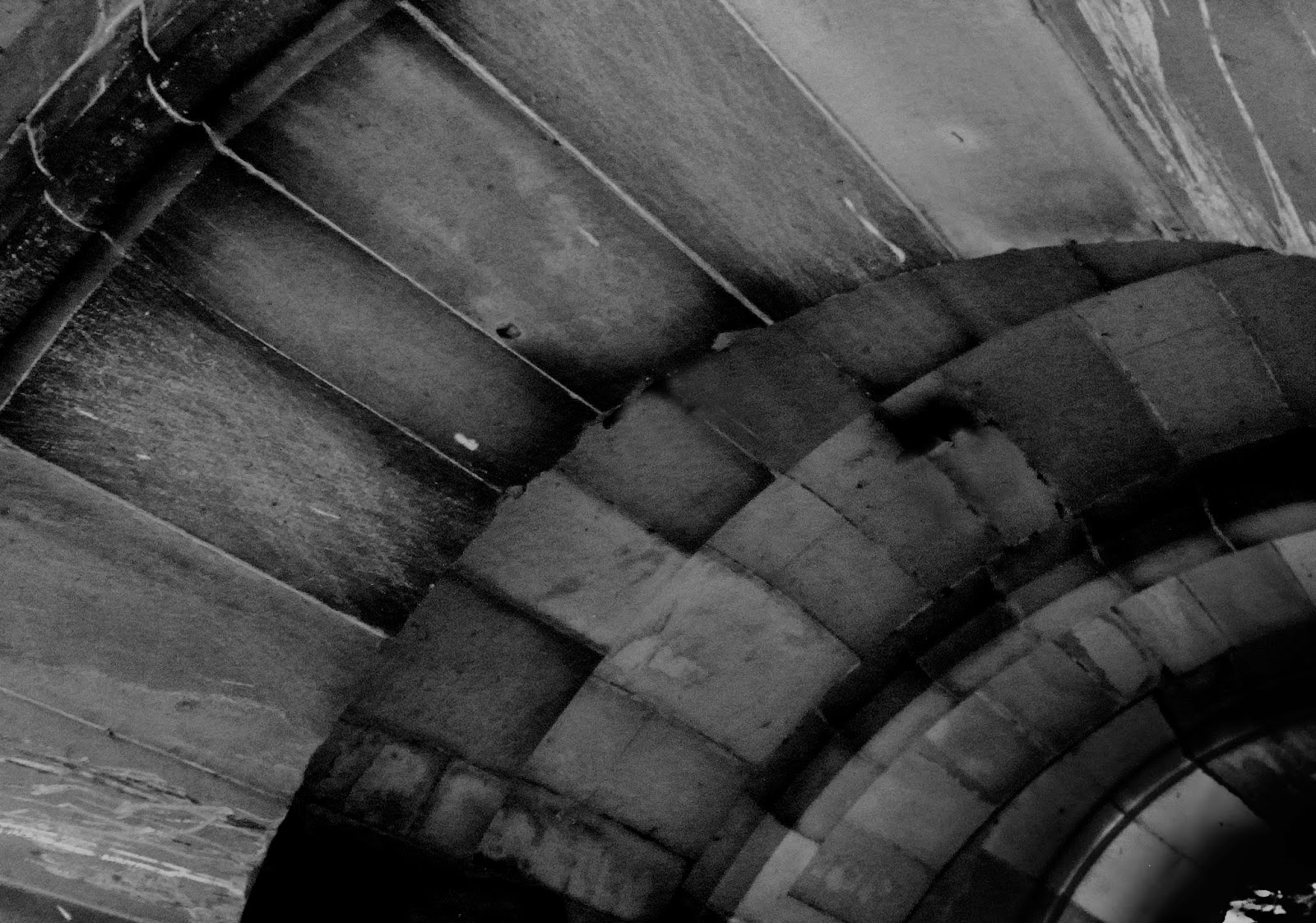
The shrine is accessed via the inner courtyard, and under this arch. I don't know if this arch is a structural brace between the two buildings, or if it is a walk-way for uses I cannot fathom, or part of a tall gate that once sequestered off this royal section of the castle. Anyone who can explain it to me has my gratitude if they do so. 

The same archway, this time looking outwards.

Through this archway, inwards, is a courtyard. The inner courtyard is called the Royal Square, and it is surrounded by the Great Hall, the Scottish National War Memorial, and the Royal Palace (which holds the Honours of Scotland; the nation's crown jewels, comprised of a rod, sceptre, crown and sword, and the Stone of Destiny). This was not quite as grand as I had imagined, but Edinburgh Castle, with all its military architecture, cannons and defensive location, was primarily a working fortress and not decadent palace. That's not to say the interiors are not sumptuous - I will post later another blog entry with some colour photographs of the interiors - just that I have been to fancier places. It was a dreary day when I was visiting, and it lent the castle interiors a dreary atmosphere, even with their warm simulated candles. I suppose with fewer visitors, more comforts and all the big stone fire-places containing a lit and roaring fire, it would seem a lot more cosy.


The Royal Palace. At four storeys and with a tower, it's quite tall.
I visited both the Royal Palace, some rooms of which are apparently still used for state functions (I can assume only small ones, though) and are finely wood paneled and luxurious. There's a lot of heraldry about the place - I guess that sort of decor was done to impress visitors (the nobles that once would have come, not present day visitors) with the long hereditary claim to the throne, especially as it was a rather contested throne.

Mary Queen of Scots gave birth in rooms in the older parts of the building, to the boy that later became King James VI of Scotland and I of England, and a few Kings later, Mary and William of Orange became King and Queen and it got complicated, Jacobites and Hanoverians fought over who would be King, and whether parliament could interfere in the succession and 'divine right of kings', quite literally with battles and suchlike, culminating in the Battle of Culloden (not to far from where I now live) in 1746. Politics then was more complicated than what you get in a George R.R. Martin book, and just as deadly, even if with fewer dragons.  The depute head at the school I work at has tried explaining the complexities of the Jacobite uprising to me, but I must admit I lose track of which factions were on which side, and why, and the complexities of fractioning Christian sects of the time that underpinned a lot of the conflict confuse me utterly. As with most conflicts, I am at a loss as to why all of it should have escalated as far as lead to murder, death and battle. 


I have forgotten exactly where this door is, but I think it is
an entrance into what is now the Visitor's Information Centre

Edinburgh Castle is on an ancient site, apparently used as some that could be fortified from as far back as the Iron Age, and still in use a while later, as Edinburgh is mentioned (as a large banner at the castle proclaims) in the Y Gododdin, some of the earliest Welsh poetry, as where warriors feasted for a year and a day before going off to die in battle. A quick hunt of the internet makes it seem an epic poem worth reading - in English translation for me, perhaps in modern Welsh for Raven. It's a lot of history; more than I could take in through only one visit; I'd have to read more books and visit a second time at least, to even start making sense of it all. A lot of the castle's history is military history as it was an army fortress for just about as long as Britain has had a proper army rather than just those called up to fight for local lords, and before that it was a fortification too. It's still a military place now, though now one of museums and offices, the annual Royal Military Tattoo (for those who don't know what that is, it's about marching bands, dance and pipers, not about getting inked!) and suchlike, rather than a working fortress. Military history is not really my area of interest (unless you count the 'Sharpe' novels by Bernard Cornwell. I'm pretty sure that does not count, though!)

I think this is the Argyle tower and junction with the top
of the Laing Stairs, but I am not entirely sure. 

I enjoyed myself and I really enjoyed the architecture. It's a pretty large complex, the sort that brings to mind the epic 'Gormenghast' of  Mervyn Peake, but less malevolent in architecture, yet with the slopes of the hill up to the crag all covered in old stone buildings, some more Gothic than others. I took so many photographs while I was there, but many of them ended up relegated to my discard pile. I hope you enjoy the exterior photographs here - later I will display some of the colour interior photographs. I think the autumnal grey of the weather just made the place seem colder and learning its conflict-ridden history just makes it seem a place full of the blood and sweat of warriors and soldiers from centuries past. The stones are greyed and the sky is greyer; monochrome photography seemed fitting.