My personal blog as a 'grown-up' Goth and Romantic living in the Highlands of Scotland. I write about the places I go, the things I see and my thoughts on life as a Goth and the subculture, and things in the broader realm of the Gothic and darkly Romantic. Sometimes I write about music I like and sometimes I review things. This blog often includes architectural photography, graveyards and other images from the darker side of life.

Goth is not just about imitating each other, it is a creative movement and subculture that grew out of post-punk and is based on seeing beauty in the dark places of the world, the expression of that in Goth rock. It looks back to the various ways throughout history in which people have confronted and explored the macabre, the dark and the taboo, and as such I'm going to post about more than the just the standards of the subculture (Siouxsie, Sisters of Mercy, Bauhaus, et al) and look at things by people who might not consider themselves anything to do with the subculture, but have eyes for the dark places. The Gothic should not be limited by what is already within it; inspiration comes from all places, the key is to look with open eyes, listen carefully and think with an open mind..

Showing posts with label churches. Show all posts

Sunday, 21 May 2017

Dundee City

For New Year's/Hogmanay, I went to stay with some friends in Dundee. I think it was either New Year's Day or 2nd January, but one of the days of the trip, Raven and I went for a wander around the city. There's a lot of very pretty architecture there, and an interesting cemetery in the city centre. Raven and I were on a quest to find a specific restaurant, so most of the pictures were just snapshots, and I didn't get a chance to look at what they actually were, and with this being exam season (and with me having been generally extremely busy with college this spring) so there's not my usual historical and architectural context.


Quiet Dundee Streets

The one place I have some context on is the Howff Burial Ground. It is urban, bordered on two sides by walls and roads, and on the other two by the rear walls - and windows - of tall Victorian buildings, including the former newspaper offices. There's a windowed tourelle on one of the old newspaper offices that seems to be firstly an afterthought, and both leaking and leaning precariously, which seemed expected - the whole cemetery seemed like a bubble within the city that was in a different time and a little bit like a different world. Even the trees there were tangled, winding and strangely shaped! The burial ground was originally part of the grounds of a Franciscan monastery, and I think the wall with the arches dates from 1601!

Tangle-wood tree

I don't know if this is is a specific species of tree that grows like this, or the result of some kind of pruning technique, but this tree just grew in knots and tangles and lumps and snags. I've never seen a tree like it, but there were at least two in Howff Cemetery. There were no leaves or flowers on it so I, who am no expert on trees, didn't even have that to go on to identify them.

It is possible to do a virtual cemetery tour if you look up 'The Howff' in Dundee, Scotland, on Google StreetView. Apparently it was uploaded by a Google user (a Kevin Reid) - I didn't even know that was possible! It looks like it was done with one of those 360° image cameras or something, as a series of "image spheres" at locations all around the cemetery paths. I don't know how you link to a specific place in Google StreetView, so I won't add the link here, but I do recommend looking it up. 

Neoclassical tower

Near the cemetery was this rather large and fancy Neoclassical building - I didn't catch what it actually was, as I was walking within the cemetery walls, not without, and didn't actually walk past the exterior of whatever it was to see a sign or anything. Whatever it is, it's a very ornate and grand building, and the light on that wintry day caught it beautifully. I looked it up on Google StreetView, and it looks like a concert hall or theatre. 

Church tower, one of a pair

I liked this church, but it was hard to get a god photograph of it because there is a bus stop right in front of it. It is on Panmore Street and has two of these towers and a charming rose window. I thought I'd take one of its 'witches' hat' roofed spire. I love the vents - possibly to help the sound of bells escape. 

McManus Galleries

I had a walk around the McManus Galleries - an amazing Gothic Revival building. I didn't get to go inside them as they were shut, but I took several photographs of the exterior. I would love to do a photo-shoot on the fabulous steps - I wonder if that could be arranged! I also think the steps - in Baroque swirling design - work really well with this otherwise very Gothic design. It's an altogether fabulous, magical-looking building... 

Steeple under rainy skies

This is the steeple on a rather interesting building. In the centre of Dundee is a building that, at first glance, would look like a cathedral. It is huge, old, and Gothic and very definitely the size and shape of the average cathedral. However, it is not a single-purpose building. It has been subdivided, and done so historically. There is the steeple, shown above, which I think is a municipally run clock tower, and at least two churches and a youth group using the rest of the building, with the spaces subdivided for these uses. Apparently subdividing the building became a necessity centuries ago, as there have been several serious fires in the building. The history of the site is very long with the earliest church on the site being from 1192 - a time-line of history of the building can be read ::here::. It's currently surrounded by a shopping mall!

The observant will have noticed that some of the photographs -specifically the ones of  buildings and monuments - are watermarked 'Architecturally Gothic'. This is one of the two Tumblr accounts I run. ::Architecturally Gothic:: is  my architectural photography Tumblr. It's mostly my own work, but I reblog a lot of other people's architectural photography too. 

Friday, 26 December 2014

Inverness Churches, Dark Skies and Winter Weather

These were taken before the Christmas holidays, when I was on my lunch-break from work, having taken the bus into town. I have a later lunch than most, so it was mid afternoon when I went for my break, and the weather was rolling in to get dark early - earlier than the roughly 3:30 time the sunsets seem to start in the depth of winter here. Inverness is surrounded by hills and mountains that significantly raise the horizon, meaning that the sun has far less distance to go to set, plus, for American readers, we're a wee bit further North than Sitka in Alaska (for comparison's sake) and to European readers, we're similar to Yaroslavl in Russia and a bit south of Gothenburg in Sweden! Anyway, the general result of the cloud and latitude and season was to create some rather atmospheric lighting and I took the opportunity to take these photographs in the city. 

Photograph by me. 

This is the Free Church of Scotland on Bank Street, as seen across the graveyard of the neighbouring Old High Church. I think this is the first photograph I have taken of it from this angle. The clouds rolling in are pretty dramatic in this photograph, and I think it best captures the weather. 


Photograph by me

I took a few photographs of the church tower from very similar angles that day. I read in the papers recently (I think it was the Inverness Courier...)  that the congregation can no longer afford the insurance, and that it may have to close. I think that would be a vey sad fate for what is a very beautiful and very old building. I hope that their fundraising goes well. 


Here is the same building again, this time in colour, and from an almost identical angle. I think in colour the low sun is more visible, and the warm reds of the masonry. It's a lovely, lovely old church and has been a city landmark for centuries - I really do hope it manages to get funding both to remain open and keep the building in good repair. I am not Christian, but I do appreciate good architecture, and I do appreciate the role the various churches have in the community locally (I know that they run a lot of local charitable ventures, and are linked to the food-bank, etc.), so things like the possible closure of this church make me sad. 

Sunday, 31 August 2014

Music That Inspires: Choral Music

This is such a broad topic! I've found it very hard to narrow it down to one aspect for this blog, as music is something that permeates my life. Back when my I still had headphones for my iPod, it was something that was pretty much a constant in my life. I studied it up to A Level and play several instruments, and I sing. When I am particularly strapped for cash, I perform as a street musician (a busker) in Inverness with my recorders  and I am very glad to have a talent (turned into something useful by all the hard work and music lessons and the 6hr-a-day practice schedule when I was a teen) that can earn my keep if necessary. 

I also have milder synaesthesia, and for me sounds tend to be accompanied by colours and 'textures' (I 'see' a lot of it as solidified light almost like glass) to the point where when I am composing, I tend to pick things that look good when I shut my eyes, because they invariably sound good too, and even wrote up an entire chart of chords by colours and what they invoke imaginatively to help me in my compositions. 

I didn't want to write about my tastes in stuff like Goth, Darkwave and French Coldwave because I'm pretty sure I've covered various aspects of that on my blog already. Beyond Goth, my tastes in music are quite broad. I thought I would focus on an aspect of my musical life that has inspired me as a Goth while being quite removed from Goth itself. 

I like early ecclesiastical sacred choral works from a variety of traditions, not limited to but including many things from Gregorian chant to Renaissance polyphony, to modern works such as those of John Taverner and Karl Jenkins. 

When I was younger and somewhere between my Christian roots and my Pagan faith, I was rather active in various church choirs and I have been singing from a very young age. I sang in both church choirs and school choirs, but as many of the schools I went to (I moved a lot) were Christian, I still sang mostly sacred music. I have not attended Church for worship service in years, and do not intend to as I am thoroughly Pagan now, but I still attend the occasional concert of sacred music.  Choir holds almost all positive memories for me. I got to a relatively high standard and ended up singing some challenging music in some really beautiful places. 

While the religious content was not always in alignment with my personal faith (and as I grew older, I grew further away from Christianity) there was something about it that connected with me on a very profound and spiritual way. I think there is definitely something spiritually powerful about religious singing, as an act of worship and an act of faith in itself rather than as simply a celebration thereof. There is a lot in the Bible about music, from David's lyre, to the songs of Solomon, to the angels who sing eternal praises in Heaven, and while this is heading off on a tangent that probably deserves its own post, I certainly think that Christianity and other religions that use sacred song (I have some CDs of Buddhist singing, from a period when I was interested in becoming Buddhist), and they have something very precious and definitely inspiring. A few years ago I tried writing some Pagan songs in a similar choral style, but suffered from a lack of people to sing them (I experimented with multi-tracking myself, but it come out very strange!) and so that project was put into indefinite stasis. 

The heavens my imagination transports me to might not be the one I envisioned when I believed in an afterlife in Paradise, but the music still has the power to supremely move me. It also always reminds me of the glorious Gothic architecture of the Chapels, Churches and Cathedrals I have attended for various things from Royal School of Church Music summer-schools at Magdalene College Chapel in Oxford (a building that is truly glorious) to St. Mary's Church on the bridge in Henley-on-Thames with it's Morris-esque murals and beautiful stained glass, to Peterborough Cathedral (which is Gothic on a truly vast scale!) and thus whenever I hear certain pieces I think of certain places and events.

It should be relatively apparent that historic architecture, especially that in the Gothic style, is something that I am really passionate about. With early Gothic literature, the term came about because of the use of settings, and how a lot of those settings were the sorts of buildings I love. To me, I cannot easily separate my experience of those buildings from the music performed in them, the music I performed in them as part of a choir. 

I have a specific fondness for requiems (how stereotypically Gothic of me!) especially the later ones. Later requiems were written more as concert pieces than to be sung at requiem masses, but they are still based around religious texts and sentiments, and as such I'd like to mention a few here. Fauré's requiem with its serene , and is also one of my favourites, then Verdi's with its furious Dies Irae, and Mozart's as well (and the wonderfully Gothic story written about it for the film Amadeus! It's not true, and Sallieri was not driven by obsessive jealousy to murder Mozart by working him to death, but it's a very good story!). I also like Vittoria's 'Missa Pro Defunctis" and "Officium Defunctorum" - his "mass for the dead" and "offices for the dead", the latter of which I heard sung by The Sixteen back in 2006 in Reading. It was  one of those moments when, despite struggling with depression at the time, I managed to unlock the glass box it felt my head was in, and be lost in the music rather than my own thoughts. 

Choral music of various Christian traditions has inspired both my own musical life as a choral singer (I even ran a choir at the school I work at until my chronic illness made in untenable) and also as an artist and poet and photographer as glorious music mixes with beautiful colour and light in a synaesthesic mix in my head, and always evokes a sense of wonder, sacredness and a belief that there is a Divine and glorious presence in the universe, even if to me the heavens are the literal heavens of space full of stars, nebulae and very real glorious light, and to me, a pantheist, the Divine is inherently manifest through reality. When I shut my eyes and sit on the bare earth and feel the boundaries between what is me and what is everything else dissolve and meditate, there's a similar sense of awesome, brilliant, glorious something that I touched when I was singing psalms, evensongs, hymns, masses and oratorios. 

My Musical Pick
There is some overlap with my tastes in more Goth music; some of my favourite pieces by Dead Can Dance are the ones where multi-tracking has been used to create a choral effect, but the songs they sing have words of Lisa Gerrard's glossolalia rather the Latin texts various masses and offices. I think that same sense of light and glory that is forever intangible that I got when listening to choral concerts in Oxford collegiate chapels and grand Gothic cathedrals is what inspired Host of The Seraphim with its vocals that seem to soar ever upwards in plaintive chant over a very minimal (electric?) organ and distant strings. It reminds me of how psalms are traditionally sung with the chords changing according to the text, rather than the text made to fit the melody (think Alleghri's 'Miserere mei, Deus'). To me, Host of the Seraphim is like watching angels come and go, filing past out of view and into nothing but beautiful light. 

Saturday, 25 August 2012

Arches, Tracery and Details

❝Architecture on a Saturday?
What is this heresy? 
Photographs are for Fridays!

<evil villain> 
You all thought you'd escaped Photographic Friday's usual bunch of architecture pictures, didn't you? You thought that I'd be content with Raven's lovely pictures of me (lovely because he's a good photographer, not because I'm a lovely model) and that there would be no spires, steeples, turrets, arches, or other architectural photographs of any kind, and that you were safe from my photographic obsession with buildings. 
Wrong!
Bwahahahahaha!
 </evil villain>

Out in the sunshine with a camera and a corset.
Photograph by Suzy_Bugs

Now, over the last week or so, I have not actually been out to photograph buildings, but spending a lot of time indoors. This is for two practical reasons. The first is that I physically am not up to walking around a lot. Last Thursday (yep, actually last Thursday) it was really rather hot out, and I fainted in the heat, landed awkwardly, bruised my hip, sprained my ankle and bruised my knee badly. Normally I would say this is minor damage and carry on as per usual, but I work on my feet and cannot afford to take days sick. I made the mistake of trying to carry on as per normal, with Roller Derby on Monday night and walking my daily 14 to 15 mile commute on the Tuesday, but by Tuesday evening my ankle was so sore that I was using my cane and not shuffling far from the sofa! As such, I thought it best to avoid too much unnecessary walking, so my photographic activities have been curtailed. The second reason is that I have been focusing my efforts on illustrations for a book. This is paid work, valuable to me, so it must take priority. 

I didn't have to digitally straighten this one!

That said, I did dig out a few pictures from a previous trip. These are all (I think all) of St. Mary's Catholic church on Huntly Street, in Inverness, on the opposite side of the river from the churches I usually photograph. It is an unusual church building, and a very beautiful and ornate one. From the website, I gather it has beautiful stained glass windows, including some wonderful modern pieces commemorating local historical figures and ties with the Polish community in Inverness, but I do not want to be disrespectful by photographing inside the church, especially as I am not Catholic (even if I once was, maybe because I once was.). 

Dramatic skies ahoy!

Trying to get a half decent angle that takes in a large portion of the building was a real challenge - one I think may best be answered from the other side of the river! The picture above is from an angle suggested by Raven, as he was being a very helpful photography coach for me.  The sky was mostly a dull sort of cloudy that day (hence why the direct photograph has such a dull sky above it) but it had a moment of drama, and I took the opportunity. This is my favourite photograph from this little expedition, and in my uneducated opinion, the best. 

Open tracery

The front of the building is designed to maximise grandeur, with the church recessed from street level and connected to the equally ornate ecclesiastical buildings either side with angled walls that create a bit of false perspective and also draw the visitor in towards the church door. It does not appear, in terms of size, to compete with the Protestant churches of various denominations on the opposite side (Free Church, Church of Scotland, etc.)  although I do not know how far back it goes, and it does not posses a tall and imposing steeple. It does, however, manage to cram as much ornament as physically possible into a relatively compact space. It is a Victorian Gothic Revival building in a city full of Victorian Gothic Revival buildings, and I do wonder if the architects involved got a bit competitive. 

Fleur de Lis design. 

Even the floor tiles are fancy! This tile is made with two different clays, rather than being painted, a terracotta red for the design on a creamy-coloured background. Tiles have been produced in this manner and in similar designs for hundreds of years - the Victorians didn't just emulate their Medieval inspiration, the reproduced its craftsmanship. Now, where can I get some of these for my hall-way... 

The cement render behind the gate is in pretty ruin.

I want some of my pictures to have a sense of narrative, a sense that they are part of a story. I like taking pictures that have doorways, paths, arches, passageways - things that give a sense of how the building is something that can be walked through, not just detail on a flat plane, and also I want there to be a bit of mystery. I'd like people to wonder, as I do, what lies behind the gates, around the columns and down the passageways. Whenever I played games like Tomb Raider or Assassin's Creed or Prince of Persia, it was always exploring the nooks, clambering on buildings and generally being curious that intrigued me, more so sometimes than finishing the level! I have this sort of attitude towards real life, except with the limitation that there are places I am not allowed to go and apparently clambering on the buildings is frowned upon (not that this stopped me at boarding school...). 

I have a feeling this is part of another church.

Sometimes it's just the shapes, the patterns, the textures, things less directly 'building' that catch my eye. Hopefully, as my legs (especially that ankle!) recover, I shall be out and about taking more pictures. Maybe there will even be variety as I find something other than buildings and monuments to photograph. Either that or I will eventually produce a comprehensive guide to twiddly buildings in the Highlands. I am hoping to get some castle photos taken; Cawdor Castle, Inverness Castle, Brodie Castle, etc. etc. Lots of castles around here, including the fabulous Eilean Donan Castle (my correspondents will recognise that one from the multitude of postcards I send), so it that sort of project could keep me occupied for a while. 


Friday, 20 July 2012

Spires, Skies and Shadows

More From The High Church Graveyard
I keep going back there, and each time I spot something else that intrigues me, something I did not capture the previous time. It seems that whenever I think I have exhausted it of material worth photographing, that something else catches my eye. Today was a trip out with the "proper camera", which is a Canon 300D, and Suzy of ::Suzy Bugs:: let me borrow some of her lenses, for a bit more experimentation. 

Shiny different lens to play with meant that I could take pictures of details up on the roof of the neighbouring church, which as they are rather pretty (especially the spire) became the focus of my little expedition. I did not actually take that many pictures of the graveyard itself. 
If Vertical Was Going To Be Impossible,
Diagonal Would Have To Do!
The spire is reasonably high on the Free Church North (at some point I will have to find out exactly how high, but it is definitely one of the taller spires in the area) and getting a shot in full of it with the lenses to hand was going to be impossible. (I have taken a photograph encompassing the whole church,  but on a different day, with a different lens) so I decided to focus on various points that interested me. 

Dramatic Clouds
Sometimes it is more the clouds than the architecture, or the combination of clouds and architecture. I think a plain blue sky is, while sunny, quite dull, and much prefer some interest in the form of clouds to balance out the image. Today it was blue skies and patchy white clouds, and these provided a lovely sky and a lot of nice shadows from the bright sunshine, which on the spire really gives a sense of the various facets of the octagonal roof. I love the pinnacles. 
Clouds Don't Always Appear When I Need Them
Clouds don't always appear where and when I need them, though! I took this photograph from reasonably close to the base of the steeple, but far enough back to get enough of a diagonal to have some sense of perspective. I tried taking a photograph really close to the base, but it did not really have the same effect. I really wanted to portray how high and imposing and solid the steeple is. As it does rise a way above the church, and is thin in relation to its height, it can seem rather elegant from a distance, but up close it is very solidly built, and for this picture I wanted to show some of that. 

Pinnacle or Steeple
This mini-steeple or pinnacle is part of some adjoining ecclesiastical buildings. It is much smaller than the steeple with spire (and for that matter, the spire) on the church itself, and I presume it is technically a pinnacle rather than a steeple, but I always think of pinnacles as the miniature spires decorating a full-sized spire, atop a steeple. If it protruded from a wall, I would call it a turret. At some point I will have to rat out that book of architectural terms that did rather well on historic architecture, but I think it is back in England, somewhere in my father's loft. Regardless of what it is, I love the details of the false slit windows and the arches that elaborate them. It is reminiscent of the towers on the spire, which also have arches and false-slit windows. I'm getting lost in pedantry. Whatever it is, I think it looks nice, which is why I took the photograph. 
A Rather Fancy Vent
This photograph was taken to capture the texture of the tiles and the lichen growing on them. I heard that lichen grows best in clean air, which is good news for the city of Inverness as the roof is covered with the stuff! I think the little white "light house" is actually a rather fancy cover for a vent. I love it when mundane things are made needlessly ornate, because why shouldn't functional things be beautiful too? If it were up to me, everything would be designed to be at least as beautiful as functional. Things need to be fully functional, of course, but beauty can still exceed that! 
Finally!
I managed to finally get a photograph of the roof of the Catholic church across the river that I actually like. The spire is quite short, wooden and painted red - rather different to the other buildings in the area. The ornate front door of the Catholic church faces away from the afternoon and evening sun, and with mountains behind, it is soon in rather dark shadow, which means it is usually rather awkward to photograph. Sometime in the near future I will have to visit during morning hours to get a good photograph of the front of the building because it is really quite something. 
You Can See Tiles!
This is the steeple on what is now the funeral home opposite the High Church on the other side of the river. I love the conical roof and the open columns. Unlike most of the other churchy buildings in the area, this one is not in the least bit Gothic in terms of architecture, but it is still rather fabulous. It is far more austere, which is quite fitting for a funeral home. I wonder if it was purpose built as such, or is a re-purposed church. 
Cobwebs!
I also got to play with Suzy's macro lens while she was busy using the other lens to photograph a rather large rabbit. It is these sorts of decorative details on the monuments that I love, especially when they are still crisp centuries later. 
The First Five Tries Weren't Even Sharp...

Tomorrow (Saturday) I will be at the Northern Meeting Park in Inverness, which is across the road from Eden Court, for the Inverness Highland Games  & Armed Forces Day. I will be there with owls and raptors. I will also have the point-and-shoot camera with me, so hopefully next week's photography slot will be themed on that building - quite a modern departure from this week's! 

Friday, 6 July 2012

Architecture, Statuary and Suchlike

I have been into Inverness taking photographs of buildings, details and in graveyards again.  As far as photography goes it is buildings, monuments and similar things that I prefer taking pictures of. I have a fondness for architecture stemming to my teenage years, having once aspired to being an architect. To me, my photographs are a form of appreciation of the buildings I admire. Inanimate objects that won't run away when I point a camera at them also provide good practice material. 

Suzy has lent me a nice Canon camera with proper manual settings to play with, but it's big and heavy, not weatherproof and I'm still not very confident using it, so for this trip I took my little pocket point-and-shoot camera as it fits in my handbag and I am not afraid to take it out in the rain. I really want to get more confident using the proper camera because when I have taken pictures with it, they are so much better than with the point-and-shoot because I can control the variables to favour the results I am aiming for, rather than have to put up with the automated choices that the point-and-shoot assumes are what I want (and rarely are). 
Pay attention to that storm...
As per usual I began my trip at the Old High Church, on Church St. (aptly named, it has several churches) and took pictures there. Whenever I go there I spot something else I want  to photograph that I did not spot on the previous occasion. Today it was the lamp-post at the top of the ridge overlooking the river that caught my eye. Behind it was a moody sky, and I wanted to capture that. That is indeed a typical Scottish summer sky; full of rain and thunder. I'm sure Noah accidentally wandered up here when he had to build that ark... 
Slightly less rainy.
I find dramatic rain-laden clouds the most interesting backgrounds, second only to sunsets. There is something fascinating about the contrast of the perpetually changing natural beauty of the weather and the static beauty of human artifice. In this picture I concentrated on the thick glass of the lantern portion and the way the clouds are distorted in it. Most of my pictures on this blog are set to black and white to fit the aesthetic of the blog, but here the colours have been kept as it conveys the atmosphere better with the colours retained, and the image is fairly grey anyway.
Grassy
Sometimes it is the smaller things I notice, such as these grass seeds by a grave, where the monument has sheltered the grass from the strimmer and it has grown long. Next time I try this I will try and angle myself so that the background is all church and graves as the grass was well-lit and the composition would have been better if it was the grass with its highlights against the darker blurred stone. There are all sorts of interesting natural things in graveyards. I tried taking a photograph of a spider in the stone folds of a monumental draped urn, but it scurried off at my invasion of its privacy. 
Carved on a headstone.
The above image is a detail from a headstone. I tend to shy away from photographing headstones and actual grave markers in their entirety as to me they are personal things erected by family as memorials, but sometimes I photograph statuary and small details, trying to avoid the names and dates upon the stones. This stone is actually relatively old, 19thC in fact, but the carved vegetative design is still crisp, the narrow stems and the indentations in the flower still clearly visible and relatively unweathered despite the exposed position of the graveyard. 


I had a lot of fun wandering around the city and crossed the bridge to look for more buildings to and locations, in search of some variety. Inverness is a really interesting city, there are plenty of things to photograph. I have to explore  more of the Northern bank of the river and the city beyond.
Eden Court Theatre
It is not only Gothic Revival and other historic buildings that I enjoy photographing. This is Eden Court, a rather modern building. Eden Court was opened in April 1976. At the time, the design was strikingly modern, and to this day it is still striking and feels decidedly contemporary. It is a very angular building, but with interesting geometry - it is full of diagonals and not at all box-like. It is clad with a variety of textures and has a large amount of glass, making the building reasonably light indoors even with the notoriously dingy Scottish weather. When I first visited, I assumed the building was built in the last 10 years, not over 40 years ago. Eden Court is the only large performance venue in the region, with a very good variety of performances and exhibitions to attend. The building was designed by architects Law & Dunbar-Nasmith to house all types of performing arts from opera to drama and films (it is also a cinema and even shows art-house movies) to things like the HiEx comic convention.
Railings on an exterior stairwell.
Eden Court is a very interesting building. I think its strong lines, angular design and interesting textures, combined with a lot of interesting dark greys make it an interesting building for this blog, even if it is not Gothic, Perpendicular or Gothic Revival. Mind you, 20thC architecture has its links to the Gothic subculture too - after all, one of the seminal Goth bands is called 'Bauhaus'. Today I only took a few photographs of Eden Court, but I feel that it is one of these buildings that I will keep coming back to - expect to see more of it here on this blog. 
Architecture reflected in architecture
Sometimes the old and the new meet in clear contrast, such as the reflection of this Gothic Revival townhouse (I don't think it was built as a hotel or other non-residential building) caught in the polished surface of part of the cladding of Eden Court theatre, a building that, as you can see from previous photographs, is thoroughly modern. It is these sorts of little things that make me smile. Life is full of moments of unexpected beauty. 
Arch
I look for interesting architectural details wherever I go. This is an upper-floor arch between two curved turrets (the sort that are really stacked bay windows than actual turrets - towers, maybe) which have lovely "fantasy castle" conical roofs. This is part of the facade of the Palace Hotel, on the riverfront in central Inverness, across the bridge from most of the churches I photograph, on the road to the Cathedral and Eden Court. 
Arrogant Angel
Above is a rather arrogant looking angel I found nestled in a the concave nook of a corner. Its expression seems so haughty and condescending - not exactly suitable for an angel! I thought the attention to detail on the folds of its robes, the curls of its hair and the feathers of its wings were really quite exacting, so I wonder if the expression was the result of the mason making some sort of joke, and if the angel was modelled on a real person who exhibited such traits. It definitely seems to be looking down its nose at the humans walking around below it. 

Inverness has a truly vast cemetery at Tomnahurich. It has been used for centuries. I stayed over an hour there, on my first visit and only explored a small fraction of the graveyard. It is very leafy, and a good section of it on the hill is actually woodland. It has a variety of grave markers and monuments from the local Victorian-era style of grave-markers, to rather ornate graves, especially at the graves of families that had immigrated from Southern Europe, especially Italy. 
Hope, Faith and the Immortal Soul
The above figure is from a Victorian era grave, it is placed above the actual marker. The figure is an allegory of Hope, and the anchor represents the following passage from the Bible: "Which hope we have as an anchor of the soul, both sure and steadfast, and which entereth into that within the veil." (Hebrews 6:19), the five-pointed star on her brow is representative of the soul, and the hand across the heart a symbol of faith. The anchor itself echoes the cross with wreath in its design. There are actually quite a few figurative monuments and allegorical and religious statuary
Intriguing Statuary
This is part of a fabulous statue in a part of the cemetery where many Italian immigrant families are buried. It really intrigued me because I had never seen such a figure at a grave before. It is young woman down on one knee, barefoot in Neoclassical robes (and a Neoclassical style), with a scallop shaped bowl containing a cross with the iota-eta-sigma monogram resting at an angle in the bowl. Not only had I never seen such a statue at a grave, I had never seen such a statue at all. It would have been so useful had I taken a full-length picture of the statue rather than this bust. I asked Magdalena of ::Goth In Plain Sight:: who is rather knowledgeable in Christian iconography about it. It is a pilgrim to the shrine of Sant Iago. (Saint James.) There is a big shrine to him in Spain. The person buried there probably made the pilgrimage, or had some connection to the shrine. Maybe they were Spanish rather than Italian and that the area of the cemetery is bonded by common Catholicism rather than common location. 

Sunday, 5 February 2012

Graveyards, Buildings & A Competition

I have entered the raffle at Bethezda's Preoccupations for nail-polish and eye-shadows in glorious colours. It is ::here::. Part of the terms of entering the raffle is mentioning it on your own blog.

Earlier today I went to Inverness city, and visited several graveyards and churches and took quite a few photographs. I've been into the city before to take photographs of the architecture and suchlike and this post will be a conglomeration of the two visits. Next time I am there in good weather I may take more photographs. I am going to give location details within Inverness for these graveyards and statues so that if anyone is holidaying there or lives in the area and likes visiting graveyards and historical buildings then you can visit these ones. 


This is a mausoleum at the very old graveyard at the end of Academy Street in Inverness. It is in a far corner, over towards the main road, at the opposite side to the entrance, tucked in the corner backing against the Longman Road. I like this graveyard, it's gated and makes an idyll of tranquility in the middle of the city. It has some very, very old graves, dating back to at least the 1700s, some I think are even older. What I've noticed about the graves in Inverness is that they have unusual decorations, often incorporating skulls, bones, angels of death and other decided Gothic motifs. I really need to go back and take more pictures because many of the ones of said designs did not turn out very well. 

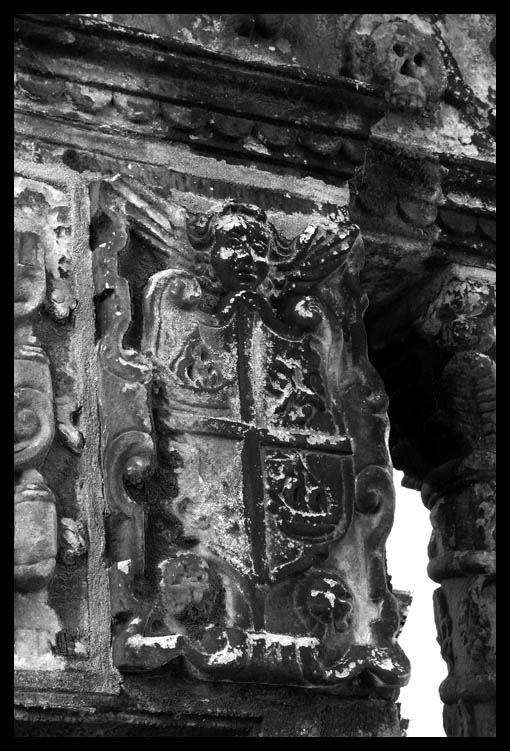
There's a sailing-ship on their crest

This is from the graveyard associated with The Old High Church, which is unsurprisingly on Church Street, near Bank Street. It is a church on a natural mound, higher than the other churches along the river - and there are a LOT of churches and chapels along the river. Most of them are gothic architecture, and the Catholic church on the opposite side o the river is especially ornate. By the time I'd walked to that church it was too dark to take good photos, sorry. I did try, but it was really rather dingy and I couldn't hold the camera still enough. Sorry. 


I did, however, get a picture of The Old High Church against a rather dramatic sky. I took a colour photo of this church that turned out well earlier this year, but I think I'll stick to photos in black and white, or at least in dark shades otherwise it will clash with the rest of the entry and the page design. It's hard to imagine, looking at it from this angle, that this is pretty central in the city and surrounded by other buildings!


This is a different church, along Bank Street. This is the Free Church of Scotland North. It has some of the fanciest architecture on Bank Street, and lots and lots of Gothic detailing - note the street lights aren't even of a modern design. I haven't ever been inside this church, maybe that should be my next project - although that will probably be sketches as many churches consider it disrespectful to take photographs inside, so unless I can find someone to ask and OK it with them first, I generally stick to drawing. I have noticed that it is best to wear more conservative (although not necessarily less Goth) clothes for church visiting. 


This is a hostel, and it is built over the alley into Lombard Street in the centre of town. I stood on one of the stone decorations/seats to take this photo above people's heads because below are shop fronts, and lots of people being people and therefore scruffy, mundane, with shopping bags from Primark and Currys and bad hair and that doesn't quite have the right atmosphere. A lot of people walk straight by buildings like this, maybe out of familiarity, maybe because they just don't realise how nice the stuff above eye-level can be. A lot of people walk around looking downwards. How they avoid bumping into people is beyond me. 


This is a rather nice building somewhere off across the Bridge Street/Young Street bridge... I actually can't remember where I was when I spotted this. Oops. Usually I've got an amazing memory for places. I liked the ironwork on the roof, probably Victorian, and the fact that someone thought to make this mini-turret and gables. Inverness was once rather affluent, looking at the architecture, as there are rather a lot of very fancy houses, guest houses, hotels, civic buildings, etc. etc. Old Town especially, but all across town there are lovely buildings. Yes, there are quite a few mid 20thC ugly buildings, but there's some stunning modern buildings too, although they don't really come under the scope of this blog. 


This is a gargoyle on the Victorian Market (back on Academy Street) and it is a ram. I thought it was a goat, but Raven, who used to live on a farm in Wales, says it's a ram. I'm going to defer to his judgement on that. Whatever he is, he's got amazing curly horns. The Victorian Market is basically a Victorian market building that houses a variety of independent retailers and cafes and has lovely architecture inside as well as out.  It has some rather funky modern details too, including some interesting murals and canopies which I am also going to have to photograph. 


This is part of an archway (yes, with an inverted curve) to the side of Falcon Square, which is pretty much the centre of Inverness. This is another case of things spotted on looking away from the obvious. The designers of the square have picked the clock, the entrance to the Eastgate Shopping Centre (the mall) and the statue as the foci of the area, but that doesn't mean that the rest should be ignored. I love designed spaces, because they really don't need much to make them look nice - if the architects have done their jobs properly they look nice from just about every angle. That said, unplanned places that have evolved and been built over long centuries also have a special sort of eclectic attractiveness, but one that tends to appear more amongst older buildings rather than 20thC ones.