My personal blog as a 'grown-up' Goth and Romantic living in the Highlands of Scotland. I write about the places I go, the things I see and my thoughts on life as a Goth and the subculture, and things in the broader realm of the Gothic and darkly Romantic. Sometimes I write about music I like and sometimes I review things. This blog often includes architectural photography, graveyards and other images from the darker side of life.

Goth is not just about imitating each other, it is a creative movement and subculture that grew out of post-punk and is based on seeing beauty in the dark places of the world, the expression of that in Goth rock. It looks back to the various ways throughout history in which people have confronted and explored the macabre, the dark and the taboo, and as such I'm going to post about more than the just the standards of the subculture (Siouxsie, Sisters of Mercy, Bauhaus, et al) and look at things by people who might not consider themselves anything to do with the subculture, but have eyes for the dark places. The Gothic should not be limited by what is already within it; inspiration comes from all places, the key is to look with open eyes, listen carefully and think with an open mind..

Showing posts with label historical. Show all posts

Thursday, 7 February 2019

The Sacred Well and the Howling Moor

This year I hope to put up more posts based around Gothic tourism - visiting places such as ruined castles, ornate graveyards, ancient monuments, great cathedrals, etc. Today's post is of a windswept moor - which if you have read 'Wuthering Heights', you'll know is a very Gothic sort of landscape. To get there, I went up through Culloden Woods, which has a clootie well now dedicated to St. Mary. Culloden Wood also has a ruined mausoleum once home to the remains of various members of the Duncan Forbes family of Culloden House, but I forgot to walk to that part of the woodland and take photographs - this I apologise for. As usual, click to enlarge thumbnails.

My intention was to walk all the way up to Culloden Battlefield, but I left too late in the day, and it was getting dark by the time I was up near the Battlefield, and I wanted to get back to the city before dark (especially as I didn't want to wait around in the Battlefield carpark for a bus, as it is windy and exposed up there, so quite chilly). Culloden Woods is easily accessible from Inverness City Centre by bus. There is also a bus up to Culloden Battlefield directly, as implied earlier. The weather was wet - drizzle and sleet down in the city, but snow up on the hill with the moor. The precipitation came in patches and flurries, with still moments in between. The skies were low and grey, and the sun seemed dim and always closer to the horizon than I wanted it to be.

The Bridge with the oak tree growing on it.

Culloden Woods is forestry pines - cultivated for timber, but it seems to be transitioning to more natural woodland, with areas of birch and more native pines, as well as the new 'Douglas Wood' section that is intended for children and is dog-less (hence the name; naming things with puns is pretty common up here!). There's a railway line cutting the woodland in half, and over that railway is a handsome Victorian railway bridge... with an oak tree growing on it!

St. Mary's Well in the rain.

Clootie well. Click to enlarge.
What I wanted to visit in the woods was the clootie well. A clootie well is a well where 'clooties' or cloth strips are hung around the well for some folk-magic or quasi-religious purpose. With St. Mary's Well at Culloden, the water is supposed to have healing properties, and to use them, you must tie a clootie dipped in the water to a tree above the well, with the sickness or disease disappearing as the cloth decays - I hope all those who hang non-biodegradable things on the trees around the well don't hope for healing! (I imagine there are many that are tourist mementos). There's more to the 'ritual' -if you would call it that - than this, but I can't remember all of it. I think there was once a plaque explaining how to 'use' the well, but it's now gone. 

Clooties on a tree near the well.

St. Mary's Well is not the only clootie well near Inverness - there's also the Well of the Spotted rock above Craig Dunain on the opposite side of the city, and a few others a bit further afield (Munlochy and Avoch both have one), plus there are other springheads with cultural distinctions of one sort or another - bits of history or folklore attributed to them. Clootie wells seem quite common in Gaelic countries - plenty in both Ireland and Scotland - but there are a few in England too. Wales has sacred wells, too, but all the ones I have come across do not have the practice of tying cloths near them, and are more specifically attributed to saints - usually 'Celtic saints', early saints from the Christianisation of the area. Perhaps I will visit more of the local sacred/special wells, and write about them on this blog. I already have a brief mention of the Well of the Spotted Rock planned for my next blog entry.

Blurry photo of a burn (stream)
There's several burns running down crags, which are both rather beautiful and fill the forest with the enchanting sound of running water. When I was there, it was raining, and very slippery, so I didn't get to photograph the crags well as I was slipping and sliding all over the place, hence there being only one rather mediocre photo of the burn near the path up the hill. Maybe if I go back up there, I'll take some more pictures of the forest itself.

I headed back down from the clootie well to the path along the forestry track, which leads out into cleared land that has reverted to a sort of moorland. It's windy and open, but quite beautiful. It had snowed a few days before, and the drainage channels redirecting burns through the land had frozen, and then started thawing, so there was fractured ice floating. It snowed again properly a few days later. There were a few patches of snow on the cleared land, but I didn't get any pictures. The low shrubbery and wild plants seem to close in around you, despite the wind blowing across and the distinct lack of trees other than a few lonely deciduous trees, birches mostly, stand scraggly and stranded out in the open.

View out of Culloden Woods into the cleared land.

One thing out on the open land that I don't want to either romanticise or sensationalise, but I feel should be mentioned because it is a part of the history of that land is the Prisoner's Stone. This isn't something I want to promote as something to visit because it's 'cool and spooky' or something, it's a place to pause and reflect on an atrocity that may have happened over 200 years ago, but which a lot of local people still feel strongly about today.  It's a site where something really horrible happened in the aftermath of the Battle of Culloden - 17 Jacobite prisoners were executed there, for being on the wrong side an 18th man was spared to spread word of what had happened. There's a bench, inscribed in both Gaelic and English; 'Murder of frozen souls here - marvel that I remained alive, to tell' is the English translation. I don't know if being killed on the moor was better or worse than the fate of those taken prisoner and forcibly marched to be 'tried' and executed in London, many of whom died on the journey. All of it is awful.


The Prisoner's Stone

The same surnames on the clan markers on the Battlefield are the surnames of co-workers, friends, and neighbours; there are still people for whom the dead are names in the family tree. It wasn't something I knew people felt very strongly about until I met some of these people at a protest against luxury housing being built on land that was part of the battle and likely has corpses on it, who were very upset because it was members of their family who died in the battle, and who couldn't collect their sons, brothers, husbands etc. after the battle because of fear of the Hanoverians, even if they died centuries before and had never met. They spoke quite passionately, and before that I didn't realise that it was such a personal thing for some still. Ancestry is very important to some people, even if it's not something that's as meaningful to me; I've always felt sort of detached from my long-dead blood ancestors, but a deeper connection to figures in history who align more with how I think, some of whom I am quite sad I can't write letters to! Since meeting those people, I've felt like it's important to treat it as a the site of something nasty in history, and while I think tourism is an important part of transmitting history, it shouldn't make the nastiness seem 'fun' - I think the bench is a good idea; gives people somewhere to sit and reflect on what happen, and what can get people to feel justified in killing each other.

The Gaelic inscription on the simple bench.

Beyond the Prisoner's stone is plenty of cleared forestry land, leading up to the road. The path I took wasn't that one, however, as I went between some leafless fruit-trees along a more sheltered footpath that runs alongside a farm track to the main road, and is part of the official Culloden hiking/walking trail.  

Walking towards the clouds on the moor.
After crossing the main road, I took a path continuing the hiking trail that leads past some houses to more cleared forestry land, windswept and dreary with snow-clouds closing in. There are stands of pines still (mostly) standing, except for those blown down by the wind. I continued out, and every now again the forestry path turned walking trail would open out onto glimpses of the valleys and snow-covered hills below. This far up the hill, there were plenty of patches of snow left and even when the breeze was light, it felt chill. The clouds were not just dimming the sun, but faint hues in them made me suspect that it wasn't rain, but more snow that was to fall.

The sun begins to set over the dregs of snow.

Along one path I took, all the trees that had been the exposed edge of the stand of pines had blown over, and the craters left by their roots had filled with water - meltwater, I would guess. The land there is moorland, crossed by a multitude of burns that I could hear, but could not see through the dense scrub (mostly whin bushes, a type of gorse, but with all sorts of other more damp-loving plants between, and then the odd young and bushy pine), and a mixture of hard and rocky patches of uneven glacial land and wet ground that tried to steal the boots off my feet each time I stepped in it (I tried to circumnavigate a section of path that was flooded, ended up taking a detour that led nowhere useful, and headed back). It's an eerie place to be. 

Snow clouds and felled land. 
I had headed off in the opposite direction to the battlefield to admire the scenery first, and maybe find a shortcut to Clava Cairns, but my detour delayed me and between the heavy cloud and the rapid decline of afternoon into evening, I was loosing daylight so I headed home - or at least to a bus stop first!
🌲🌲🌲

I have several more posts in the 'Gothic Tourism' category to go up - Clava Cairns, Brodie Castle, and several graveyards, ruins, etc. that I visited last year but never had the time to process the images from. 

Tuesday, 26 June 2018

Castell Arberth/Narberth Castle

A few weeks ago, Raven and I went to stay with my Dad. I came across this castle by accident - My Dad got Raven to drive him on an errand, and the route went past this castle mound, which was partially obscured by how the road goes down a deep cut in the hill below it. I asked if we could visit the castle on the way back, and we did. If any of my readers are familiar with the Mabinogion, then they will recognise Castell Arberth as one of the chief courts of Pwyll, father of Pryderi. 

Narberth Cemetery

On our way to the castle we went into a cemetery by mistake - we were looking for the path up to the castle mound, and thought this might be through the cemetery, as the graveyard path initially seemed to slope up. The cemetery was founded in the 1930s, so most of the graves are 20thC, I think with some more recent ones. As it is quite a recently used/active cemetery, I only took one picture of the general cemetery area, rather than any of specific graves, and certainly no posing with the gravestones. 

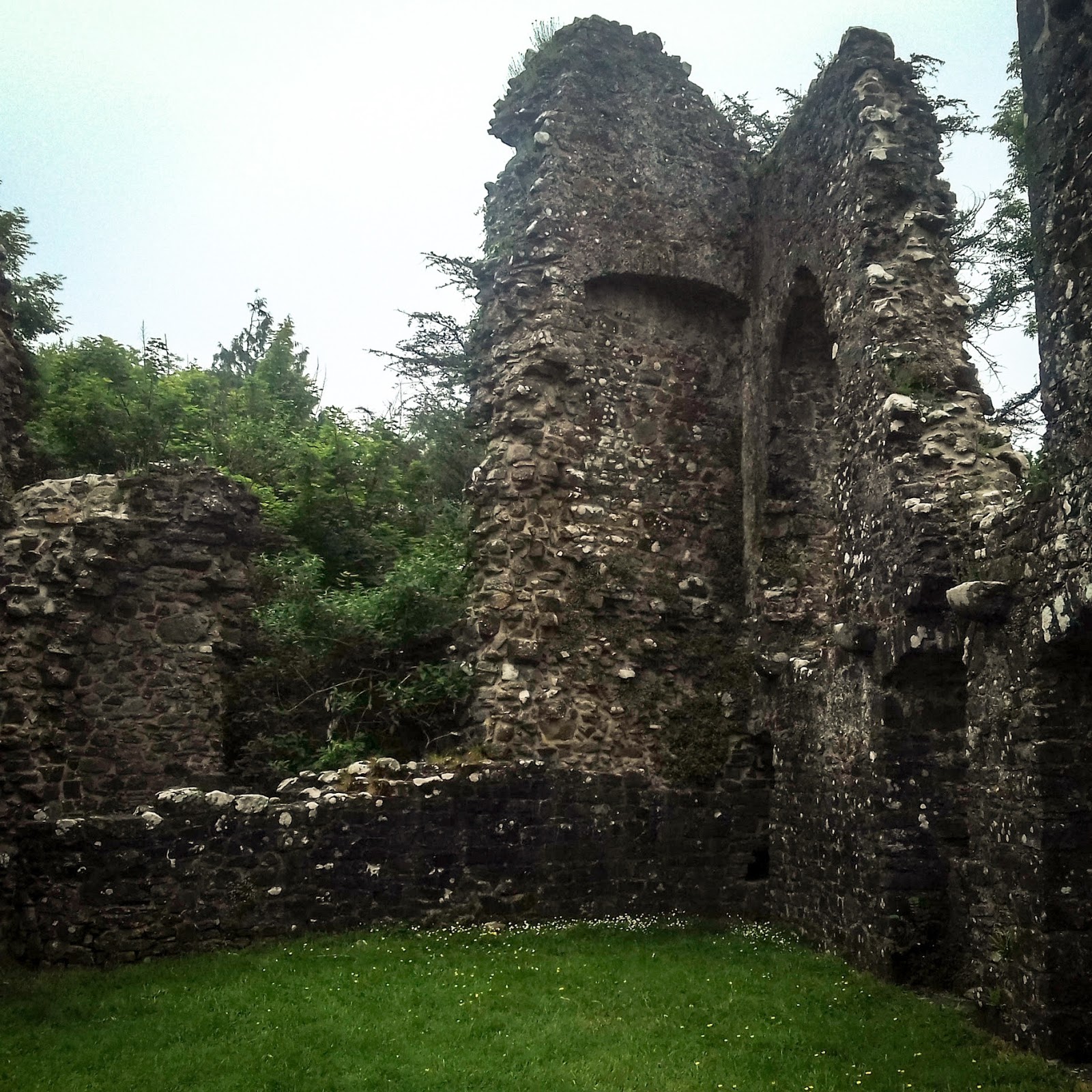
Remains of the castle sticking up like fangs from the ground

The castle was up a different path. You can't see much of it from the road, only one of the towers, but once up there, a lot more of the castle is visible. It is hard, from what is left, to visualise that it was once a mighty fortress, at least the second built on that site, and was built sometime after 1246 (you can read the CADW page ::here::). There were signs around the place with artist's impressions of the original castle, but I think the windows in the paintings are a tad more Gothic than might have been based on the actual window shapes remaining. However, there may have been more pointed tracery in stone frames now long gone. 

This is just part of a broken tower, once attached to a building
It was a damp, muggy day, with a dull grey sky, so I apologise in advance for the photographs being hazy and the skies being boring. I took all the photographs on my phone, as well, as I still haven't got a replacement camera. I'm currently unemployed, so it will be a while before I can afford a decent camera.

Raven was there too, and he took a couple of pictures of me.

Window into the cellar
The most complete part of the building is the pantry/kitchen cellar, with its tough barrel vault weathering the test of time. It's the building that Raven's standing in front of in the picture above. A lot of the stone from the castle was reused to build the town/village of Narberth (Arberth in Welsh) that surrounds. It's a very craggy-looking ruin, and the exterior walls, which would have likely been rendered and whitewashed to avoid the stone walls providing hand-holds, and to add an extra layer of protection from the elements, are now bare, with much of the walls' cores exposed. 

What is left of the great hall. 
The castle was built on a promontory, with a steep drop down to the graveyard below, and even further to the current road level. Geographically, it's quite a defensible location. I think the castle walls merge into a deliberate escarpment to the right of the buildings pictured above. Looking out over the trees now is quite magical. The vegetation there is very lush - West Wales is where parts of what is known as the 'Celtic Rainforest' grows - dense and green, watered by the decidedly soggy climate and warmed by the warm air currents that pass the West of the British Isles, brought by the Gulf Stream. 

Through the windows
The buildings were stabilised in 2005, after an extensive project to stop further ruination of what is left. Unfortunately, there has been graffiti since then, limiting what I could photograph (I don't want to put swear words, crudely drawn phallic images and suchlike on my blog) and also damaging the stonework as it would be difficult to remove the spray paint from the walls without also damaging the surfaces of the stones. It saddens me that I often go to castles and other ancient monuments and there's litter, beer cans (and sometimes worse) and graffiti - the results of people disrespecting their heritage. Ones that charge for entry tend to have less, but I think it's more the supervision of stewards than the price that changes things. 

I went through that doorway.
I did see a family taking their children for a stroll, which is a good thing - nice to see children being taken to such things at young age, hopefully to grow up more respectful of the castle than those who spray-painted the graffiti. I get really angry about people damaging historical buildings.

Inside what's left of the great hall
You can see corbels jutting from the walls where once sat the joists for the first floor. I don't know if there was a second storey on this part. The towers definitely had ground floor, first floor and second floor at least, probably with battlements behind crenelations. All of that is gone now. You can also see where they changed their mind about a window and walled it up into an alcove. 

Note corbel and hole in the wall where a beam once slotted in
I probably spent longer exploring and taking photographs than we really had time for. I find such ruins quite captivating. 800 years is pretty ancient in many ways, but it's actually relatively recent in Welsh history. Near Narberth/Arberth is a truly ancient hill-fort that is thousands of years old. It's somewhat overwhelming at times just how much history there is, layered all around us. I'll have to visit more of the really ancient stuff and blog about that, too. 


The arches are roughly Gothic, but it's hard to tell what the windows looked like with any more detail than that. The castle, like most medieval castles, also had a chapel, which I would expect to have church-like Gothic windows, maybe once having stained glass. Now there's just a hole in the wall. I wonder what happened to the glass. 

The hat and cloak make me look particularly severe.
Raven took a picture of me looking very serious by a window. I'm such a tourist sometimes - I want an 'I was there' picture of me at the places I visit. You can see how much better the resolution is on Raven's phone camera than on mine. I visited two other castles while I was in Wales, and I'll update my blog with those in the near future. 

Saturday, 23 June 2018

Cawdor Castle - 2017 Visit

Last year, Raven took me to Cawdor Castle for my birthday. I wanted to post about it nearer the time, but I lost my SD card with the photos I'd taken. I've been there ::before::, and the first time I was there, it was with the HTC smartphone that didn't have a good camera at all, no proper camera, and in dreary weather. This time, it was May, the weather was bright and sunny, and I made sure to bring a camera with me. Raven also took a lot of photographs while we were there, so there's plenty of photographs from him in this blog! If I find my SD card, I'll do a second post about this trip with my photos on it. I'm really grateful to Raven for letting me use his photographs; I'm really sad about having lost my SD card, especially as it had more than just Cawdor Castle on it. I took a LOT of photographs of the castle building itself, and I really wish they weren't lost.

Photos in this blog-post are in a carousel gallery - if you click on a photo, it will enlarge, and you can navigate between photos with the arrow keys. I've had a couple of messages about 'tiny pictures' so I thought I would clarify. 


Photo by Raven of me walking up to the castle
Cawdor Castle was initially built as a defensive castle in the 14thC by the Thanes of Cawdor. It's since become more of country mansion house with later, less defensible extensions, but it has a rich and interesting history. This time, we went inside the castle as well as seeing the grounds, paying the extra entrance fee, so I got to see more the castle and learn about the castle history - which is my favourite reason to visit castles! You can visit the official Cawdor Castle website ::here::

When I temporarily had blue hair!
Selfies by me. 
I went on the trip during the time I had ::temporarily blue hair::. I keep ending up with unintentional blue hair - I've currently got unintentional blue highlights in my black hair because the black dye is not quite as opaque as I imagined, and also doesn't adhere so well to where my hair was previously green. However, in this instance, my hair turned blue after I washed it, and had originally been green and purple. My current theory is that it's because I'd been using dandruff shampoo, and some ingredient in that caused it to wash out certain pigments from the dye, leaving the blue. 

The first thing I did at the castle was go and get a hot chocolate, and I think either a pain-au-chocolat or a savoury muffin - it's been over a year, I can't remember what I ate. I do remember that whatever it was, it was tasty! The hot chocolate was rather yummy, with frothy cream and marshmallows - a more luxurious hot drink than my usual tea as a birthday treat. 

My hair nearly matched the cup. Photo by Raven 

Photo by Raven, edits by me.
Once thoroughly refreshed, we went for a wander around the castle. Near the entrance to the cafe, I spotted this alcove. As well as looking out of the window at the castle grounds, and being impressed by the immense thickness of the walls, I persuaded Raven to take some aesthetic pictures of me.

The gatehouse has had to repel those who would attack the castle, so its sturdiness is not just for show. One of the daughters of the clan at Cawdor - 9th Thaness Muriel - was at the centre of a lot of clan dispute when as a teenager she was married off to Sir Campbell. It got very 'Game of Thrones' with battles, kidnaps, plots and Thaness Muriel surviving her husband, living 30 years longer than he did. (You can read about that ::here::, just scroll down to Muriel Calder). If you think the fiction of Macbeth is dramatic, then just look what was actually happening in Cawdor a few before Shakespeare.

I actually don't remember this part of the castle, but it's pretty
Photograph by Raven 
We went around the castle interior first. The castle is still lived in - by the current Lady Cawdor, so not all the rooms can be visited. There's a route through some of the castle that is opened up, with guides at various points who can be asked questions about the castle. I remember we bumped into some American tourists who were just as excited about the castle as I was (and who liked my outfit; I think I got called' Lady Macbeth' in a complimentary way.) and both they and I asked the guides plenty of questions. There was an older chap as a guide and he was incredibly knowledgeable about the castle. I perhaps asked too many questions, but I'm a glutton for knowledge.

Palantir-esque orb
Photo by Raven.
There are a lot of spherical ornaments in Cawdor Castle - I think this is an aesthetic choice of the current lady Cawdor, as she commissioned several of the spherical statues in the castle grounds, and it is by her desk that one of the larger stone/crystal orbs resides. Raven took a photograph of it (to the right, click to enlarge thumbnail image). There's also one in one of the visitable bedrooms that is in a stand that makes it look like Palantir from Middle Earth. There's also an ORIGINAL Charles Addams drawing which I got completely over excited about. I don't have a photograph of that. (Lady Cawdor's art collection is intriguing, and I have so many questions in my head from it!)

There's a really fabulous room, with a tree growing in it, and an adjoining 'secret' other room that had been walled up for a long time. I don't have a photograph of it - it's something I tried hard to photograph, and there might be pictures of it on my SD card, but in the meanwhile there's a picture of it on the ::Cawdor Castle website::, second one along, click to enlarge. The tree is part of a legend about the founding of the castle. The Thane of Cawdor, whose earlier medieval castle was not too far away, wanted to build a bigger and better, stronger fortification. He had a dream in which he was instructed to put a chest of gold upon a donkey's back, and then to follow it to where it lay, and build his castle there. He did this, and the donkey went to lie down under a hawthorne tree, which the castle was built around - the tree is still there, growing through the castle basement, protected as the family's prosperity is thought to be linked to the tree. I keep saying British history is very much like Game of Thrones, but in this case it's more like the Shannara Chronicles.

Historic Kitchen at Cawdor Castle, photo by Raven

Photo by Raven. 
Looking at the historic kitchen was interesting. All those copper pots and pans! It's intriguing to see what utensils they had then compared to now - some things I have no idea what their purpose is, some things that haven't changed much, and some things that seem obvious by their absence. What was even more interesting is that one of the last things you go through in the castle, once you've been through the historic kitchen, is the modern kitchen - presumably for when there are private functions (I'm going to guess Lady Cawdor doesn't let hundreds of visitors walk through the same kitchen her dinner is cooked in each night!).

I really like the recessed windows from an aesthetic perspective - I'm guessing they are small and in such deep alcoves because the kitchen is in the basement, and the castle needs really thick, sturdy walls at that level to hold up everything that is above it, especially as it was defensive. Small windows means less of a void in the wall, and less of a space someone could climb in through - however, wide alcoves means more light as light can enter the room from a variety of angles in relation to the window.  
Modern Kitchen at Cawdor Castle, photo by Raven

Photo by Raven.  Click to expand
In front of historic kitchen window
The comparison between the two definitely makes you think about how much the functional aspects of the castle have changed, and the expected requirements for a kitchen. As an architectural technologist, and one that would like to work on residential properties, things like the types of room that have been used for kitchens over the centuries is something that interests me - for example, the historic kitchen is long and linear, almost in a basement, and with the well in the room, (Not visible in the photograph, Raven would have had his back to it when he took this picture) whereas the modern kitchen is in a much squarer room, and a storey up from this kitchen (I think? It's hard to judge when the various phases of the building aren't all on the same set of levels) - both rooms are relatively bright, with lots of white, but the modern kitchen seems much airier, even though it has dark wooden panelling - perhaps because the ceilings are much higher (high enough to be out of shot!). It's also interesting to note the HUGE copper canopy for the extract fans in the modern kitchen - no such thing centuries back, so it would have been much steamier to work in! 

Raven's really into cooking, so I think he also found the two kitchens quite interesting.


Maze with minotaur (left) and castle (right). Photograph by Raven.
There's a hedge maze (or labyrinth?) at Cawdor, but when we were there, it was closed to visitors because the roots of the shrubbery needed to recover from repetitive trampling. However, it was visible from outside, as was the mythologically suitable minotaur in the centre!

Formal gardens, before their peak, in a cloudy moment. Photo by Raven.

Walking with parasol
Photograph by Dave
After we looked around the castle as much as we could, we then went out to the grounds. Last time I went to Cawdor Castle gardens, we walked mostly through the woodland walk area and didn't go through all of the gardens, but this time we went to the gardens. In the Highlands, early May is more springtime than summer, so the gardens aren't as green and luscious as they probably are in later months. I should probably actually go there around this time of year to best appreciate the gardens! That's not to say that there wasn't greenery - as there was, it's just that the trees, hedges and shrubbery weren't at their maximum foliage. 

The weather was quite bright - not hot, but warm enough that a lacy shrug was enough to keep away the chill. However, it was definitely bright enough for sunglasses and parasol (well, to me at least, but I think I have a low tolerance for bright light.) for most of the day. There were cloudier moments, too, but when the sun came out again it was really quite bright.

Spherical fountain, photograph by Raven. 
As mentioned before, there were several spherical garden statues/fountains at the ground. A really interesting one was made of shards of stacked glass, but I lost the photographs I took of that. The stone sphere fountain in the photograph was made by a Japanese sculptor, and there was a matching crescent moon shaped statue - I think the fountain represents the sun. It's an interesting mixture of modern art and a historical castle and grounds. I think the natural stones helps keep the fountain fitting to the site. 

Pond opposite ticket booth/entrance. Photograph by Raven
Cawdor Castle has two main areas of laid out gardens, and then plenty of grounds, wooded and more pastoral, beyond that. There is a lovely pond near the drive and ticket booth, which Raven photographed. It looked most picturesque, a wonderful capture of springtime, especially with all the white tree blossoms. There are more ponds in the woodland area, but I didn't go there that time - they are also very pretty, especially when viewed from the wooden bridges. 

Photograph by Raven, edits/filters by me.
The last photo from the Castle is me sitting at a small picnic table near the ticket booth, I think having just finished a carton of apple juice or something, and discussing with Raven what the rest of our plans would be. For some reason, sitting there was probably the thing that stuck most clearly in my head. I think it was because I looked up at the new leaves on the tree above me, and the sun, which was quite bright, was glowing through them, so they seemed so incredibly vibrant, almost glass-like. It was later in the afternoon by that point, as we had spent a good few hours at Cawdor Castle, and I tweaked the colours in the photograph just a little to try and best capture what the light felt like when I was there. Sometimes you have to bend reality a little to capture what something feels like.
 

Raven and I together, phone pic by me. 
As far as birthdays go, I think last year's was one of the best. Sometimes a trip out is better than a party (especially if you're more introverted like me. I end up poking my phone at my own parties because I get 'peopled out'!). Going to Cawdor castle was Raven's treat, so I'm very thankful to him for taking me (even over a year on!). He took me out to dinner, too (which, just before, is when I took the selfie of us together - hence the different makeup and outfit). Raven is very much the romantic, and I'm eternally grateful to him for all these years together - as well as Birthday trips out!

Also, this blog would be much less aesthetically pleasing without his photographic talent! Not just this specific entry (which would just be a big wall of text about how much I like Cawdor Castle otherwise), but in general - he's taken so many of the photographs of me for this blog over the years, and they're always really flattering. I don't look half as good in my own selfies - let alone real life - as I do in Raven's pictures of me. He's got a knack for composition and posing that does well to minimise my many physical flaws and highlight my better features (so, less turkey neck, more cheekbones) and even manages to take pretty pictures of me when I'm not trying to pose (those probably turn out better; I pose awkwardly when I know I'm being photographed) 

Tuesday, 31 May 2016

Photographic Collaboration With Raven: Haverfordwest Castle

In April, Raven and I went to Wales. It was more a family visit than a holiday, and I was mostly doing work (coursework, too) but we also went on a day-trip to Haverfordwest (yes, that name is all one word). We went by train and were supposed to meet up with one of Raven's friends, but they ended up having to cancel, so we got the afternoon to wander around the town.

Train selfie with Raven.  Photo and editing by me.
Raven is reluctant selfie person!
Haverfordwest has a very prominent castle. It was pretty much the first thing I saw walking from the station, and I am, as you probably all know, quite obsessed with castles, so I really wanted to visit the castle. The weather was coming in, however, so we couldn't stay too long. 

Church with storm clouds. Photo by me, editing by Raven.
On the way up to the castle, I spotted the storm clouds above this church, and borrowed Raven's mobile to take a photograph. The photograph is my work, the editing is all Raven's work. He really brought out the impending doom in those clouds - shortly after this there was a terrible downpour. We were at the castle at the time and got thoroughly soaked!

Clouds and windows. Photograph by me, editing by Raven and I.
Another photograph of the castle ruins. This is one by me, with editing by Raven and I. Raven did the contrast and colour adjustments on the architecture, and I did the editing on the sky. I would imagine that the castle was once quite impressive, with grand Gothic windows, and quite a large building indeed. I had fun editing the sky on this one - it is deliberately a bit fantastical, although those are real clouds. 

Clouds above the ruins. Photo probably by Raven, editing by Raven.
This another atmospheric photograph of the castle. Neither Raven nor I can remember which of us took this photo, as we both tried to photograph this view. The flag flickering was the Welsh flag. Personally, I believe it was Raven who took this photograph. Raven certainly did all of the editing on this one. 

Raven in an alcove. Photograph by me, editing by Raven.
This is the portrait I took of Raven in another one of the alcoves. The original composition I tried was with him at the end of a row of several alcoves, but he was too tiny on the camera phone photographs. It took several attempts to get him in focus, too, as it is hard to use a touch screen when it is raining! Raven's always dressed in black, but he's a lot less elaborate than me in his tastes. Raven thinks this looks like what an album cover photo would look like if he  ever released one. 

Me in an alcove. Photo by Raven, editing by Raven and tweaked by me.
This is the photograph Raven took of me hiding from the weather in an alcove. Most of the editing is Raven's, but I tweaked the contrasts on my outfit a bit. I didn't have space in my luggage to bring chunky Lolita shoes, so I am wearing Gothic pikes with a Gothic Lolita outfit here! Walking around a castle in pointy shoes with stiletto heels was not comfortable, and not easy for someone with a co-ordination issue! I wish I had brought some flat Lolita shoes with me. 

Stairs. Photograph and editing both by Raven.
This last photograph is all Raven's work. I didn't go down the stairs because it had a used condom at the top, and all sorts of litter down at the bottom. I don't think Raven went to the bottom of the stairs either. As beautiful as the ruins are, it is clear they are not well looked after - so much litter, some if it quite grim, such as several used condoms, broken glass and plenty of cans and suchlike indicating people had been drinking heavily up there. There was also dog mess. It is a shame because it is an amazing ruin, a jewel crowning the town. Visiting it in such dramatic weather should have been sublime (in the more archaic version of the term), but it was marred by having to constantly watch my step, and not just because of wearing heels. There is a museum on site, and I am surprised there are no wardens or stewards to prevent people from abusing the ruins. 

Altogether, it was still a pleasant visit, even if the rain soaked us (we scurried away to a gallery and cafe to dry out and warm up) and the ruins were besmirched by those who don't respect them. The skies were beautiful and dramatic, and the castle itself is a stunning ruin. 

Sunday, 13 March 2016

Newcastle Emlyn Castle

This is a post from March 2013 that somehow got relegated to a draft! I'm not sure how it never got published! Have a look at some castle photos from Wales! 

I went to where the last dragon was slain.

There isn't much left of the castle at Newcastle Emlyn (Castell Newydd Emlyn) but I have visited what remains a couple of times before. My most recent visit was on Day 3 of my holidays. 

I didn't get a photograph of the gate, but there is a rather grand wrought iron gate with a dragon breathing fire at the top, and an oak-leaf design. The dragon is painted gold with red flames. It is a modern tribute to both local legend and local history. 

Photograph of the castle by the HouseCat
Most of what remains are the two towers either side of the main entrance and the castle mound. The castle was quite small (by castle standards) when complete, and now that it is ruined it does not take long to walk around it. Or clamber. I must admit that I like being able to touch and clamber on my history, to explore every nook of it. I try to be careful, as although the walls are old and have remained for centuries, some bits are loose and I neither want to fall or damage the walls. 

It was a lovely, bright and sunny day, but cold. It was not as blustery as when I visited Cilgerran castle. I still ended up wrapped up in my long leather coat, but didn't need to wrap my hair to my ears with my scarf this time. We were there in the mid to late afternoon, and the sun cast strong shadows across the stonework. 

Inside of one of the towers.
Photograph by the HouseCat

The sky was a good clear blue and the surrounding countryside and river looked absolutely gorgeous. It was nice to just stroll around the grounds, take photographs and chat to Raven. 

See, I CAN take colour photographs of buildings!
Photograph by the HouseCat

There are quite extensive grounds about the castle, with nice gardens and a picnic area. We didn't, however, eat a picnic, but went to ::Pachamama Bistro::, which is in the town itself. I had this lovely goat's cheese and onion chutney sandwich in lovely crusty bread with salad (dressed with tasty dressing!) and a few crisps. It was really tasty. I also had a 'Mellow Mallow' hot chocolate which I can highly recommend as a delicious hot chocolate. As well as a range of delicious Western sandwiches and salads, they do a range of Thai, Chinese and Indian dishes. It's a lovely cosy place to eat and the staff are very friendly.

Light through the old windows of the castle.
I managed to have a rummage around a charity shop and  a browse of some of the other shops. Dave was very lovely and gave me a £1 coin (I was all out of cash as I rarely cary much/any, and it was too little to pay for on card) with which I bought a rather nice four-candle black metal candlestick. I also went to   'The Maker's Mark' which is run by a lovely lady called Nada (I hope I spelled that correctly) who remembered us from our last visit. I really enjoy shopping in Newcastle Emlyn; for a smallish town, it has a lot of good quirky little shops, more than Inverness, which is a city.