My personal blog as a 'grown-up' Goth and Romantic living in the Highlands of Scotland. I write about the places I go, the things I see and my thoughts on life as a Goth and the subculture, and things in the broader realm of the Gothic and darkly Romantic. Sometimes I write about music I like and sometimes I review things. This blog often includes architectural photography, graveyards and other images from the darker side of life.

Goth is not just about imitating each other, it is a creative movement and subculture that grew out of post-punk and is based on seeing beauty in the dark places of the world, the expression of that in Goth rock. It looks back to the various ways throughout history in which people have confronted and explored the macabre, the dark and the taboo, and as such I'm going to post about more than the just the standards of the subculture (Siouxsie, Sisters of Mercy, Bauhaus, et al) and look at things by people who might not consider themselves anything to do with the subculture, but have eyes for the dark places. The Gothic should not be limited by what is already within it; inspiration comes from all places, the key is to look with open eyes, listen carefully and think with an open mind..

Showing posts with label pictures. Show all posts

Saturday, 11 August 2018

Domesticated: Study Decor

Originally, when I set up Domesticated Goth, I intended it to be about crafts, homemaking, cooking and decorating - a blog to give people ideas on how to make Gothic things for their house, small art projects, etc. Unfortunately, I moved into a rental apartment that had strict rules on decorating, and that put a real dampener on that idea, and instead the blog evolved into a more general Gothic & Goth lifestyle bog, with Gothic tourism, art projects, accounts of my involvement with Gothic Lolita, photography, the odd musical post (I am terrible at writing about music intelligently) and discussion of the Goth subculture itself. 

Three years ago, however, Raven and I bought a house - we didn't buy it outright, we have a mortgage on it, and it's not a very big house, but it's where we call home. Over that time, we've been decorating. Not all of the house is Gothic (the living & dining rooms are open-plan with each other, and have a more earthy, slightly witchy sort of feel, with lots of greens, dark wood and natural and Pagan motifs) and some rooms are more Gothic than others. There's also still a lot of work to be done, so many rooms are still very incomplete; we don't have much money, so we can't hire people to decorate for us, and we barely have the time and the money to do it ourselves, so it has been dragging on. However, my study is the smallest room that isn't a bathroom, and therefore it's one of the more complete.

Spiderweb candelabra and skulls are still quite 'Hallowe'en'
My initial idea was to decorate it in a deliberately kitschy, Hallowe'en-esque sort of way - LOTS of skulls, cartoon bat decals on the windows and ceilings, and quite a vivid purple (Valspar's 'Purple Storm'). However, having had the room for 3 years, I feel that style both feels a bit overbearing and doesn't really reflect my personal aesthetic any more, as I've definitely got further and further into a Romantic, Gothic and very Victorian/anachronistic sort of aesthetic, and I want my study to feel more like it is inhabited by a vampire from an Anne Rice novel than one from a Tim Burton movie. I've still got the vinyl decals on my window because I simply can't get them off, and I think I'm going to have to use a heat-gun to remove them!

My window, with its bat stickers as well as SunSeal mandalas
There are a lot of pentagrams and stars hanging up in my window.
Some of the vinyl decals, those of Gothic architecture and Gothic arches, I will keep. I feel like it's still in keeping with the reproduction 1820s Gothic Revival wallpaper of window tracery, especially the arcade of grey/silver arches - something I need to get a good photograph of! I'm in two minds about the vinyl decals of buildings. I'm not sure if they are too cartoonish to look good, or if their simplicity is a good thing, or whether they should go entirely, or whether I should carefully take a scalpel to them and give them a few more details to make them a bit classier (including making some of the Romanesque arches into Gothic ones!). I don't want to make my study too Victorian either; my 1960's house doesn't have high enough ceilings to really pull off the Victorian look without feeling claustrophobic; the spaces are too horizontal. 

The rounded arches and lack of details annoy me!
I have two favourite sections of my study so far, my 'book nook' reading corner, and my feature wall. My study has a weird L-shape, with a short stubby bit over the staircase, and an above-the-stairs cupboard that I store manga and art materials in. In the stubby area, I have a book-case, a corner unit, a wicker peacock-back chair (inspired by Morticia Addams) and a two-handed broadsword! The broadsword is a claymore, the distinctive variation from Scotland. 

My book nook. Chair pulled out to get a good photograph.
The bookcase is all non-fiction. The top shelf is architecture books, the middle shelf history, culture and anthropology, and the bottom shelf is for big A4+ size books, mostly art, but a few history ones too. It's not big enough for all of my art and architecture or history books, but it's got a few. More shelving is actually something my study desperately needs, and is something I've been working on. Some friends of mine are moving to Scandinavia, and have a lovely double-Gothic-arch bookcase that I would like to buy off them, and I've put two new above-door shelves up in my study, one above the main door for ornaments, and one above the cubby door for notebooks (you can see a bracket for it, sans shelf, in the photo above). I'm awaiting some more shelves in our bedroom, so that I can move all my fiction books out of their stacks under my study desk! I've also got a stack of art books under my study desk, and another stack of art books next to the book-case, all of art books too big to go on the bottom shelf of the bookcase. I've got a few shelves above my desk, but they're for art materials, not books. 

Cubby visible in mirror!
My cubby needs a lot of work; it already has shelves, but they're too broadly spaced out, but too close to simply put an additional shelf in between - I need to take the existing shelves out and put new ones in.  There's also a crack where the back board of the cupboard has come away from the wall, and I'm not sure what the best way to deal with that is, as the problem appears to be lack of an allowance for the expansion and contraction of the building. I think perhaps an L-shaped piece of wood, attached to the brick wall and not the board, will cover the gap while allowing the different materials to expand and contract sensibly. I'm not sure whether the back wall of the cubby should have wallpaper or be painted, and if so, what colours. I also want to save up to get an electrician in, both to move the main overhead light at the conjunction of the two parts of the study, but also to install an additional light in the ceiling of the cubby, so I can see what's in there better. 

The purple and gold book is actually a Harry Potter themed lamp! They're available ::here:: and at the time of writing, they're on sale below half price at £35 (hence why I could afford one!). I'm a bit of a Harry Potter fan, so this was perfect. If there had been a silver on purple version, I would have loved that even more. I had the cover text customised to 'Liber Lux' - book of light (probably slightly wonky Latin; it's been over 12 years since I studied Latin!). When you open it up, the pages light up, and create a lovely ambient glow. I put mine on a mini-lectern/book stand so I can use it while I'm letter-writing or whatnot.

My mini-bodhran and a Gods' Eye weave.
Another thing I use my study for is music practice. I have my bodhran and my doumbek, my fiddle and a whole lot of recorders (flûte à bec, not for recording music), whistles and flutes. Eventually I wish to move my harmonium (pedal organ) up into my study, but my staircase is steep and winding, and Raven and I alone are not strong enough to carry it upstairs; I think it's a four-person job, but not a four-person staircase! I'd like to get a piano for the living-room to sit where the harmonium currently is; I used to play, and my nice piano is at my father's house. 

Raven, in front of a resin crow figure from TKMaxx
The silver and black damask bag behind has love-letters he sent me.
The silver and black box below has letters from friends and family.
I also have a desk, which is where my computer sits, and where I do a lot of my art-work. I haven't taken any proper photographs of the desk itself, because currently my desktop is just some MDF (medium-density fibreboard) and I'd like to get something like some black sparkle formica to make desk-top. I've been looking at the wonderful geode-inspired resin art-work of ::Mrs ColorBerry:: (which is totally incredible; I seriously recommend checking it out!) and I'd like to learn to do something similar to make a cool poured-resin worktop for my desk, although I wonder how heavy that would be! Raven built my desk, and to get ornate table-legs, he cut some banister spindles down to size! 
Hand-painted skulls, and easy DIY project. Just prime then paint!
I do like skull motifs, even if they are sometimes a bit kitschy. These three are small skull decorations from Hallowe'en - £2 for a pack of 9 - which I repainted using nail-polish, to immortalise some of my favourite nail-polish combinations. The iridescent green and purple one is my favourite. These skulls are tiny, about and inch and a half high each. 

I love the Art Nouveau packaging
I love burning incense in my study, although it tends to leave an ashy, dusty mess around the burner. I keep the incense for my study (which has cheesy names like 'Werewolf's Bite' or 'Gothic Prayer') in that purple vase. I used to have dried roses in the vase, but they just disintegrated entirely. I love the Art Nouveau packaging for the 'Yesteryears' incense, so I keep that particular incense out on display. The wall faces on the window aperture are painted a lighter purple (I think it's called either 'Lightning Bolt' or 'Haunting Melody'; I can't remember which of those two I eventually settled on. More Valspar paint.) 


My favourite part of my study is the wall behind where I sit at my desk. I painted it black, with silver glitter dusted into the paint, and it is the feature wall I use to display art work. The art work is on rotation. Currently I've got a lenticular image of a crow on a skull, which I think is from Alchemy Gothic, and a postcard of a cat as Moriarty (having stolen the crown jewels). Half of the picture frames are from TKMaxx and Dunelm Mill, and the other half are thrifted. I'm starting to swap out the artwork for fine art images. Not really visible in this picture, but the image in the concentric rectangles frame at the upper left is a postcard of a Edward Burne Jones sketch  (it is of a woman looking down to her left, with a crown of golden leaves, done in chalks or pastels on a purple background, you can see a version ::here::). I'm going to hopefully fill all the frames with classic art soon, just need to accumulate prints/postcards at the right size. The picture of my father (at work, he's an archaeologist) on the far right is going to be re-framed in a black frame and moved to our bedroom, where we have a wall of friends and family pictures.

Display wall from the other angle, with sword.
Also note the Gothic Revival wallpaper in grey.
You may have noticed I have another sword. I collect them, especially antiques. The sword on my display wall is an antique officer's dress sword from the 1870s-1880s, from Italy, with a beautifully engraved blade. I love the duality of beautifully made weaponry; both artistic and aesthetic, yet designed for a lethal function. There are dents along the spine of the dress sword that indicate it's been used in some form of combat, and I wonder if someone fought a duel with it. It's definitely not a battle weapon (unlike say, a cavalry sabre). 

Unfinished wall with broken sconce; the mirror got shattered.


As you can see, this is not a complete over view of my study, and there is much left to do. I'm going to put a Gothic arched cabinet over my radiator, and I've got facings to put on the shelves over my door. I need to take more pictures of things I have added to my study, like the two new shelves. I still don't have a final floor covering; I've got a rug over floor-boards as I can't afford enough laminate flooring to cover my study yet (however I do have a roll of underlay!). I'm going to try and 3D print a single tile of cornice, then make a mould, and then use that to make dozens of foam ones, in order to get a repeating Gothic arch design to go around where the ceiling connects to the walls. I've already painted skirting board gloss black, but I can't put that in until I've got the laminate floor down. I still don't have enough shelving, as detailed above, and I still have lots of stuff in boxes. 

If my readers are interested, I can update the blog with progress on my study, and with how other rooms are decorated. Please comment if you want to see more of the Gothic décor in my house. There's the witchy living & dining area mentioned before, a French belle-epoque inspired aesethetic, just with added skulls, for our main bedroom, a more modern take on Gothic decor for the spare bedroom/games room and the kitchen. The upstairs hallway is going to be quite opulent, with some really fabulous wall-paper, but I'm still currently stripping the original wallpaper! 


I also suggest checking out two Gothic DIY blogs:
::GIY: Goth It Yourself::, which is currently on hiatus, but which has an archive of PLENTY of projects worth reading and looking at, and
::Me And Annabel Lee:: which is also full of wonderful Gothic decorating and craft ideas and tutorials. 


Sunday, 19 July 2015

A Goth In Dingwall


I am continuing with project photographing Goths and similar alternative types in the Highlands. It is really important to me to show the world that even a mostly rural and often quite remote area like the Highlands (quite sparse in terms of population, with Inverness, our only major city, being smaller than some towns) has Goths, and that we are every bit as fabulous, unique, and varied as Goths in other places. I actually think that are lower numbers means that we do not tend to group ourselves into cliques by genre, and that many of us are quite varied as individuals as well as each being representative of varied styles; I know I can be anything from Gothic Lolita through Romantic Goth to Trad Goth when it comes to fashion and that I am hybrid of all of those things when it comes to my approach to Goth itself, and to being alternative, and there's so many different aspects to many of the Goth individuals I know locally - I am certainly no exception. 

Samm, a portrait. I love the narrow depth of field in this one!
Photograph by HouseCat

This installment of the project is bringing you Samm, from Dingwall. Dingwall is a town of Viking origin that's a short way North of Inverness. I was quite happy to get there on a £6.10 day ticket that could also take me as far south as Daviot  -which I considered, but I ran out of time. Daviot has a lovely church in a beautiful location that I have been wanting to photograph ever since I saw it on my way up the A9 to get here! Samm is an enthusiastic cosplayer, as well as Goth inclined alternative lassie, and a big fan of camping. I have had an awesome time camping with her, and hopefully we're going camping together again soon. 

Full length Samm, by a railing and vines. 

Samm's style for this photoshoot is very Nu-Goth, with a Killstar top and and H&M skull scarf, a neat black skater skirt and chunky black boots. This is just one variation on Goth and Alternative fashion that Samm wears, and I may well photograph her again in the future in a different set, wearing a different style. She took her jacket off for the photos, and as you can probably see, it started off a grey and dull day, so the scarf is actually mine, lent to her as I didn't want her getting cold! 

Looking into the graveyard, the sky making

The location is the churchyard of St. Clement's church in the centre of Dingwall. It is bordered on 3 sides by carparks (including a particularly large one for the local supermarket) and offers an idyl of quiet and respite from the traffic and busyness around it. I am not the sort of person to ask models to drape themselves across gravestones, nor to walk across graves like they are ordinary grass, nor to be loud or obnoxious in a cemetery, so I was very careful in taking these photographs to respect the surrounding graves, and to only use fence railings as "prop"s, not the graves themselves and to at least try to keep the wording on graves obscured, as I feel those things are personal to the families of the deceased. 

Samm and the "teeny tiny urn-thing". Photograph by Housecat

Samm is a particularly chirpy and bubbly person, and I tried to convey that in the photos. She was trying to do her "serious Gothic modeling" expression, but it always cracked into at least a smirk. It doesn't help that I called the finial on the railings a "teeny tiny urn-thing".  Perky Goths are real (and I am one! especially once caffeinated... ). 

Playing with the angles of stone walls. Photograph by HouseCat

In terms of photography, I am relatively with how these came out. My favourite is the first one shown, with the narrow depth of field. I both like how that specific effect turned out, and also the composition for that photograph. All the photographs are in black and white, which is not something I have done for portrait photography before - I took inspiration for how I normally treat my architectural photographs. In some of them, where she is mostly monochrome and the background is quite leafy, I do feel like she would have been more distinct from the background in colour, but over all I like how this set turned out. 

Thursday, 9 October 2014

Edinburgh City Part 6: Edinburgh Castle (Exterior)

PICTURE-HEAVY POST

One of the main reasons I went to Edinburgh was to photograph the castle. As Scotland's largest castle, and one of the more impressive, situated as it is on a rocky volcanic crag high above the city, looming over everything as a stony sentinel, it seemed the perfect subject for a display on castles for the Primary 4 class at the school I work at, and I personally adore castles and want any excuse to visit one. 

Looking left from the entrance bridge.
The guttering looks a bit like cannons.

Once at the castle itself, the city seems opened out all around, and just how high and isolated an outcrop the castle is seems very apparent. The views are amazing even on a dull and hazy day like the one of my visit. I am sure that on a clear and bright day that one would be able to see for many miles in any direction. I tried to take some photographs of the view, but they were mostly quite hard to make out, so none of them will go on the blog. 


Looking up from the entrance gate to the
Half Moon Battery, built for huge cannons.

So much of the rest of Edinburgh seems to have been built with at least some inspiration from the castle; all the castle-like details of the Scottish Baronial buildings that seem everywhere, the vistas that seemed planned to give you a good view of the castle, the gardens between Prince's Street and the railway that make the castle seem somehow separated from the city itself, etc. etc. Not many British cities still seem to have their old castle at their heart. Only Stirling, which also has its grand castle perched high above a steep rocky outcrop, seems to have some of this, but Edinburgh certainly seems built around its castle more than just geographically. Oxford, for example, still has its castle, but that castle has been swamped by the far grander buildings of the university and re-purposed so many times; it feels like it has been subsumed by its city.

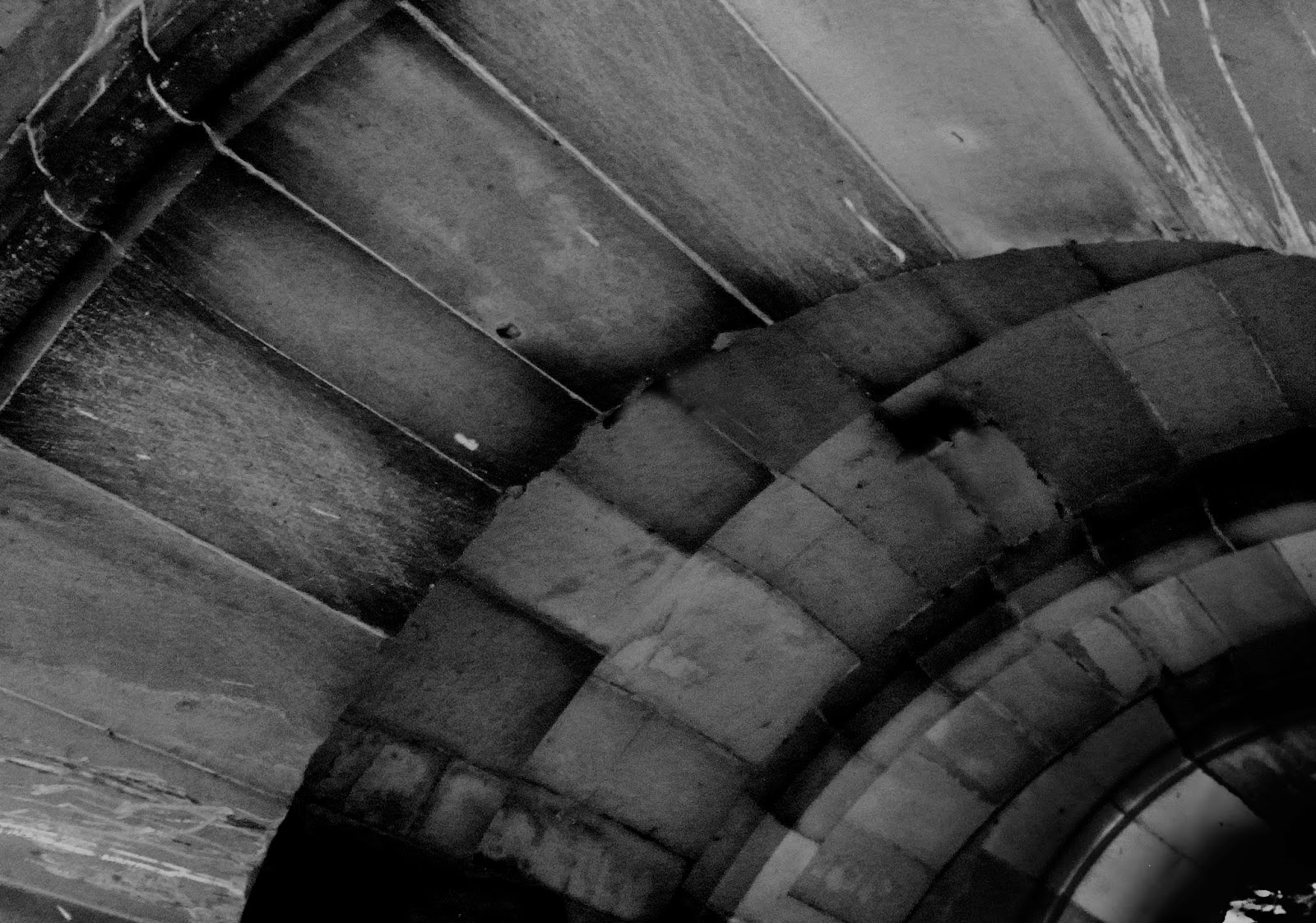
Where the gates had once been underneath the Argyle Tower.

I took the photograph above because even before I read on a plaque that there had been many gates (five, if I remember rightly), the ribs in the vaulting made it clear that there had been defenses there before. I was surprised not to find holes of some sort to shoot down upon, or pour boiling liquids upon, invaders as I have seen this in other castles. Medieval warfare was grim, bloody and painful. Combined with the steep rocky crag the castle is built upon, the one main road up to the entrance, and the terracing that would make it so easy for archers or muskets to shoot down upon attackers, the castle is certainly not a structure that would have been easy to get into!

Looking up to what is now the castle shop!

Entry to the castle is not cheap. I think it cost me £16 just for myself. I then purchased a guide book, a few history books, post-cards and snacks all on top of that, making it quite an expensive visit. I am quite glad I had money saved up as otherwise I would not have ordinarily been able to afford such a trip. I think it is cheaper if you are a member of Historic Scotland - something I am seriously considering doing as I am quite fond of visiting historic sites (as visitors to my blog should know!). 

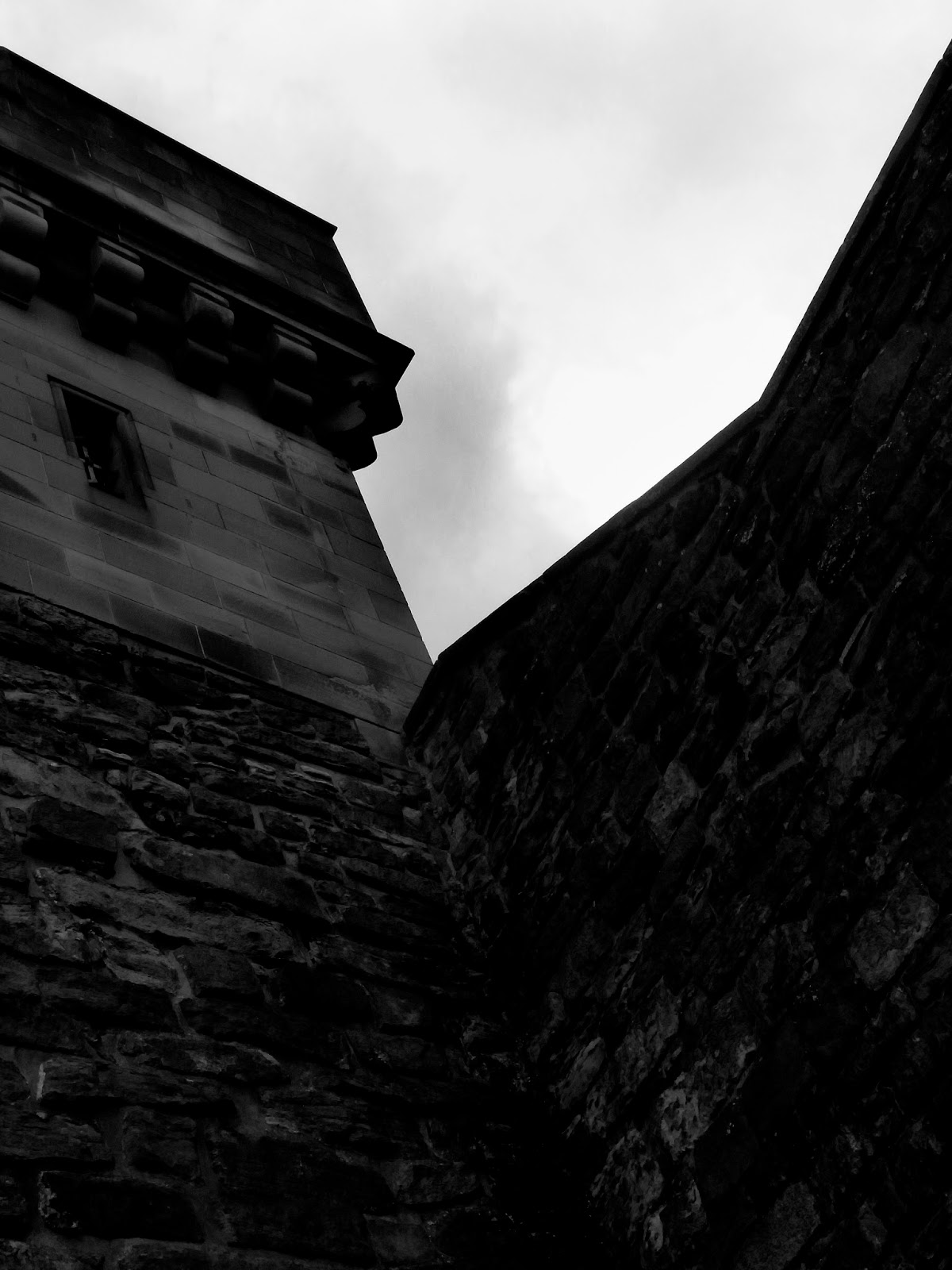
Staggered walls of castle shop.
Looking up at some clouds being interesting!

As I mentioned in yesterday's post, the weather was grim, bleak and windswept. The skies were grey, pale with wan sunlight and the wind made the day far chiller than the the day before, when it was sunny, warm and humid enough to have me nearly fainting. It was not the prettiest day for taking photographs; I prefer it when it is partially cloudy so that I get interesting contrast with the clouds, or at least when the clouds are being dramatic. The sky that day was dull, often quite flat, with the occasional interest of denser, darker and more leaden skies that came with unfulfilled promises of rain. Every now and again there was a slight break of blue through the cloud, but very little. 

Rear view of the shrine of the Scottish National War Memorial

One of the more recent buildings is the Scottish National War Memorial, built over what, if I remember rightly, had once been both a barracks and a church at different periods. I don't know how much of the architecture is 20thC and how much is an adaptation of older buildings, but I do know that it is a place of reverence and remembrance. Photographs are not permitted in the Shrine itself, to preserve the dignity and attitude of reverence, but I can say that it is both somber and beautiful, with the names of the war dead from all three branches of the military kept in a metal box designed to resemble the Ark of the Covenant. 

The archway, looking in from the approach.
The shrine is accessed via the inner courtyard, and under this arch. I don't know if this arch is a structural brace between the two buildings, or if it is a walk-way for uses I cannot fathom, or part of a tall gate that once sequestered off this royal section of the castle. Anyone who can explain it to me has my gratitude if they do so. 

The same archway, this time looking outwards.

Through this archway, inwards, is a courtyard. The inner courtyard is called the Royal Square, and it is surrounded by the Great Hall, the Scottish National War Memorial, and the Royal Palace (which holds the Honours of Scotland; the nation's crown jewels, comprised of a rod, sceptre, crown and sword, and the Stone of Destiny). This was not quite as grand as I had imagined, but Edinburgh Castle, with all its military architecture, cannons and defensive location, was primarily a working fortress and not decadent palace. That's not to say the interiors are not sumptuous - I will post later another blog entry with some colour photographs of the interiors - just that I have been to fancier places. It was a dreary day when I was visiting, and it lent the castle interiors a dreary atmosphere, even with their warm simulated candles. I suppose with fewer visitors, more comforts and all the big stone fire-places containing a lit and roaring fire, it would seem a lot more cosy.


The Royal Palace. At four storeys and with a tower, it's quite tall.
I visited both the Royal Palace, some rooms of which are apparently still used for state functions (I can assume only small ones, though) and are finely wood paneled and luxurious. There's a lot of heraldry about the place - I guess that sort of decor was done to impress visitors (the nobles that once would have come, not present day visitors) with the long hereditary claim to the throne, especially as it was a rather contested throne.

Mary Queen of Scots gave birth in rooms in the older parts of the building, to the boy that later became King James VI of Scotland and I of England, and a few Kings later, Mary and William of Orange became King and Queen and it got complicated, Jacobites and Hanoverians fought over who would be King, and whether parliament could interfere in the succession and 'divine right of kings', quite literally with battles and suchlike, culminating in the Battle of Culloden (not to far from where I now live) in 1746. Politics then was more complicated than what you get in a George R.R. Martin book, and just as deadly, even if with fewer dragons.  The depute head at the school I work at has tried explaining the complexities of the Jacobite uprising to me, but I must admit I lose track of which factions were on which side, and why, and the complexities of fractioning Christian sects of the time that underpinned a lot of the conflict confuse me utterly. As with most conflicts, I am at a loss as to why all of it should have escalated as far as lead to murder, death and battle. 


I have forgotten exactly where this door is, but I think it is
an entrance into what is now the Visitor's Information Centre

Edinburgh Castle is on an ancient site, apparently used as some that could be fortified from as far back as the Iron Age, and still in use a while later, as Edinburgh is mentioned (as a large banner at the castle proclaims) in the Y Gododdin, some of the earliest Welsh poetry, as where warriors feasted for a year and a day before going off to die in battle. A quick hunt of the internet makes it seem an epic poem worth reading - in English translation for me, perhaps in modern Welsh for Raven. It's a lot of history; more than I could take in through only one visit; I'd have to read more books and visit a second time at least, to even start making sense of it all. A lot of the castle's history is military history as it was an army fortress for just about as long as Britain has had a proper army rather than just those called up to fight for local lords, and before that it was a fortification too. It's still a military place now, though now one of museums and offices, the annual Royal Military Tattoo (for those who don't know what that is, it's about marching bands, dance and pipers, not about getting inked!) and suchlike, rather than a working fortress. Military history is not really my area of interest (unless you count the 'Sharpe' novels by Bernard Cornwell. I'm pretty sure that does not count, though!)

I think this is the Argyle tower and junction with the top
of the Laing Stairs, but I am not entirely sure. 

I enjoyed myself and I really enjoyed the architecture. It's a pretty large complex, the sort that brings to mind the epic 'Gormenghast' of  Mervyn Peake, but less malevolent in architecture, yet with the slopes of the hill up to the crag all covered in old stone buildings, some more Gothic than others. I took so many photographs while I was there, but many of them ended up relegated to my discard pile. I hope you enjoy the exterior photographs here - later I will display some of the colour interior photographs. I think the autumnal grey of the weather just made the place seem colder and learning its conflict-ridden history just makes it seem a place full of the blood and sweat of warriors and soldiers from centuries past. The stones are greyed and the sky is greyer; monochrome photography seemed fitting. 

Friday, 25 July 2014

Rait Castle & Barevan Graveyard: Raven's Photographs

Raven is photographer at ::Chance Photography:: and these are his photographs from the photography trip. 

✥ Rait Castle
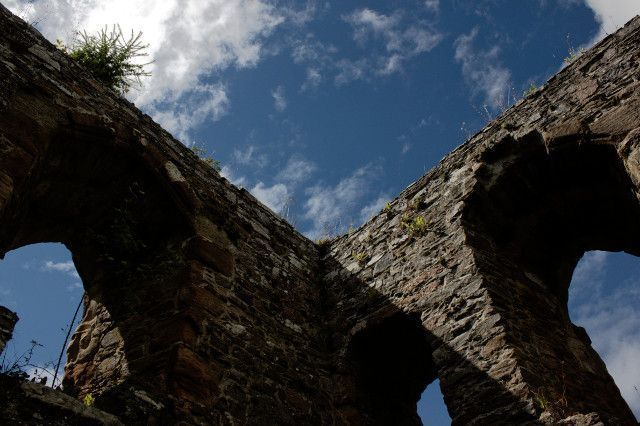
Rait castle is located roughly two miles south of the town of Nairn, and about sixteen miles east of Inverness. A modest castle in my opinion, it could easily be mistaken for a derelict chapel or church.The castle is reported to be haunted, but this wasn't a ghost hunting trip, and it was far too bright a day to tempt out anything spooky!

The image above is a simple one, I liked how the shadow matched the line of the top of the wall. All I had to do was line up the shot and hope for the best.
I decided to keep the sky a slightly desaturated blue as I didn't want to detract from the detail in the walls, which came out really nicely with a slight tweak of the contrast.

HouseCat: I really like this photograph, for its balanced composition and very unusual angle. I don't think I've actually seen an intersecting walls photograph quite like what Raven has done above. This has got to be one of my favourite photographs by him. I need to persuade Raven to print one off for our walls!


Here we have a classic angle of the castle - simply google "Rait Castle", and you'll see what I mean. I am pleased with the way the colours came out on the walls, and the way the reds pop out against the greens of the foliage.


HouseCat: There are indeed about 10 photographs from a similar angle on the first page of Google Images - not something we actually looked at before out trip to Rait Castle! I think this is the most obvious angle from which to take the castle, partly because there is actually enough clear ground on that side of the castle to step back far enough to get the whole length of the castle in one shot, which there isn't on the other side. One thing that is interesting is how every photographer's image, even from very similar angles, has different results. Weather, and thus lighting, is certainly one factor, but each photographer has chosen a slight difference in distance from the castle, or angle to the castle; different cropping, different saturation. Raven and I went to the same place and chose completely different sections of the building, but even between photographers who chose the same things, there's a lot of difference. 


This one is one of my favourites... Simple but effective, in my opinion. I enjoy taking photos like this one. I think it is because of the way the light bleeds in, highlighting details that would be otherwise washed out if you used a flash, or if it was in broad daylight.

This is a macro of algae on the wall. Nice and simple again... The thing that drew me to the shot was the clear division between cold rock on the wall, and this lush green algae bursting its way in.

HouseCat: Raven has a very good eye for small details, things that most people would miss. The world is very interesting if you pay enough attention to spot the fur at the edge of the algae in a crevice of a wall!


Shots like the one above are what I like to call "grab shots". I saw the House Cat taking a photograph (using one of my lenses) so I took the opportunity using my telephoto, which proved effective by blurring out the background, and really making her stand out in the image.

This was me taking those photographs of the windows on the upper storey of the castle. Usually, when I am not actively modelling, I try and scurry out of photographs because I'm not really very photogenic without making the effort to be (I discard half of my selfies because I end up looking ungainly with a weird expression on my face!). I think he's managed to get a good composition for a photograph that was taken slyly as I concentrated on making adjustments. 

In summary, it is a lovely little castle, and I hope it stays protected for a long time to come. I found myself imagining what it would have been like in its day, and what kind of people walked it's hall.


✥ Barevan Graveyard & Chapel
This is a graveyard we drove past on our way to Rait castle, and we agreed that it would be a good idea to stop there on the way back... Which we did.

This is a very old grave yard indeed, and a rather pleasant one at that.I have always found grave yards to be quite cold, but this one seemed rather welcoming in an odd kind of way... almost as if it liked being visited from time to time.

Another two photographers were in our group - Suzy Bugs, who was taking only wildlife photographs, so is not taking part in Architectural Photography Week, and a Goth-y friend who goes by the screen-name Hemlock. Hemlock lives in the area and knows the countryside there pretty well, and it was he that pointed out the farm track to Rait castle (so we didn't have to park at the side of the road and hike the steep way up!) and also pointed out this graveyard.


Here is an image which really caught my eye... I don't think the photograph does what I saw justice to be honest. I found the way the light gently flowing through the trees onto the stone and foliage was quite eye catching.

HouseCat: I tried to take photographs of  chapel from this angle (not realising that Raven was too!), and I could not get anything as pretty as this; it's a testament to Raven's skill that he actually got something where the all the different layers and light levels in the image, from the brightness looking into the chapel through that window, to the details of the stones in the shade, are visible and nicely captured. 


Here is a simple photograph, which was initially intended to go in my texture library. It is a close up of a large stone sphere. I liked the way the structures of the rock are revealed through the polishing of the sphere, and through weathering over time. This is located in a smaller section, which belongs to the Cawdor family.


And here, we have the final image from my little set... The watchman. He can be found watching over the graves in a tree in the corner to the left of the gate as you come in.This character seems to get mixed reactions off different people. Some think it's creepy, having a face in a tree (which is totally natural, I might add!) but I, personally, found its smiling gaze to be rather endearing.

All in all, a great day was had by everyone involved, and it was nice to catch up with a couple of friends. I'll have to get back to Rait castle and do a shoot with a model or two at some stage, but anything like that is a way off yet!

Housecat: I volunteer to model, but Raven is probably sick of taking pictures of me! I hope you all enjoyed today's guest post by Raven. Hopefully Hemlock will be sharing his photographs from the trip tomorrow, and I will be back on Sunday to finish architecture week. 

Raven's photographs are NOT under the same "share if you properly attribute them to me and link back" rules as mine. I do not take photographs as a means to earn money, but he DOES, so please respect his work. If you want to share these photographs, share a link to the blog, rather than sharing the photographs themselves. Both of us will be every unhappy if we find our work being used commercially. This applies to all of his photographs on this blog, not just the ones here. 

Friday, 29 March 2013

Inverness Castle

Another architectural instalment for Photographic Friday!

Inverness Castle from across the river.
As far as castles go, Inverness Castle building is quite young. It's 19thC, built just before Queen Victoria ascended to the throne. There has been a castle on that site for centuries, though. The current castle was built as a police-station, prison and court, and to this day it is the Sherif's Court. I actually got summoned for jury duty to the Castle, and while it has been decorated with the plainness of most municipal buildings for the most part, the courtrooms themselves do have a level of Gothic grandeur. The castle is built in the Scottish Baronial style, and has quite a few pointless turrets, towers and suchlike. It was never built defensively, as the false arrow-slits and large windows attest. It's weird to think of a castle as a functional building rather than as a relic from a former age or a ruin, because virtually every castle I have visited has been either used as a museum or been ruined. 

Another of the photographs from across the River Ness
I have tried photographing the Castle on numerous occasions since I moved to Scotland, but Inverness Castle is strangely resistant to photography. Part of it is because it is only really visible in full from the opposite bank of the river, and many photographs of the castle end up being taken from the same few vantage points on that bank, and thus seem practically identical except for the weather conditions, lighting and cropping. I have, actually, taken two full views of the castle from the North bank of the Ness, but I have also tried to photograph the castle from a wider variety of angles. 

From the car-park up the brae.
For the photograph above I walked up above the castle, higher up the hill, and took a photograph of the most prominent towers against the hills behind. The light was perfect to separate it from the surrounding landscape, and I think this is one of the best photographs of the Castle that I have taken so far. The last thing I want is to be derivative, but there are a finite number of good vantage points from which to photograph the castle. This picture appears to be from a new one, because so far I have not seen one quite like it. Perhaps some people think that the ducts and pipes on the roof ruin it somewhat, but to me, at least, seeing how things work is interesting. My only wish is that there had been a few more clouds in the sky that day, rather than just the hazy gradient that is almost invisible once the image was turned from colour to shades of grey.

A sense of verticality. 
This photograph was taken from Castle Wynd, up behind Inverness Museum, on the steps that head down to the riverside behind the shops and offices. The composition is a bit unorthodox, and it was an attempt to emphasise the sense of height and massiveness in a building that is spread over quite a horizontal space and can therefore seem smaller in height than it actually is. I also wanted to focus on the unusual and irregular roofline. I debated having all the 'vertical' lines converge centrally, but then went for everything being at a slant - this may not have been as good a compositional idea as I thought it was.


Finally, the standard touristic image of the castle, in full colour. I figured that with the black and white images it seems that the castle is grey, but in fact it is a sandy reddish-brown colour. Also, I wanted to prove that Inverness does indeed get blue skies once in a while! This late afternoon image may seem warm, but it was actually one of those cold but clear Scottish days that is deceptively bright, and actually quite chilly. 

I hope you enjoyed this blog instalment. I am quite the fan of castles in various styles of architecture (although I prefer the older ones actually built as fortifications) and so trying to take good photographs of the castle in Inverness is an enjoyable ongoing challenge for me. At some point in the future I will probably post about the castle again, hopefully with better photographs as I learn to improve my architectural photography skills. 

Friday, 7 September 2012

Inverness Town House

It's Friday and that means it's photo time!    


This is was the quietest moment for photographing...

The focus this week is the Town House in Inverness. I've been avoiding it for a while because it's not exactly in the quietest part of town, being at a busy intersection, off the high street, and always full of people, and I'm not exactly a 'people-person' or the sort of person that is happy standing around on the high street with a camera. That and I was considering clambering up the street furniture to get a reasonable angle.


The front of the Town House.

There's two sets of lights outside the townhouse - big cast iron things. I can't figure out if they quite fit the aesthetic. I know the chunky design is supposed to compliment, and I am sure they are purpose made, but maybe it's the fact that I know that real castles would not have had electric (or gas) lights outside the front door like that. Still, they serve a function, and they are quite fabulous in their own right, and they look far better than the brackets for the flowers. 


Turrets, tourelles, something...
The Town House in Inverness is one of those over-the top Scottish Baronial buildings - Scottish Baronial architecture being a combination of Gothic Revival extravagance and inspiration from the old Scottish defensive tower houses. Basically, it's pretending it's a castle, which is quite surprising considering it is next to the actual castle (now the Sheriff court - I had to do jury duty there) and really does not compete when it comes to size and location. The current castle in Inverness is also 19thC, built in 1836 (a year too old to be Victorian) but not quite as overtly Gothic. Inside the castle there's a good few Gothic Revival details, but on the outside it's actually rather plain with lots of rounded arched windows. Anyway, the Town House was one of those Victorian buildings where it seems no expense was spared and all architectural exuberance was permitted. It is one of those buildings designed to impress, and it does that very well indeed. 


Fancy windows.

Apparently the Highland Council run guided tours of the building twice a week, and apparently it is rather fancy inside (and has swords), but I haven't actually been in it yet. I'm hoping to go on one of the guided tours during half term, as it is a historically interesting building with a lot of items within it relating to the broader history of the city. I'm still trying to work out what the difference between a turret and a tourelle is. I think a tourelle is a specific sort of turret which has to be round, corbeled, with a conical roof and on a corner (as opposed to rectangular or starting on the flat plane of a wall.) Anybody who knows the answer to this is encouraged to elucidate me on the matter. The decorative ironwork on the roofs, and the dormer windows, show a Parisian influence. 


The top of Mercant Cross

A lot of my photographic ventures have been based in Inverness, and I think it is about time I addressed the Cathedral, seeing as I've showcased Eden Court (directly next to it) and a few other ecclesiastical buildings of various denominations already - leaving out the Cathedral, of all buildings, seems odd! I wanted to hear the Merlewood ensemble there yesterday - there was a free concert with a charity retiring collection (I think in aid of the building's restoration, not entirely sure), and I like a bit of chamber music, but unfortunately I had somehow got convinced it was tonight rather than last night. Oops. Anyway, I have been out to photograph the cathedral, but my efforts have been less than satisfactory, so far. The Cathedral shall be next week, if I haven't been to Cromarty church in the meanwhile. 


Sometimes I'm just lucky...

When out photographing things in any city, it is always a good idea to look upwards as even a lot of boring shops are part of more interesting. I originally wanted to take a photo of this Scottish Baronial style façade over a shop, then I saw the seagull and waited... 

Friday, 24 August 2012

Dark Romanticism and Goth

I'm more aptly a 'dark Romantic' than a Goth.


Photograph by Raven, Editing by the HouseCat

Maybe I've always had a broadly Romantic attitude, but one that was not really cultivated into anything productive until I started reading about the philosophy and literature of that time period. I started finding that I agreed with a lot of it and that the rest of it was taking me down new and exciting avenues. Some of these ideas became building blocks of my personal philosophy (which constantly evolves) and some of them fell by the wayside, but my way of thinking and my creativity were far more influenced by things that happened over  150, even 200 years ago than by what happened in the 1980's. My head was full of Clare, Keats, Wordsworth,  of Beethoven, Paganini, Weber, Liszt, Chopin, etc. long before it was full of Ian Curtis, Siouxsie Sioux, Robert Smith, Andrew Eldrtich, Patricia Morrison and Dave Vanian. Mary Shelley, Edgar Allan Poe, Bram Stoker, etc. were my transition between the two, with a large dash of Arthurian poetry and art, Pre-Raphaelites and Tolkien. 


Photograph by Raven, Editing by the HouseCat

Romanticism informs far more of my world-view than Punk thinking - even my tendency towards anarchism is rooted more in centuries-old political philosophies than 1970s political philosophies. My search for experience is core to my way of life, to the point where I think the purpose of life is to experience as much and as richly as possible. A lot of my art is based on direct inspiration from nature; I see strong emotion as an authentic source of aesthetic experience, with a decidedly Gothic emphasis on such emotions as apprehension, horror and terror, including the feelings that come around contemplating the inevitability of our own demise and decay. Awe, to me, is the emotion upon which I build inspiration, especially that which is experienced in confronting the sublime glory of untamed nature - the awe experienced while looking into the raging storm, or at wild currents of a river's rapids - and I'd go storm-chasing at white-water rafting if I could. On one hand I embrace medievalism, Gothic revival architecture and Arthurian myth, and on the other I look to the exotic (relative to my culture), to Japanese culture and ancient ruins. I empathise with William Blake as he talks of 'dark Satanic mills" in reference to early industrialisation, and see it continue in the smoke-stacks of coal fired-power stations, and in the seemingly unstoppable increase of materialistic consumer culture and all the factories thousands of miles away that feed it. 


Photograph by Raven, Editing by the HouseCat

In feeling like an alien amongst mainstream society I went looking for philosophies I did agree with - somewhere other people had to see things the way I did, and it did not seem that I was mad - and unfortunately found them to be an anachronism in relation to modern life, but then, as I read and experienced more about the various counter-cultures and subcultures from Arts & Crafts and Pre-Raphaelite era women in 'artistic dress' through Hippies and Punks to Goths -especially Goths- I saw the ideological tendrils that began with Sturm und Drang and revolutionary France were still bearing fruit. I did not set out to become a latter-day Romantic, albeit one with a fondness for black and the macabre, it just suits my personality down to the ground. 


Photograph by Raven, Editing by the HouseCat

My interests are broader than the Goth subculture, my perspective has not grown out of punk or of rock, but out of philosophy, literature and art, and I'm often a bit of a walking anachronism in more than just my fashion choices. Talking of fashion choices, stylistically I am fascinated by an aesthetic, not a subculture, and will wear things from Visual Kei, Elegant Gothic Aristocrat, Lolita and other Japanese styles as much as I'd wear Goth things, and will also wear vintage things or "hippie" things, or whatever else takes my fancy. I am more interested in anachronistic styles, luxuriously textured fabrics and an almost theatrical appearance than in what particular subculture you could attribute a garment to. My eclectic approach to fashion is not something I disguise, and where possible, I do try to accurately describe my various subcultural influences. 


Photograph by Raven, Editing by the HouseCat

My not-Goth interests predate my interest in the Goth subculture, and have not really wained in interest, only in time to spend on them. I am into the music, the fashion, the broader creative endeavours and the attitude that comprise the Goth subculture, but that only represents a small facet of who I am, and I feel that "Dark Romantic" encompasses a far greater amount of who I am than "Goth". Goth is still part of my identity, I still think the label applies to me, just it does not cover everything.