My personal blog as a 'grown-up' Goth and Romantic living in the Highlands of Scotland. I write about the places I go, the things I see and my thoughts on life as a Goth and the subculture, and things in the broader realm of the Gothic and darkly Romantic. Sometimes I write about music I like and sometimes I review things. This blog often includes architectural photography, graveyards and other images from the darker side of life.

Goth is not just about imitating each other, it is a creative movement and subculture that grew out of post-punk and is based on seeing beauty in the dark places of the world, the expression of that in Goth rock. It looks back to the various ways throughout history in which people have confronted and explored the macabre, the dark and the taboo, and as such I'm going to post about more than the just the standards of the subculture (Siouxsie, Sisters of Mercy, Bauhaus, et al) and look at things by people who might not consider themselves anything to do with the subculture, but have eyes for the dark places. The Gothic should not be limited by what is already within it; inspiration comes from all places, the key is to look with open eyes, listen carefully and think with an open mind..

Showing posts with label ruin. Show all posts

Tuesday, 26 June 2018

Castell Arberth/Narberth Castle

A few weeks ago, Raven and I went to stay with my Dad. I came across this castle by accident - My Dad got Raven to drive him on an errand, and the route went past this castle mound, which was partially obscured by how the road goes down a deep cut in the hill below it. I asked if we could visit the castle on the way back, and we did. If any of my readers are familiar with the Mabinogion, then they will recognise Castell Arberth as one of the chief courts of Pwyll, father of Pryderi. 

Narberth Cemetery

On our way to the castle we went into a cemetery by mistake - we were looking for the path up to the castle mound, and thought this might be through the cemetery, as the graveyard path initially seemed to slope up. The cemetery was founded in the 1930s, so most of the graves are 20thC, I think with some more recent ones. As it is quite a recently used/active cemetery, I only took one picture of the general cemetery area, rather than any of specific graves, and certainly no posing with the gravestones. 

Remains of the castle sticking up like fangs from the ground

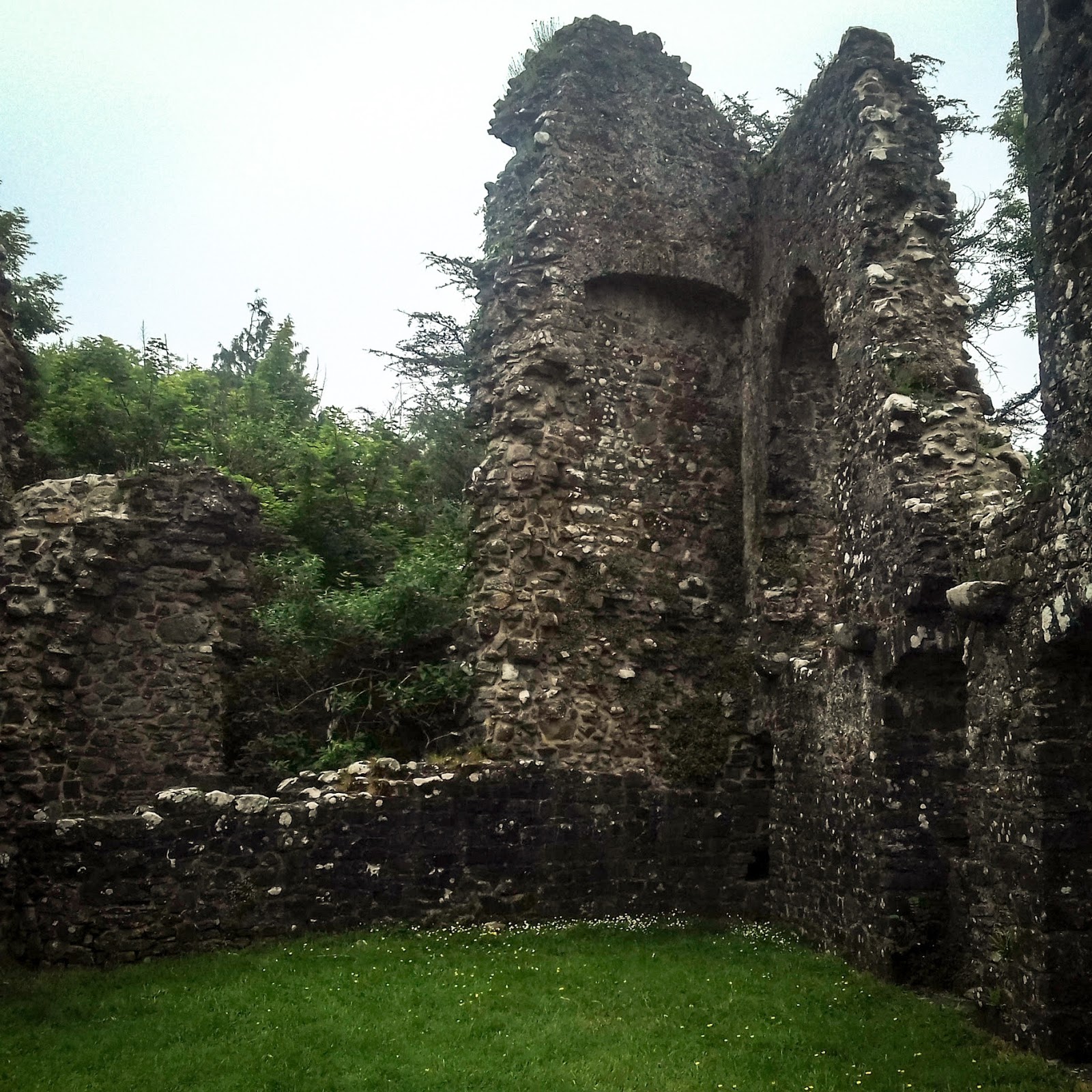
The castle was up a different path. You can't see much of it from the road, only one of the towers, but once up there, a lot more of the castle is visible. It is hard, from what is left, to visualise that it was once a mighty fortress, at least the second built on that site, and was built sometime after 1246 (you can read the CADW page ::here::). There were signs around the place with artist's impressions of the original castle, but I think the windows in the paintings are a tad more Gothic than might have been based on the actual window shapes remaining. However, there may have been more pointed tracery in stone frames now long gone. 

This is just part of a broken tower, once attached to a building
It was a damp, muggy day, with a dull grey sky, so I apologise in advance for the photographs being hazy and the skies being boring. I took all the photographs on my phone, as well, as I still haven't got a replacement camera. I'm currently unemployed, so it will be a while before I can afford a decent camera.

Raven was there too, and he took a couple of pictures of me.

Window into the cellar
The most complete part of the building is the pantry/kitchen cellar, with its tough barrel vault weathering the test of time. It's the building that Raven's standing in front of in the picture above. A lot of the stone from the castle was reused to build the town/village of Narberth (Arberth in Welsh) that surrounds. It's a very craggy-looking ruin, and the exterior walls, which would have likely been rendered and whitewashed to avoid the stone walls providing hand-holds, and to add an extra layer of protection from the elements, are now bare, with much of the walls' cores exposed. 

What is left of the great hall. 
The castle was built on a promontory, with a steep drop down to the graveyard below, and even further to the current road level. Geographically, it's quite a defensible location. I think the castle walls merge into a deliberate escarpment to the right of the buildings pictured above. Looking out over the trees now is quite magical. The vegetation there is very lush - West Wales is where parts of what is known as the 'Celtic Rainforest' grows - dense and green, watered by the decidedly soggy climate and warmed by the warm air currents that pass the West of the British Isles, brought by the Gulf Stream. 

Through the windows
The buildings were stabilised in 2005, after an extensive project to stop further ruination of what is left. Unfortunately, there has been graffiti since then, limiting what I could photograph (I don't want to put swear words, crudely drawn phallic images and suchlike on my blog) and also damaging the stonework as it would be difficult to remove the spray paint from the walls without also damaging the surfaces of the stones. It saddens me that I often go to castles and other ancient monuments and there's litter, beer cans (and sometimes worse) and graffiti - the results of people disrespecting their heritage. Ones that charge for entry tend to have less, but I think it's more the supervision of stewards than the price that changes things. 

I went through that doorway.
I did see a family taking their children for a stroll, which is a good thing - nice to see children being taken to such things at young age, hopefully to grow up more respectful of the castle than those who spray-painted the graffiti. I get really angry about people damaging historical buildings.

Inside what's left of the great hall
You can see corbels jutting from the walls where once sat the joists for the first floor. I don't know if there was a second storey on this part. The towers definitely had ground floor, first floor and second floor at least, probably with battlements behind crenelations. All of that is gone now. You can also see where they changed their mind about a window and walled it up into an alcove. 

Note corbel and hole in the wall where a beam once slotted in
I probably spent longer exploring and taking photographs than we really had time for. I find such ruins quite captivating. 800 years is pretty ancient in many ways, but it's actually relatively recent in Welsh history. Near Narberth/Arberth is a truly ancient hill-fort that is thousands of years old. It's somewhat overwhelming at times just how much history there is, layered all around us. I'll have to visit more of the really ancient stuff and blog about that, too. 


The arches are roughly Gothic, but it's hard to tell what the windows looked like with any more detail than that. The castle, like most medieval castles, also had a chapel, which I would expect to have church-like Gothic windows, maybe once having stained glass. Now there's just a hole in the wall. I wonder what happened to the glass. 

The hat and cloak make me look particularly severe.
Raven took a picture of me looking very serious by a window. I'm such a tourist sometimes - I want an 'I was there' picture of me at the places I visit. You can see how much better the resolution is on Raven's phone camera than on mine. I visited two other castles while I was in Wales, and I'll update my blog with those in the near future. 

Wednesday, 13 June 2018

Glasgow Cathedral & Necropolis: A Very Gothic Lolita Meet

Graves through the trees, last
 time I visited. Click to expand
Last month I went down to Glasgow for a meet-up I was very excited about - a visit to the Cathedral and the Necropolis. It was organised by the moderator of the Scottish Lolitas group on FaceBook. Originally it was supposed to be for a guided tour on the Saturday, but it was re-arranged for the Sunday, which means we didn't get a guided a tour, but we were there for choral evensong rehearsals! I've been to Glasgow Necropolis before, once a few years back (when I had no idea how to style my wigs, or what boots suit what outfits... so I won't link back to that one!)
Getting to Glasgow from Inverness is a good 3+ hrs on the coach from Inverness, and I don't even live in Inverness itself, so I had to travel to the city first, and Lolita is not the most practical style of clothing for travel! For the most part, I kept my impractically high heels for photographs, and switched to ugly but comfortable trainers (more about how this didn't work out later on). The weather was really quite bright, and I started doubting my choice of an all-black ensemble to wear! It had been cloudy and overcast in the Highlands, but the weather got warmer and sunnier as I travelled south to the central belt.

I made some attempts to get a few photographs of the stunning Scottish scenery taken out of the window. I really like looking out of the window on long coach and train journeys, but I always end up wishing I could stop off at all of the interesting places and explore - one of  the downsides of not being able to drive is I can't go off on my own detours!

A rather tall and craggy hill, not entirely sure where

One place I'd love to go on a detour to explore is Ruthven Barracks - I managed to get one moderately clear shot of the Ruthven Barracks out of the coach window. It used to be the site of a castle (presumably Castle Ruthven?) but due to the Jacobite Uprising, the Hanoverian government built an imposing barracks over the site to station troops. It was part of a rather bloody section of Highland history. 

Ruthven Barracks from the road, photo out of a coach window.

I did my make-up partly on the coach - probably not the smartest idea, but I don't think it worked out too badly. Trying to do my lipstick was the hardest bit, so I waited for the change at Perth, so the coach would be stationary, to do that bit. 

Black hair with blue highlights now! Veil to hide scruffy bits.
I met up with the other Lolitas at the Tempo tea shop, for some bubble tea, and then we walked up to the cathedral. I didn't realise how far the cathedral was from the tea-shop, and made the mistake of changing into my high heels at the tea-shop, and struggling to keep up with the group as I'm a) not supposed to walk in high heels because of my ankle injury, b) not exactly steady on high heels anyway because I'm dyspraxic and clumsy and c) it was roasting outdoors and I was overheating in my clothes. Now I know that there's a steep hill up to the cathedral, I won't be doing that again! I put my trainers back on to wander around the cathedral, because it is uneven paving and there are lots of stepped sections, etc. 


The Lolita group outside the cathedral, photographed by Meshya.
I'm wearing comfortable but ugly trainers, but hiding them behind my bag!
The cathedral itself is really stunning. It's a medieval cathedral, but it still has an active congregation. It's the cathedral of St. Mungo, who is said to be buried there, known fully as St. Kentigern (He's Cynderyn in Welsh). 'Mungo' is actually an affectionate nickname with its derivation in an earlier British language (I've read conflicting articles as to which one), apparently meaning 'dear one'. St. Mungo/Kentigern is the patron saint of Glasgow. 

[Random Harry Potter musing aside: There's a large and rather old hospital (it was opened in the 1790's) near St. Mungo's Cathedral, currently with a rather grand and ornate stone building from 1914 dominating the local area - I do wonder if the combination of the two were the inspiration for St. Mungo's Hospital for Magical maladies, especially as J.K Rowling lives in Scotland, but in Edinburgh, not Glasgow.]

The cathedral does have a few stained glass windows, but much less than I expected. I don't actually know why, but if I had been on the guided tour, that would have been one of the questions that I would have asked. I noticed that a lot of the stained glass was stylistically 20thC and had a lot of beautiful greens, blues and purples, especially one which I think might be the Millennium Window (I didn't get a good photograph, unfortunately), and I'd guess made in the late 1990s to celebrate the then-upcoming turn of the millennium. The cathedral was spared much of the more destructive aspects of the reformation because the local population stepped in to defend it, but maybe the windows were still smashed? - I do not know. According to the unofficial cathedral ::website::, the decision to put in stained glass was made in 1856, but it doesn't say why there wasn't stained glass previous to that, when in most other medieval cathedrals, stained glass was introduced centuries before, often right from the start, and one of the benefits of the Gothic style is how the arrangement of space and fenestration work really well with stained glass (I wrote a mini-dissertation for one of my graded units on this sort of thing last year...). 

These windows included stained glass, but my camera blew it out too bright.
Another thing I noticed about the cathedral is that it has a relatively cohesive design overall, and doesn't look like the sort of cathedral built in a lot of disjunct Gothic/Gothic-related styles in many phases over many centuries (eg. Canterbury Cathedral), but more like it was built mostly to one design, even if there's different ceiling designs in the main nave and the choir. It has quite a harmonious and balanced building because of this - no mismatched towers (like the basilica-cathedral of St. Denis in Paris)  or Romanesque arches beside late Gothic tracery, no buckled columns (like Salisbury Cathedral) or much later additions in Baroque or other Neo-Classically derived styles mixed in, no awkward 20th or 21stC modern elements stuck on.

It's a very large and long building, and I don't think ALL of it was built at once, but it is remarkably united and singular building considering its age, and that it was built between 1136 and 1197, which is not as long as some cathedrals and basilicas, but still more than 60 years. It's on a straightforward linear floor-plan, with one extension off-centre rather than a cruciform transept, and these two (the Blackadder Crypt and its above ground chapel are aligned with the south transept, and the boiler wing is off centre) are the only bits that seem outside of the original design - the sacristy/chapter house while not part of the main hall-shape building, does seem like at least a very old addition, and maybe part of the original design, or of the original construction phases. I've seen a floor-plan, and been to the building, and these are my educated guesses on the history - it's not something I've really researched, nor did I get a chance to ask a guide. I've got to go back there, with a note-book, and get some more information!

Pews with fabulous Gothic arches and trefoil designs.
There's a lot of stunning carved wooden furniture in the cathedral - pews, choir stalls, and things that can't really be called 'furniture' like the organ loft and the great pipe-organ itself (which I was privileged to hear played!). The interior is impressively Gothic - I guess some of the wooden bits are Victorian-era, probably Gothic Revival, but I guess in a building like that, it's less of a revival, and more of a continuation of an ongoing tradition of ecclesiastical art and architecture.


Memorial with helm, shield and sword
There are a few graves and memorials within the cathedral itself, too. I tried to photograph many of them, but the photographs did not come out well. One that did, however, was  a grave with an effigy of the person's armour rather than the person themselves, complete with ornate helm and sword. Looking at the date, it was more symbolic of knightly things than something they would have worn in battle, as the grave is much later than the styling of the armour displayed, but it's still a rather beautifully rendered monument.

Vaulted ceilings and concentric details on the arches. Best ceiling photo.
I think the most stunning aspect of the cathedral, however, are the vaulted ceilings. These vaults are structural, not just aesthetic, and are based around intersecting Gothic arches. I took an awful lot of ceiling photographs, but it was quite hard to get good ones on just my phone - I don't have the old HTC with the 'potato camera' but my Samsung is an older model, and it struggles to get pictures that are crisp and aren't grainy (and slightly off-focus) in low light levels - at least with the standard camera app; I've downloaded Lightroom now, and I might be able to get better shots by having more control over the settings.

I took a LOT of ceiling pictures but most were terrible. This one was passable
I actually got separated from the rest of the group because I got distracted by taking photos of the ceiling. When I looked down, everyone was gone! A French tour guide said what I thought was "sur les arbres" so I went out to the trees by the entrance to look for the rest of the Lolita group, but they weren't there. In retrospect, I think she might have actually said "sur les arches" and I misheard because the Cathedral is echoey and it was quite busy in there, as they'd actually gone to the crypt - under the arches. One of the group found me, as apparently the French tour guide had run into the rest of the group, too, and told them where I was! After we were all reunited in the crypt, I changed into my high heels again for a photo by a grand candelabra.


Photograph by Meshya. Very tall candelabra.
As we left the crypt, the choir had got into full swing of their rehearsals. I'm not sure which choir it was - most of the choristers looked the usual student age, so I'm wondering if they were a university/conservatoire choir, and there was a TV crew setting up around them. They were absolutely amazing! It was Renaissance style polyphonic church music, but with the organ accompanying, and it was something really special. Hearing them was truly wonderful, and coming up out of the crypt to emerge into this sound, with the two big banks of organ pipes flanking on either side, it was something mesmerising.

Byzantine-looking mausoleum and many monuments,
photographed by me, from the bridge, on my previous visit to the Necropolis
After visiting the crypt, we concluded our visit to the cathedral, and crossed the bridge over the road, to the necropolis hill nearby. Glasgow Necropolis is somewhere I have visited before, but last time around, not many of my photographs came out, so this time I tried to take a few more. The last time I was there, the weather was hazy and dull, very overcast, and so my photographs were all very drear - I deliberately accentuated this with the use of black and white. Scotland is famous for its 'dreich' weather, but it can actually be brighter and quite sunny, so all the photographs from this trip to the necropolis are full colour with bright blue skies! I thought I'd share the ones from the last time, too, though, because I'm a cliché and I appreciate the gloomy aesthetic. 


Another of the previous photographs - grey skies and many monuments.
Neo-Classical mausoleum
Click to expand.
One of my favourite things about the necropolis is that it was functioning for so long that it's a snapshot of changing artistic and architectural movements, and a reflection of changing funereal practices, not to mention the people who were buried and the various circumstances that the choice of monument reflects - those who buried by their next of kin, those with monuments paid for by the members of institutions and societies to which the deceased belonged, those with grand mausoleums, those more simple headstones... A cemetery is a history book encoded in stone and landscaping. I think I could go to the Necropolis a good few times, and with each time, learn more.

The Necropolis is also somewhere I could spend a lot more than a mere hour,  especially with a camera. I really, really wish I had a camera that worked at the moment - my cheap 'point and click' camera died (it had death spasms, with the shutter and zoom mechanism suddenly going through some random glitching motions and then breaking, before it expired) and the Canon camera I have on extended loan has trouble with batteries and charging... I just have my phone at the moment, and while the photographs are not terrible, but they could be so much better quality. A new camera is something I will have to invest in when I get a job!


I was trailing behind the group, photographing the monuments, but the group
are very aesthetic from behind, so that wasn't too bad! Note monument styles.
The Necropolis is also interesting because it also shows a lot of monuments that are both historical now, and were historically inspired when they were made, harking back to ancient Rome and Greece, ancient Egypt, Byzantium, and even a few with Celtic crosses, representing a late Victorian-era Celtic Revival. Plenty of Gothic Revival monuments, too, but interestingly, much fewer than at Inverness' own necropolis at Tomnahurich. Obelisks, and Classically inspired designs seemed most popular, partly because many are older, but also I think out of stylistic choice. I do personally think that there's something about the angular geometry and severity of some variations of the Neo-Classical that is severe and sober, perfect for sombre memorials.


An angel perched in stone. Photo by myself.
There were some figurative monuments, some with a statue of the deceased, some, like the one above, with angels. I quite like this contemplative angel - the plinth is huge and solid, and many of the neighbouring monuments are stones of similar forms, so it almost looks like an angel just landed there, on top of the stone, which I guess was the idea.


Graves through the trees. Photograph by myself.
The landscaping of the Necropolis is really quite park-like - apart from the paths and terraces, there are a lot of flowers and trees, and a lot of grass! One of the reasons I love graveyards (I wrote a whole blog on the subject ::here::). The cherry blossoms were in bloom - I like cherry blossoms in graveyards, because I think of Japanese sakura blossoms, and how they can symbolise transience, which is very fitting for a graveyard. There were also plenty of bluebells. Spring happens later in Scotland than in England, I've noticed, even later where I am. 

Lolita group participant in the shade beneath a cherry tree. Photo by me.

The Lolita group, myself included, took a lot of outfit photos and pictures of each other. While they took photos by some of the graves, I wandered off, not too far because I was back in my high heels and I am precarious in them, to look for interesting graves and vistas. I actually brought my cane with me, both to stabilise myself while wearing heels, and to help me walk once I had taken them off because wearing heels all day makes my ankles pretty sore indeed.

Lou Graves ( @gravelvet on Instagram) took this.
I looked pretty aesthetic while wandering off! 
I spotted a set of steps by some trees that were a good spot to get a tiered group photo so everyone could be seen behind everyone else, but unfortunately, in my high heels I was one of the tallest members of the group, so I needed to stand right at the top of the stairs! I was quite unsteady while trying to walk up the stairs, and getting back down was even trickier. Sometimes my eye for what might look good exceeds my good sense. 

LaFantome, who was the organiser of our meet-up. Photo by me. 
On the way down the Necropolis hill, I spotted a really pretty Gothic Revival monument. I don't often like posing with gravestones (and I've explained why in the past), but this time I wanted a picture of me with a monument because I just wanted a memento of having been to what is probably my favourite monument in the whole Necropolis - a very elaborate Gothic Revival monument with ivy growing up it. It's got so many of my favourite elements of the Gothic style - having a Gothic arch within a steep triangular gable, pinnacles, and having a screen of detached tracery. 


Me standing in front of my favourite monument, photo by
After the event, the others went to The Winged Ox, a restaurant in a converted church, but I needed to get back to the bus station for my coach home again, so I walked back to the bus station - getting some sushi en route. 

Sunset from the coach window
Overall, I had a very enjoyable time. Next time I will try and find some elegant footwear that isn't heeled and is comfortable but pretty, because swapping between trainers and high heels was just holding the rest of the group up each time, and got pretty annoying for me, let alone everyone else. The 'Tea Party' style flat shoes common in Lolita tend to look better with Sweet styles, and Gothic Lolita is usually worn with chunky high heels, so I'm struggling to think of a flat alternative that will still look elegant, especially as I have big size EU 42/UK8 feet! Any suggestions from Lolitas are welcome.

I definitely want to go back to Glasgow Cathedral, especially to do a guided tour - although perhaps I'd annoy the tour guide as I'd have a LOT of questions about the building! I also want to go back there with a proper camera to capture some better quality shots of the Cathedral's interior, especially the vaulted ceilings and the stained glass windows. 

Friday, 17 July 2015

Urquhart Castle

I have visited Urquhart Castle several times. One February a few years ago Raven and I went there on Valentine's Day - for an engagement photo-shoot for another couple, where Raven was photographer! This time however, Raven and I were there for an afternoon out together, and I took my camera. The weather was windy, with heavy rain coming in - just perfect for atmospheric photographs!

I know I am rather overdue with these pictures. We went to Urquhart Castle in early April, and it is now late July. Between now and then I have been incredibly busy (hence the blog hiatus) and I am only going to get busier over the next few months. Blogging is only a hobby for me, and I have quite a few offline commitments that have to take priority. There are quite a few photographs here, and I hope those who have been waiting enjoy them. 

Urquhart Castle on the banks of Loch Ness. Photograph by HouseCat

Urquhart Castle is on the banks of Loch Ness - supposed home of the famous cryptid - and beneath the mountains. Geographically, it is in a stunning location, a place of incredible natural beauty. Strategically, it guarded the loch and the pass beneath the mountains.  In its glory days it would have been a vast compound - more of a walled town or village than a fortified house. It is in ruins because it was deliberately destroyed by its owners, Hanoverians who, after being beseiged by Jacobites once, decided it was better to blow up their own castle than let such a strategic point fall into Jacobite occupation. If I owned a castle, I don't think I could ever contemplate anything as drastic as blowing part of it up, regardless of strategic necessity!.  They began by blowing up only the gatehouse, but this was the beginning of structural decline for the castle, as even when peace came, it was never repaired, but instead was quarried for stone (as was common for ruined castles in times past - it happened to Rait Castle, Wallingford Castle, etc. etc.) 

Craghy ruins. Photograph by the HouseCat.

Of course, ruins become picturesque as nature begins to reclaim them - especially the ruins of structures once grand and beautiful themselves. I, a true Romantic, am drawn to windswept crags and ruined castles (apparently, I am in the good company of Neil Gaiman in these tastes!), and even when swarmed with tourists, Urquhart Castle loses none of its majesty and presence. The ruins stand upon great earthworks - sculpted out of hard ground - and this unnatural landscape, once practical and now alien, gives an eerie quality to the place. The remains of buildings perch on arteficial ridges, above deep defensive ditches gouged out of the earth. I did read about whether the moat held water while I was there, but can no longer remember; if it did, the castle would have seem even more isolated, turned into its own island fortress like Eileann Donan Castle, or Le Mont-Saint-Michel.

Ruined wall with arrow slit. Photograph by HouseCat

The castle walls are now partly reclaimed by the landscape, seeming to almost be a geological feature in places, a crag or cliff with grass growing out of it and rough escarpments of boulders. There is enough remaining masonry for it to be built by the hand of man, but it is slowly blending into the Earth with time. ::Historic Scotland:: are doing a brilliant job of maintaining and preserving it as best as is humanly possible, but it is stone exposed to the scourging winds, rain, snow and frost of the Scottish climate - the elements and the centuries will take their toll; it is inevitable. 

A brooding sky. Photo by the HouseCat

That harsh Scottish weather that I mentioned made its presence felt the day of our visit. It started out bright, slightly over-cast but mostly sunny. There were fast-moving clouds on the horizon and a keen wind. As our visit progressed, the wind got harsher and colder, and the rain blew in with darkening clouds, leaden and grey. I did not get any good photographs of this (but Raven did), but the rain coming down the Loch was a sight to behold; a curtain of what seemed like almost opaque mist rapidly drawing towards us, lit by the afternoon sun, and shaded by thick clouds in bruise colours.

Best photograph of the rain I got. Photo by HouseCat

Before the rain came in, I took 111 photograph of Urquhart Castle - and a surprising number turned out relatively well. It was hard to pick favourites for this blog - I have the same problem I had with my photographs of Edinburgh Castle! There is something about exposed Scottish castles on bleak days that really compels me to try and capture a visual record - but no photograph I take really expresses what I feel when I am there and whatever flourishing words and purple prose I use to describe it also falls short. All I can say is to visit for yourself if you get the chance, preferably on a day where the weather is at least drizzling (this is Scotland, such days are frequent) and there are fewer tourists about (probably because it is raining). 


Raven stepping out of the shadows. Photo by HouseCat

Despite being a ruin, it is not a place of desolation; the landscape is too mountainous, too forrested. Even with the wind whipping at my jacket and trying to snag my hair out of my (velvet) bandana, it seemed like when the walls and roofs had been intact it would have been good shelter against even the worst of the Scottish weather - which includes flash floods and winds in excess of 100mph in lower areas and in excess of 150mph up on the mountains. The gable end of a hotel near here was blown down in a recent storm, but I doubt any such thing would happen to the walls of the castle; if it had not been for deliberate destruction of various sorts, I think the castle could easily be standing whole to this day, and what remains will probably remain for centuries more. 

Base of a round tower and a shard of wall, overlooking the waters of Loch Ness

I did stare down into the depths of Loch Ness, hoping for a glimpse of the fabled monster, but I saw nothing. Logic tells me that any plesiosaurs or similar creatures that may have lived within the loch aeons ago will be long dead, with no contemporary descendents swimming in the murky dark, but the poetic aspects of me want to believe that somewhere in the seemingly unfathomable depths, the creature or creatures lurk, feeding on the fish that swim alongside, and avoiding humans with their loud engines and bright lights. I bought my 3 year old neice a souvenir monster hat - it's too big for her head so she wears its sideways with the tail draped across one shoulder, and the head dipped down to the other. I bought her several books too - including 'Nessie Needs New Glasses' by A. K. Paterson, as it includes an introduction to Scottish places. I keep promising her that one day she and her mother will come visit me in Scotland and we can all go to ::Nessieland:: and wander around Loch Ness looking for 'Niseag' as she is called in Gaelic. 


Steep stone spiral staircase. Photo by HouseCat

One thing I will warn potential visitors about is that the stairwells are for the most part medieval - this means they are narrow and cramped, with steep stone. I don't know if they ever originally had hand-rails (there must have been medieval people who thought hand-rails were a good idea! It's just practical!) but currently they have rope for a hand-rail (as pictured). Flat shoes, and patience for others on the stairwells are a necessity. I have spacial awareness and co-ordination difficulties due to neurological issues, so I had to walk slowly as I find going down stairs difficult at the best of times (I have to literally watch where I put my feet, and to take my time), and the tuts and glares I got from people behind me were not exactly polite.

Another stairwell photo. Photograph by HouseCat

If you are ever visiting the British Isles, I seriously recommend coming to Scotland if you like castles. While England, Wales, Northern and Southern Ireland all have beautiful castles, of all the places I have visited and all the castles I have visited (including those I visited before I began blogging) Scotland has the most castles in dramatic locations - by lochs and up craggy mountains being relatively common places to find castles.

Inside part of the keep. Photograph by HouseCat

One of my favourite things about Urquhart Castle is that despite being a ruin, there is enough of the structure that is still safe and stable for people to be actually able to go inside, and they have partially restored it in a way that greatly facilitates this. It was nice to be a little bit out of the wind, and it is interesting to be in these spaces with reconstructed wooden ceilings/floors and such. It is certainly not restored to how it was; the castle is very much in a state of ruin. It is, however, restored enough to make a lot more of the castle safely accessible than it would be otherwise, and to get a sense of how the remaining parts of the castle worked as buildings, rather than as a tumble of protruding stones. 

Great edifice. Rear of the keep. Photograph by HouseCat

As those who read my blog well know, I am rather fond of castles, especially ruined ones. Urquhart is no exception to that, and its location makes it one of my favourites. I love the natural world and the beauty of wild scenery even more than I love historical architecture (and that really is saying something!) so to visit a castle in such an amazing location really is a treat for me. I really got quite carried away taking photographs while I was there, and if (no, when) I next visit, there will surely be plenty more. It is somewhere that does not seem exhaustable for interesting angles, and as the light changes, the interplay of shadows changes; the shadows walls cast on each other, the shadows in the textures of the stones, the sense of space and the way I try and capture that in a mere flat image - it fluctuates literally with the weather. 

This view deserved to be in full colour. Photograph by HouseCat

Scotland has beautiful geography, and so much history. I love living here, and I do not regret having moved to here from where I was in England. I am much happier here amongst mountains and ruined castles, and I think only Ireland compares for rugged natural beauty, and Wales for castles (Ireland has some nice castles too, but in having visited more Welsh ones, I am probably biased). England is not boring, but I am definitely a 'mountains' sort of person - like Neil Gaiman, I seek the windswept craggy places and their solitude. Most of the hills around Loch Ness are more rounded, but there are certainly craggy ones near there too. One day, I hope to visit Urquhart Castle when it has freshly snowed, nice and early so that snow is mostly undisturbed... that would be perfect. 

Friday, 25 July 2014

Rait Castle & Barevan Graveyard: Raven's Photographs

Raven is photographer at ::Chance Photography:: and these are his photographs from the photography trip. 

✥ Rait Castle
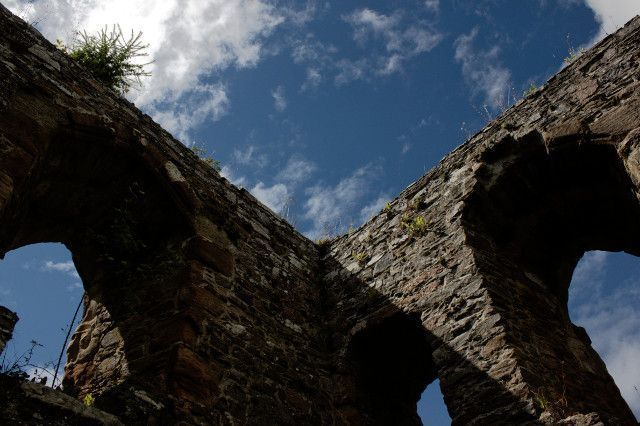
Rait castle is located roughly two miles south of the town of Nairn, and about sixteen miles east of Inverness. A modest castle in my opinion, it could easily be mistaken for a derelict chapel or church.The castle is reported to be haunted, but this wasn't a ghost hunting trip, and it was far too bright a day to tempt out anything spooky!

The image above is a simple one, I liked how the shadow matched the line of the top of the wall. All I had to do was line up the shot and hope for the best.
I decided to keep the sky a slightly desaturated blue as I didn't want to detract from the detail in the walls, which came out really nicely with a slight tweak of the contrast.

HouseCat: I really like this photograph, for its balanced composition and very unusual angle. I don't think I've actually seen an intersecting walls photograph quite like what Raven has done above. This has got to be one of my favourite photographs by him. I need to persuade Raven to print one off for our walls!


Here we have a classic angle of the castle - simply google "Rait Castle", and you'll see what I mean. I am pleased with the way the colours came out on the walls, and the way the reds pop out against the greens of the foliage.


HouseCat: There are indeed about 10 photographs from a similar angle on the first page of Google Images - not something we actually looked at before out trip to Rait Castle! I think this is the most obvious angle from which to take the castle, partly because there is actually enough clear ground on that side of the castle to step back far enough to get the whole length of the castle in one shot, which there isn't on the other side. One thing that is interesting is how every photographer's image, even from very similar angles, has different results. Weather, and thus lighting, is certainly one factor, but each photographer has chosen a slight difference in distance from the castle, or angle to the castle; different cropping, different saturation. Raven and I went to the same place and chose completely different sections of the building, but even between photographers who chose the same things, there's a lot of difference. 


This one is one of my favourites... Simple but effective, in my opinion. I enjoy taking photos like this one. I think it is because of the way the light bleeds in, highlighting details that would be otherwise washed out if you used a flash, or if it was in broad daylight.

This is a macro of algae on the wall. Nice and simple again... The thing that drew me to the shot was the clear division between cold rock on the wall, and this lush green algae bursting its way in.

HouseCat: Raven has a very good eye for small details, things that most people would miss. The world is very interesting if you pay enough attention to spot the fur at the edge of the algae in a crevice of a wall!


Shots like the one above are what I like to call "grab shots". I saw the House Cat taking a photograph (using one of my lenses) so I took the opportunity using my telephoto, which proved effective by blurring out the background, and really making her stand out in the image.

This was me taking those photographs of the windows on the upper storey of the castle. Usually, when I am not actively modelling, I try and scurry out of photographs because I'm not really very photogenic without making the effort to be (I discard half of my selfies because I end up looking ungainly with a weird expression on my face!). I think he's managed to get a good composition for a photograph that was taken slyly as I concentrated on making adjustments. 

In summary, it is a lovely little castle, and I hope it stays protected for a long time to come. I found myself imagining what it would have been like in its day, and what kind of people walked it's hall.


✥ Barevan Graveyard & Chapel
This is a graveyard we drove past on our way to Rait castle, and we agreed that it would be a good idea to stop there on the way back... Which we did.

This is a very old grave yard indeed, and a rather pleasant one at that.I have always found grave yards to be quite cold, but this one seemed rather welcoming in an odd kind of way... almost as if it liked being visited from time to time.

Another two photographers were in our group - Suzy Bugs, who was taking only wildlife photographs, so is not taking part in Architectural Photography Week, and a Goth-y friend who goes by the screen-name Hemlock. Hemlock lives in the area and knows the countryside there pretty well, and it was he that pointed out the farm track to Rait castle (so we didn't have to park at the side of the road and hike the steep way up!) and also pointed out this graveyard.


Here is an image which really caught my eye... I don't think the photograph does what I saw justice to be honest. I found the way the light gently flowing through the trees onto the stone and foliage was quite eye catching.

HouseCat: I tried to take photographs of  chapel from this angle (not realising that Raven was too!), and I could not get anything as pretty as this; it's a testament to Raven's skill that he actually got something where the all the different layers and light levels in the image, from the brightness looking into the chapel through that window, to the details of the stones in the shade, are visible and nicely captured. 


Here is a simple photograph, which was initially intended to go in my texture library. It is a close up of a large stone sphere. I liked the way the structures of the rock are revealed through the polishing of the sphere, and through weathering over time. This is located in a smaller section, which belongs to the Cawdor family.


And here, we have the final image from my little set... The watchman. He can be found watching over the graves in a tree in the corner to the left of the gate as you come in.This character seems to get mixed reactions off different people. Some think it's creepy, having a face in a tree (which is totally natural, I might add!) but I, personally, found its smiling gaze to be rather endearing.

All in all, a great day was had by everyone involved, and it was nice to catch up with a couple of friends. I'll have to get back to Rait castle and do a shoot with a model or two at some stage, but anything like that is a way off yet!

Housecat: I volunteer to model, but Raven is probably sick of taking pictures of me! I hope you all enjoyed today's guest post by Raven. Hopefully Hemlock will be sharing his photographs from the trip tomorrow, and I will be back on Sunday to finish architecture week. 

Raven's photographs are NOT under the same "share if you properly attribute them to me and link back" rules as mine. I do not take photographs as a means to earn money, but he DOES, so please respect his work. If you want to share these photographs, share a link to the blog, rather than sharing the photographs themselves. Both of us will be every unhappy if we find our work being used commercially. This applies to all of his photographs on this blog, not just the ones here.